



 62 / 196

[
] 60
included in the mission were assisted in forming Village
Development Committees (VDCs), which were the link between the
implementing agency and the beneficiaries. Recipients of shelter
were identified through consensus in committee meetings that were
attended by all residents of a village.
The houses were specially modelled to comply with the socio-
cultural and environmental peculiarities of the district and the villages
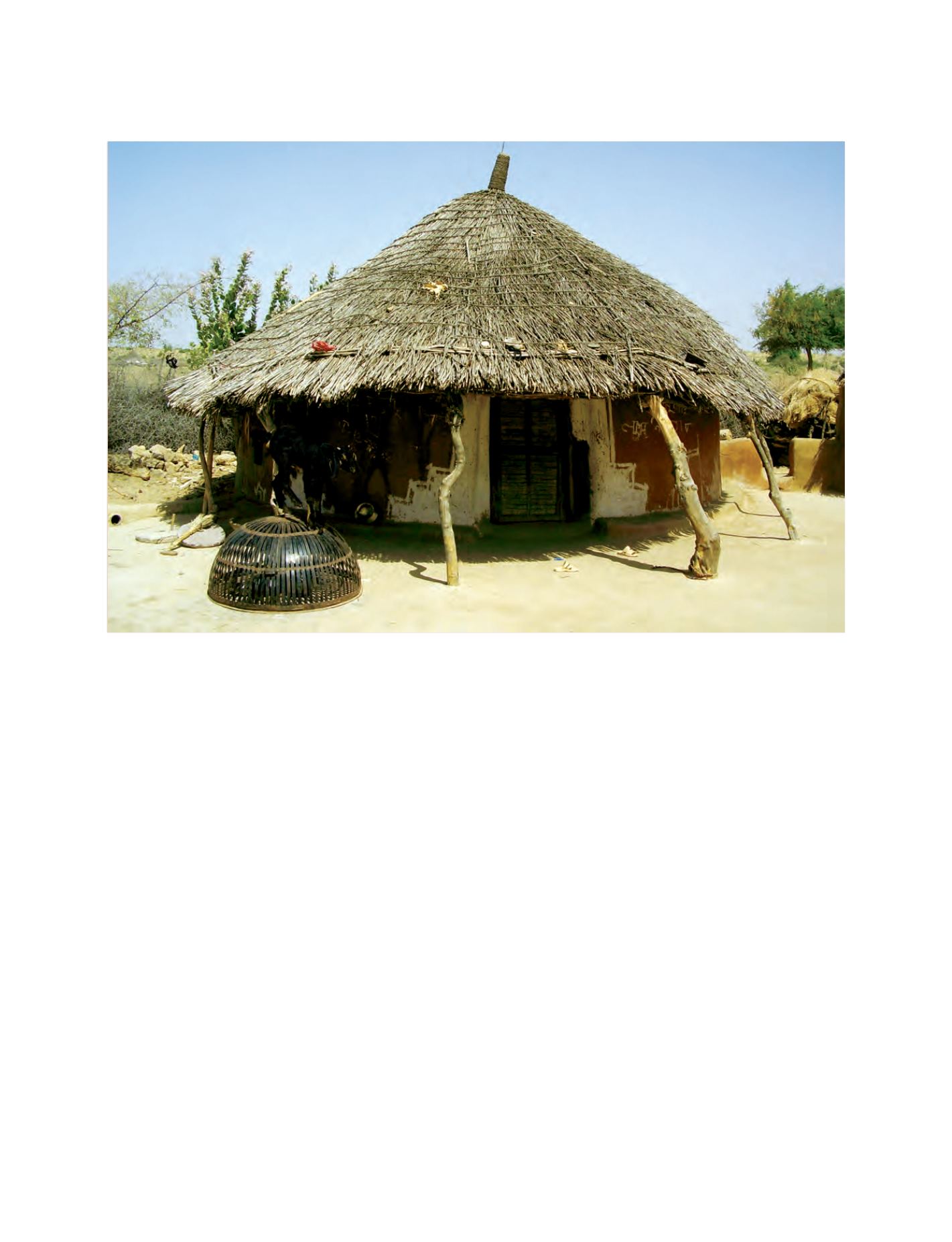
involved. The houses are built in a circular fashion on a foundation
of 3.5 feet, and made of earthen blocks. The model was on the same
lines as traditional Dhanis. The circular model is well adapted to the
weather. The shape of the structure keeps the high-speed sandy winds
from thrusting against the house, which could be a concern in a model
that consists of corners and points of obstruction for the sweep of
wind. Strengthening the structure further is the use of earthen blocks
as opposed to the normal practice of bricks and cement. These earth-
quake-resistant interlocking blocks are made of the regular dose of
cement, sand and an added ingredient of sand-loam soil, which is
sticky in texture and has a cooling effect.
Completing the construction of the house was left to the benefi-
ciaries and their families. This involved roofing the house, which
only required the families’ effort, time and a little money. The money
is needed to pay the carpenter who does the woodwork, which forms
the base to lay the three layers of the roof. Material for the roofing
is easily available locally, and is known as ‘Shaniya’ or ‘Kheep’. The
final step is the roping of the roof once all the layers are in place.
Ropes are made by the villagers themselves using straw. The conically
shaped roof converges at the top to form a thick stump (known as
‘Chotti’) bound tightly with ropes, which diverts rain-
water from seeping into the house.
Traditionally, communities in desert areas have evolved
rounded housing units. To a contemporary architect, this
may not be the best example of the internal organization
of space. However, the design works wonderfully well
from several environmental perspectives. The rounded
design of housing units in Kutch (Bhungas) evolved
because communities found this to be a perfect example
of seismically sound design. In the Thar desert areas of
Barmer district in Rajasthan, rounded units facilitated
wind movement, thus preventing severe desert storms
from hitting barriers and dropping dust.
Current practices are promoting regular stone
masonry with galvanized iron roofs. Rather than adapt-
ing traditional means to modern needs, these practices
set new paradigms, the impacts of which are not known.
These practices may provide improved utilization of
internal space. However, they cause increased insolation
within houses, do not facilitate wind movements and as
a result add up to increased environmental stress for
communities. Over a period of time, such communities
become more vulnerable.
Sudden shocks such as the August 2006 floods cause
havoc. At the first level, traditional practices collapse; at the
second level the new paradigms that are in vogue and have
perpetrated vulnerability increase the intensity of damage.
The traditional Dhanis of Barmer district were primarily made of a mixture of soil, cow dung and locally available wooden constituents
Image: SEEDS