


 36 / 196

[
] 34
What can be done?
Although science and technology cannot prevent disas-
ters from occurring, recent experiences and successes
offer real hope for reducing disaster impacts. This is
predominantly achieved by using the latest science and
technology in a) increasing the timing and accuracy of
disaster warning, b) applying Risk and Vulnerability
Analysis (RVA) techniques for better planning and miti-
gation, and c) building capacities and partnerships to
proactively take advantage of advances in disaster risk
reduction. Simply put, if disasters are defined as the
intersection of phenomena and presence, science and
technology can now help to limit the overlap of the prin-
cipal components, reducing the risks and impacts.
Reducing disaster risks is a multi-dimensional
problem requiring a multi-dimensional solution; science
and technology alone cannot achieve the ultimate
results. The work of culturally sensitive institutions in
raising awareness at the community level is also impor-
tant, approaching the problem from bottom-up.
How can science and technology reduce risks? First, by
improving the timeliness and accuracy of disaster warnings,
and improving the speed and clarity of alerts disseminated
of their citizens is often linked to natural environments or cultivated
lands that are also destroyed or altered.
Industrialized nations, where the dollar-values associated with
losses can be staggeringly high, struggle with the costs of disasters.
Developing nations, where the value of the loss is lower because
there is less to lose, often pay for their shortcomings in terms of
greater loss of life and more extreme economic setback.
Regardless of any comparisons in raw dollar amounts, natural
disasters cost developing countries from six per cent to fifteen per
cent of gross domestic product (GDP), on average. Progress is being
made on this front. Cyclone Val cost 230 per cent of Samoa GDP in
1991; Cyclone Heta cost only nine per cent of GDP in 2004.
With human lives and livelihoods at stake, every measure capable
of reducing risk and mitigating the impact of natural and human-
induced disasters must be used to the fullest. This includes
incorporating what is known of potential disasters in the planning
of development and infrastructure, and taking steps today to lessen
the effects of future disasters.
Not if, but when a disaster occurs, it is vital to have the appropri-
ate science and technology in place to support complete, concise,
accurate and actionable communication within agencies, between
organizations and right down to the last mile of early warning to
those potentially affected.
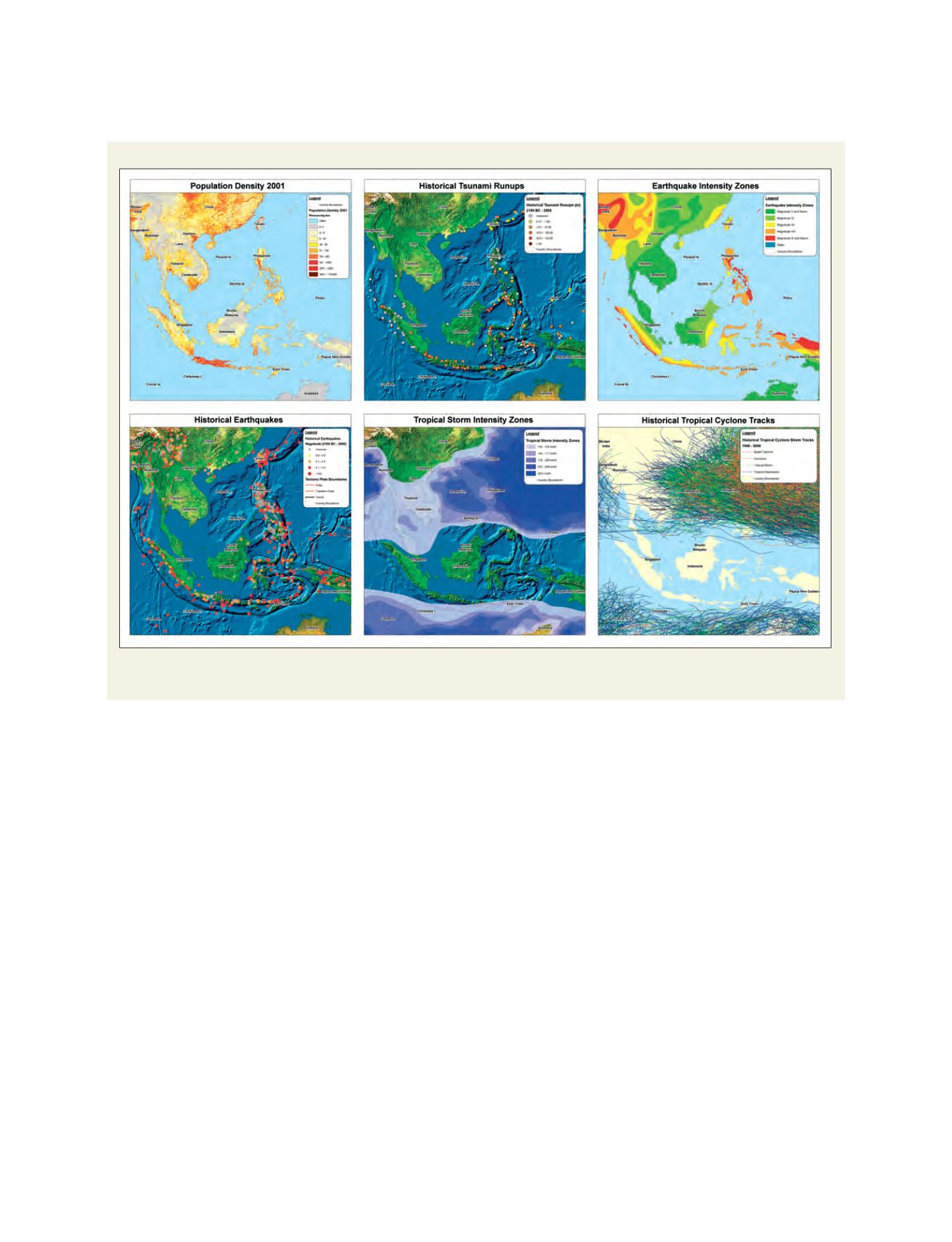
ASEAN countries regional natural disaster risk overview
Data streams from sensors, satellites, buoys and other sources can be time-consuming and challenging.
Visualized data, like the risks to ASEAN nations pictured here, can be immediately understandable
Source: Shaded Relief, © WorldSat International Inc. 2001, Digital Chart of the World, NOAA/NGDC, UNISYS Weather, ORNL LandScan 2001