


 234 / 287

[
] 235
Coping with climate variability
and change in Kenya
Kenya Meteorological Department
C
limate change can be described as a permanent shift
in the normal patterns of climate. Such a shift could
spread over a period of decades, or even longer. There is
discernible evidence – derived from numerous climate detection
processes –that climate is changing across the entire globe.
1
For a local farmer or herdsman, however, abstract scientific
notions of climate change make little sense. A definition relat-
ing to livelihood – detailing associated impacts that people can
relate to – is essential if we are ever to deal with the problems
climate change brings.
As such, climate change can be defined as lack of rain or changes to rain-
fall patterns. Practical conclusions can be drawn from such a description
since it will affect agricultural factors such as: planting times; wither-
ing of crops; drying of streams and rivers; dying of livestock; and hotter
nights. The significance of climate should not be underestimated. It
provides for all the basic needs of living organisms includ-
ing food, water and air. Furthermore, it renders the earth
beautiful by providing flowers, plants, deserts, oceans, rivers
and animals. Over many millennia, human beings and the
earth’s ecosystems have adapted to climate conditions. As
such, climate change will necessitate alterations in ecosys-
tems, as well as in human lifestyles through appropriate
adaptation strategies.
Observed climate change signals and impacts in Kenya
Temperature has generally risen all over Kenya. Analysis
of trends in temperature indicates that both minimum and
maximum temperatures have increased across the country.
In the inland areas the minimum temperatures show a
steeper increase than maximum temperatures. These trend
patterns reverse for stations near large water bodies, such
as the Indian Ocean and Lake Victoria. In both cases, the
general observation is a decrease in the temperature range.
The observed rise in temperature has provided favourable
conditions formosquitoes, enabling them to survive in envi-
ronments where they could not before. This has resulted in
the spread of malaria to initially malaria-free zones, such as
the highlands.
2
Rainfall has also been affected by climate change.
Large variations in rainfall are characteristic of Kenya
and relate to the variation in topography. Even so, the
rainfall patterns over the country have shown distinct
changes in the recent past. The changes have been
depicted in patterns of onset, distribution and amounts
of rainfall received in a season. Observations are also
made for more frequent and intense extreme rainfall
events such as floods and droughts. Recent extreme
events include the El Niño-related floods of 1997/98, as
well as floods in 2003 and 2006. Meanwhile, droughts
were observed in 1999-2001, 2005 and 2008/09.
Erratic rainfall has had impacts on many socioeconomic
sectors such as health, agriculture, energy, water resources
and disaster management. Some of the impacts include:
• Food insecurity due to poor harvests and death of livestock
• Resurgence of diseases such as Rift Valley Fever due to
heavy rainfall in the semi-arid parts of the country (as
witnessed in 1997/98 and 2006)
• Rivers drying up or becoming seasonal
• Displacement of communities
• Enhanced conflicts over limited resources such as pasture
and water.
A
daptation
and
M
itigation
S
trategies
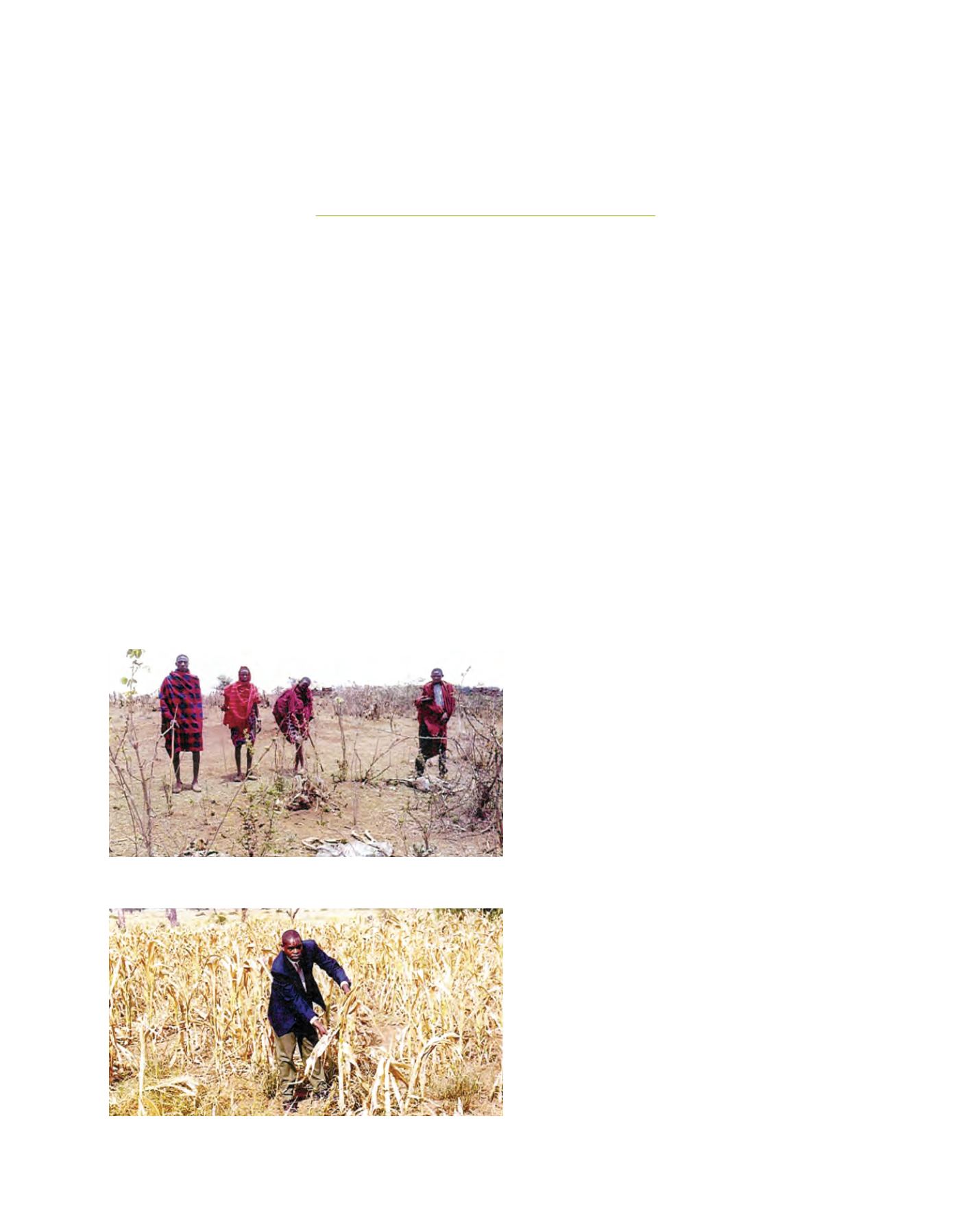
Dead livestock due to scarcity of pasture and water following prolonged drought, Masailand
Image: Daily Nation Newspaper, 2000
Wilted maize crop during a drought
Image: Daily Nation Newspaper, 1999