


 237 / 287

[
] 238
Icelandic perspectives on adaptation
to climate change and variability
Halldór Björnsson and Árni Snorrason, Icelandic Meteorological Office
I
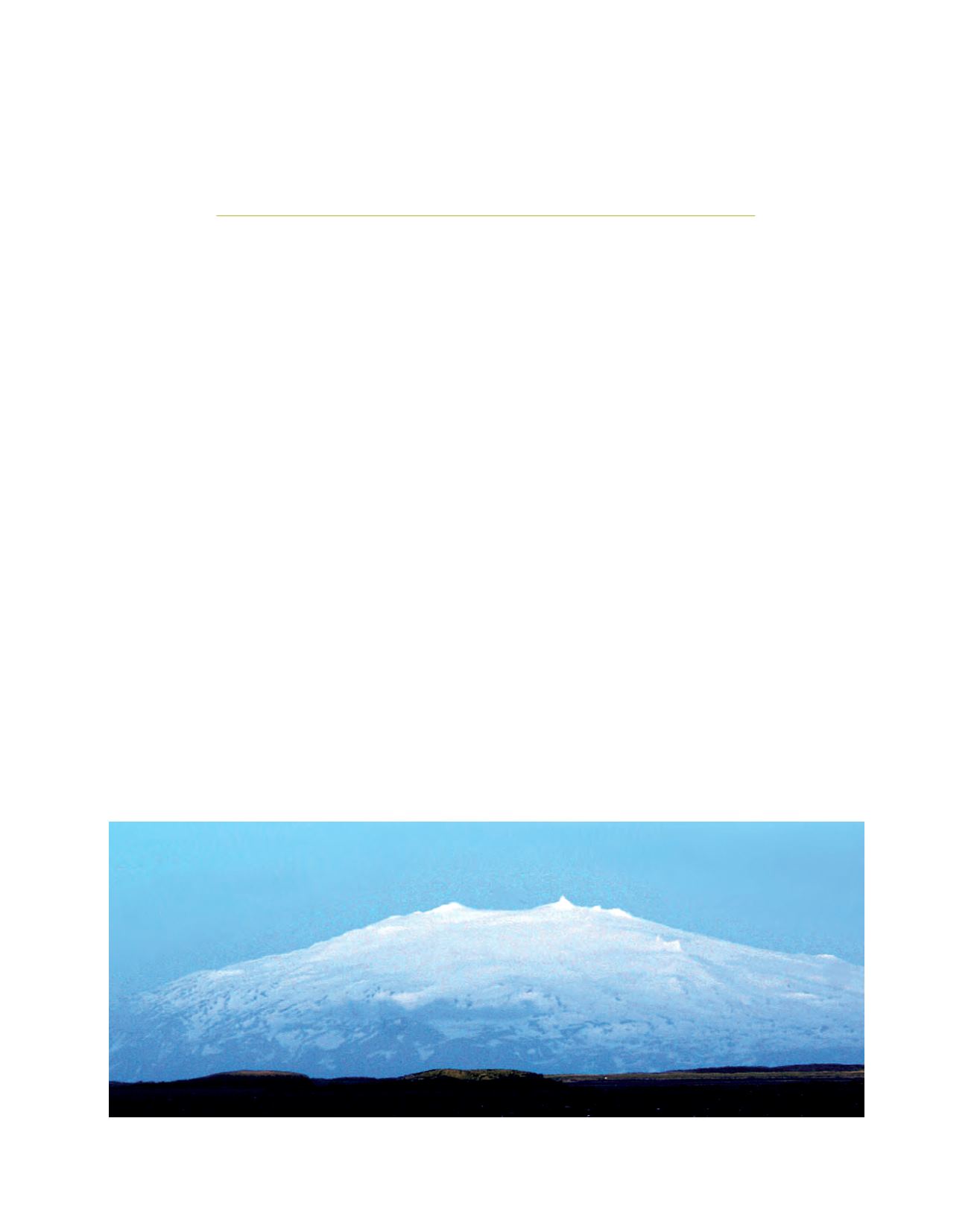
n good weather, the picturesque Snæfellsjökull ice cap can be
seen across the bay from Reykjavík. In the 1864 novel
Journey
to the Centre of the Earth
, by Jules Verne, the ice cap serves as
the entrance to a passage that led to the middle of our planet. It is
the only ice cap that can be seen from Reykjavík, and has existed
for many centuries, at least since Iceland was settled in the ninth
century. Recent measurements show that this ice cap is shrinking
rapidly in size.
The climate of Iceland exhibits considerable variability on annual and
decadal timescales. However, long-term temperature records from
the weather station at Stykkishólmur, about 60 kilometres from the
Snæfellsjökull ice cap, show that during the last two centuries the climate
of Iceland has warmed by about 0.7°C per century. In recent decades the
warming has been very rapid with significant impacts on many natural
systems in Iceland.
Recent measurements show that the Snæfellsjökull ice cap, which has
an average thickness of less than 50 metres, thinned by approximately 13
metres in the last decade. At the current rate of thinning it will disappear
within the century.
Snæfellsjökull ice cap is not an isolated case in this regard, most moni-
tored glaciers are retreating. The thinning of large glaciers, such as the
Vatnajökull ice cap, one of Europe’s largest ice masses, reduces the load
on the Earth’s crust, and the crust rebounds. Consequently large parts of
Iceland are now experiencing uplift. However, the uplift does not reach
to the urban south west part of Iceland, where subsidence is occurring.
Changes are also evident in glacial river runoff, with
earlier onset of the melting season and enhanced late
summer melting. Recent warming has also impacted
the fauna and flora of Iceland. Tree limits are now
found at higher altitudes than before and the produc-
tivity of many plants has increased. In the ocean, there
have been significant changes associated with warmer
sea surface temperatures. Several new species of fish
have expanded their range into Icelandic waters, and
Icelandic stocks that traditionally were mostly found
along the south coast have expanded their range to the
north coast.
During the 21st century the climate of Iceland is likely
to warm even further. Natural variability, while consider-
able, will not overwhelm the projected long-term warming
of more than 2°C during the century. Because of natural
variability thewarming is, however, likely to be unevenwith
the climate exhibiting rapid warming during some decades,
but little or none in others.
The projected warming is likely to cause a pronounced
retreat of glaciers in Iceland. By the end of the century
Langjökull, the second largest ice cap in Iceland is projected
to have shrunk to 15 per cent of the size it was in 1990.
The projected retreat is not as large for glaciers that are at a
higher altitude, but by the end of the century they are still
likely to lose at least half the volume they had in 1990.
A
daptation
and
M
itigation
S
trategies
The Snæfellsjökull ice cap
Image: © Oddur Benediktsson, Creative commons license