



 188 / 218

[
] 186
T
HERE IS A
growing understanding that hydrometeoro-
logical data, and weather forecasts in particular, bring
economic and social benefits to any country. The use of
hydrometeorological information in decision-making makes it
possible to minimize economic damages and loss of human
lives, as well as to gain additional economic benefits from the
forecasts of favourable weather conditions. However, existing
methods for assessing the economic benefits of hydrometeoro-
logical information and services require reliable econometric
and specialized data, considerable resources and expertise. All
or many of these ingredients are missing in the developing
countries, making it difficult for national hydrometeorological
services (NMHS) to demonstrate the economic efficiency of
their services and justify the need for adequate public support.
The World Bank was first faced with the need to develop a
method for an express assessment of the economic efficiency of
NMHS in 2003 while preparing the National Hydrometeorological
Modernization Project in Russia. The results of the study, carried
out jointly with Roshydromet, were well received by the Russian
Government and World Meteorological Organization (WMO).
This positive experience has encouraged the bank to launch
further studies in cooperation with NMHS.
Over the past 15 years, the NMHS of the transition
economies in the Europe and Central Asia (ECA) region
suffered greatly from the massive underfunding. This resulted
in increased economic losses from hydrometeorological
hazards and unfavourable weather conditions, the frequency
and scale of which increased in most ECA countries.
Modernization of NMHS and improvement of hydrometeoro-
logical service (HMS) delivery is one of the key factors in
minimizing economic losses from these events and increas-
ing pubic safety. Before allocating resources for such
modernizations, the national governments demand that
NMHS prove the economic benefits of such a decision.
For most NMHS, this poses a great challenge due to the absence
of a generally accepted methodology for assessing the effective-
ness of HMS delivery or modernization programmes; lack of basic
econometric information needed to assess losses and benefits,
and the shortage of expertise in NMHS and weather dependent
sectors capable of making this assessment. The process of collec-
tion and evaluation of the information is time-consuming and
requires substantial funding which is often unavailable.
The World Bank, jointly with a number of NMHS in Europe
and Asia (among them Albania, Armenia, Azerbaijan, Belarus,
Customizing methods for assessing economic
benefits of hydrometeorological services
and modernization programmes:
benchmarking and sector-specific assessment
V. Tsirkunov, S. Ulatov, M. Smetanina, A. Korshunov
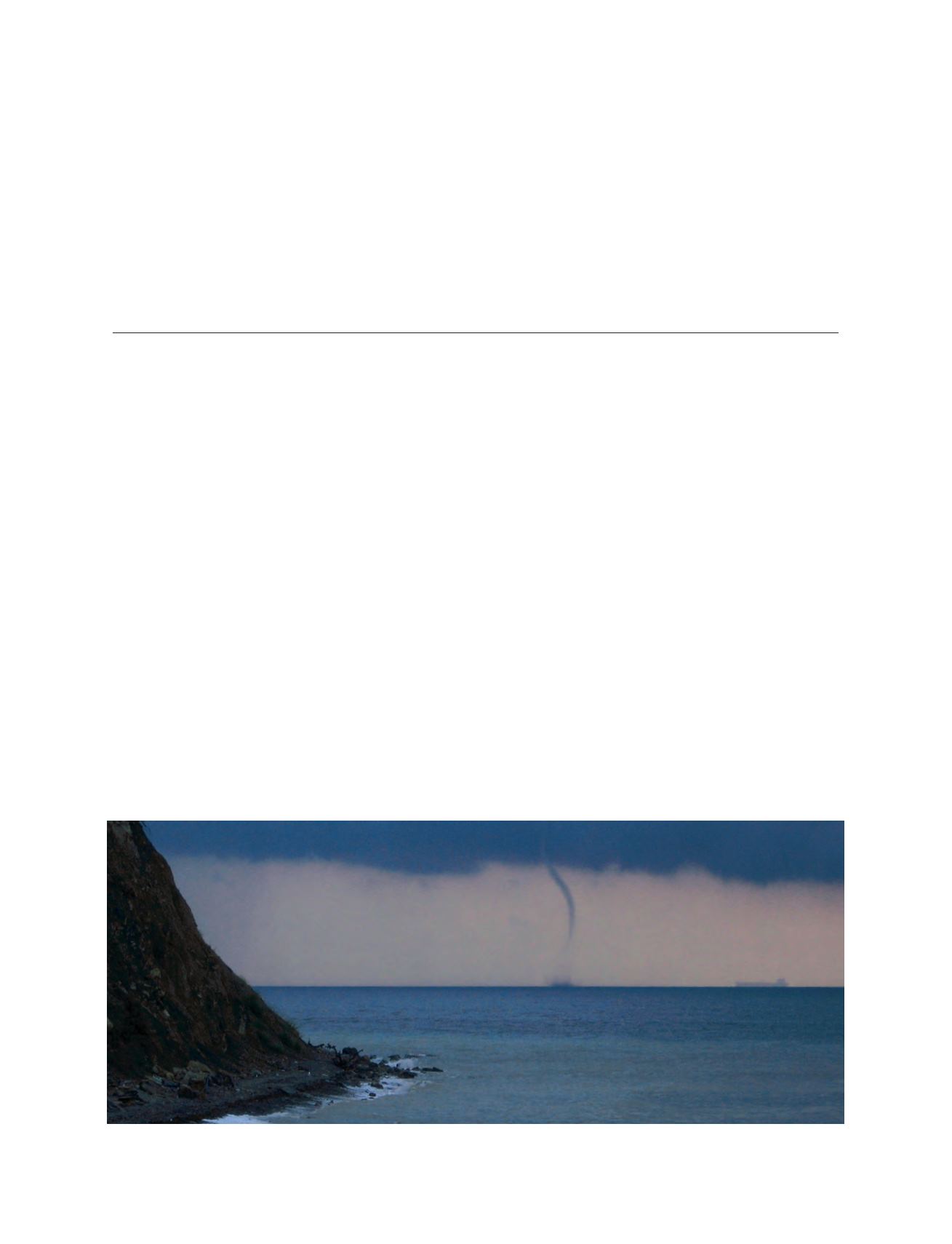
In the last five years, 15 cases of waterspouts have occurred 3-5 km from the coast, on two occasions causing the loss of human lives
Photo: Mr P Lurie