



 186 / 218

[
] 184
N
ATIONAL METEOROLOGICAL AND
Hydrometeorological
Organizations (NMHOs) aim to provide their respec-
tive citizens with world class meteorological and
environmental information, predictions and services to ensure
the safety of the population, support economic activity and
facilitate improved environmental decision-making. This infor-
mation includes millions of weather forecasts and thousands
of severe weather warnings that are issued each year, along
with billions of archived environmental observations and asso-
ciated applications for decision-makers in health, agriculture,
energy, forestry, transportation, construction, insurance and
many other sectors. The production of this information in
Canada is dependent on a public monitoring, computer,
telecommunication and research laboratory infrastructure
valued at over CAD330 million, and on the contributions of
about 2,000 meteorologists, scientists, technicians and support
staff. A significant effort is also provided through the acade-
mic community, private meteorological service providers,
media and experts employed directly by large user businesses,
institutions and organizations.
In light of such investments, public meteorological agencies
the world over have become increasingly interested in identi-
fying, tracking and evaluating the costs and benefits of
providing timely, precise and accurate information about the
past, current and future states of the atmosphere. This desire
is also driven by broader globalisation pressures that have
encouraged the proliferation of international quality control,
quality assurance and other standard-setting and performance-
measuring practices. Clearly there is a need to justify the cost
of current operations and this objective has underpinned public
agency support to date for societal and economic valuation
research.
Moving from hindsight to foresight:
a challenge in the application
of valuation research
Brian Mills, Adaptation and Impacts Research Division,
Atmospheric Science and Technology Directorate, Environment Canada
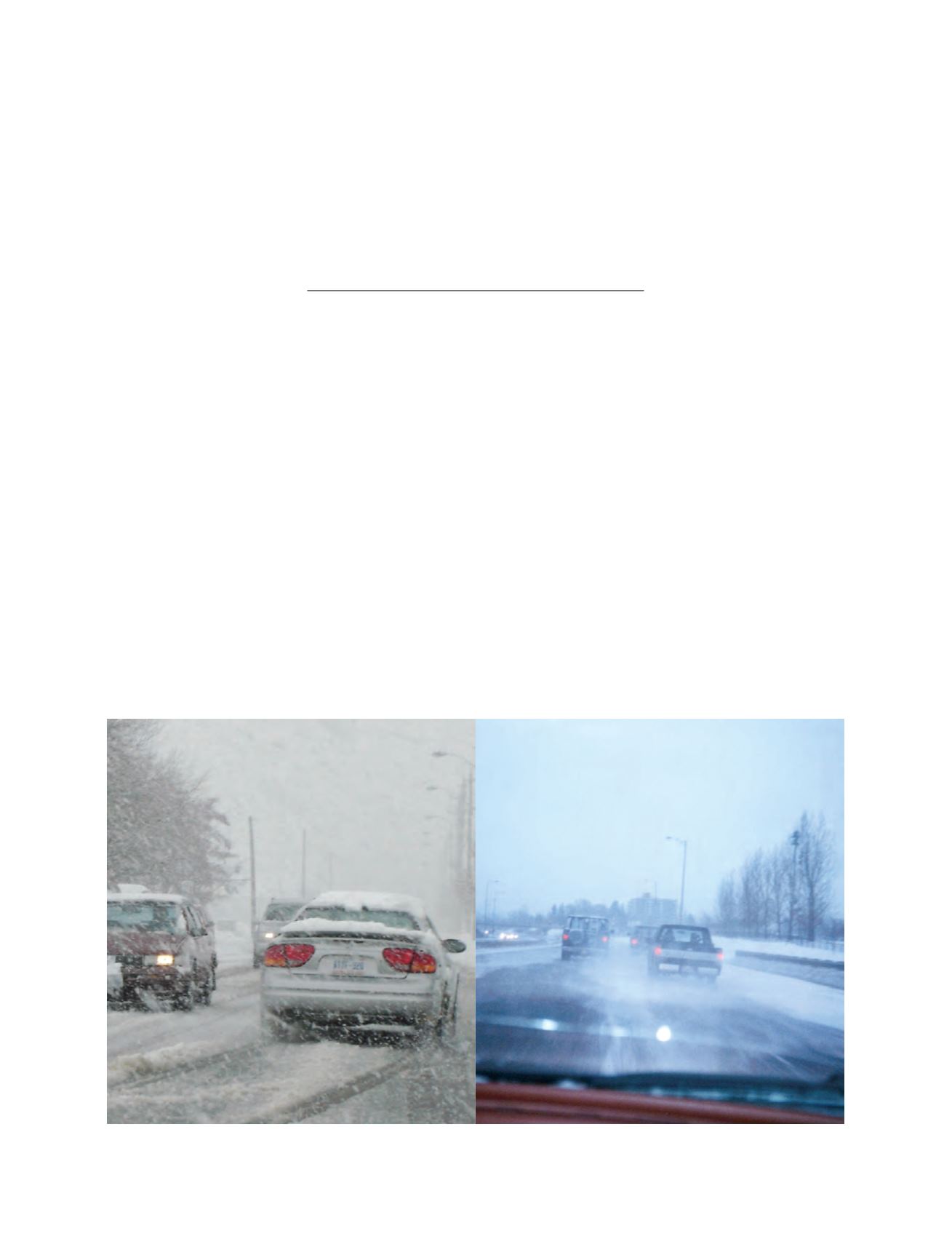
Understanding the decision-making behaviour of users – in this case drivers – is critical to developing improved weather services
Photo: J. Suggett