



 182 / 218

[
] 180
bility of forecasts following years in which something other
than the most likely events occurred. Third, they could work
with farmers to develop response strategies at the village level,
incorporating both local geographical factors and the tradi-
tional indicators. This would address the legitimacy and scale
constraints. NOAA funded a pilot project in Zimbabwe led by
Anthony Patt and Pablo Suarez of Boston University, and
Chiedza Gwata of the University of Zimbabwe, to test whether
these theoretical solutions would work in practice, and
whether actual benefits to farmers could be demonstrated once
these constraints had been addressed.
Using probabilistic information
The first issue explored in the project was whether farmers
could actually understand a probabilistic forecast. The
researchers used experimental techniques from psychology and
behavioural economics to examine the responses to proba-
bilistic information among a sample of almost 100 subsistence
farmers from seven different farming communities.
The participants played a series of gambling games with a
modified roulette wheel, choosing which colour to place their
bets on. In one game, for example, the roulette wheel was
exactly half red and half green, and the rules of the game were
that a successful bet on red would win a prize of ZWD2
(Zimbabwe dollars), while a successful bet on green would win
a prize of ZWD3. Participants who were able to optimise would
place all of their bets on green, while those with a poorer
understanding of probability and uncertainty would be
tempted to bet on red at least some of the time. In another
game, the regions of the roulette wheel were marked to repre-
sent ‘good rains’ and ‘drought’. The bets consisted of planting
maize, which paid ZWD5 if the wheel landed on good rains
and nothing for drought; and planting millet, which paid
ZWD3 for good rains and ZWD2 for drought. Over a series of
plays, the researchers changed the relative sizes of good rains
and drought on the wheel, and observed the effect that this
had on the bets farmers placed.
The results of the experiment showed that farmers clearly
could work with probabilistic information, if given the oppor-
tunity to familiarize themselves with it. When participants
played five rounds of the red/green betting game at the begin-
ning of the session, almost all of them placed some of their
bets on red, even though it had a lower expected payoff. Over
ten rounds of the maize/millet game, farmers changed their
bets in response to different probabilities of good rains and
drought. In another five rounds of the red/green game, coming
at the end of the experimental session, almost half of the partic-
ipants placed all bets on green – the correct strategy. Women
outperformed men: close to 60 per cent of the women had
adopted the optimal strategy, compared to slightly more than
30 per cent of the men.
A methodology to identify forecast value
The next stage of research was to explore whether subsistence
farmers, having access to a timely probabilistic forecast that
they could discuss with agricultural advisors and compare with
their traditional indicators, would use the forecast to make
different decisions and derive added value as a consequence.
Zimbabwe was an ideal country to conduct this research, since
the NMHS was already active in broadcasting the forecast via
radio, making it possible to test the added value of a partici-
patory approach.
unwillingness to use the information at all. Second, farmers
may not see the forecast as a legitimate basis for action, both
because it could be seen as supplanting established forecast-
ing methods within the community, and because it could be
seen to be benefiting the political and financial elite, such as
bankers who restricted credit, rather than the individual
farmers themselves. As with a lack of credibility, a lack of legit-
imacy may lead farmers to reject the information.
Third, the forecast may be at too coarse a scale to benefit
farmers. In a geographically heterogeneous country such as
Zimbabwe, it was not obvious to farmers how to apply a
national-level forecast to their own particular village. Fourth,
farmers may not understand the forecast. Many had inter-
preted the 1997 forecast in Zimbabwe to mean that there
would be no rains, and acted accordingly rather than taking
its suggestion of probability into account. Fifth, established
procedures may stand in the way of using the forecast. If the
forecast is communicated to farmers via the local agricultural
extension service offices, and if this requires a series of meet-
ings at the national, provincial, and then local level, it can
take weeks, meaning that the forecast reaches farmers after
they have had to purchase their seeds and begin planting.
Finally, particular choices may simply be unavailable to
particular farmers: the local store may have decided not to
stock the seed variety that the forecast suggests is appropri-
ate, or families may not have access to draft power to plant
at an appropriate time.
In theory, better communication practices by the NMHS and
the agricultural extension services could overcome at least
four of these constraints. First, the services could alter their
standard procedures for information flow in order to reach
farmers within days of the SARCOF meeting, giving them the
opportunity to use the forecasts in their seed purchasing deci-
sions. Second, they could better explain the forecasts’
probabilistic character. This would address the constraint of
understanding the forecast, and may also increase the credi-
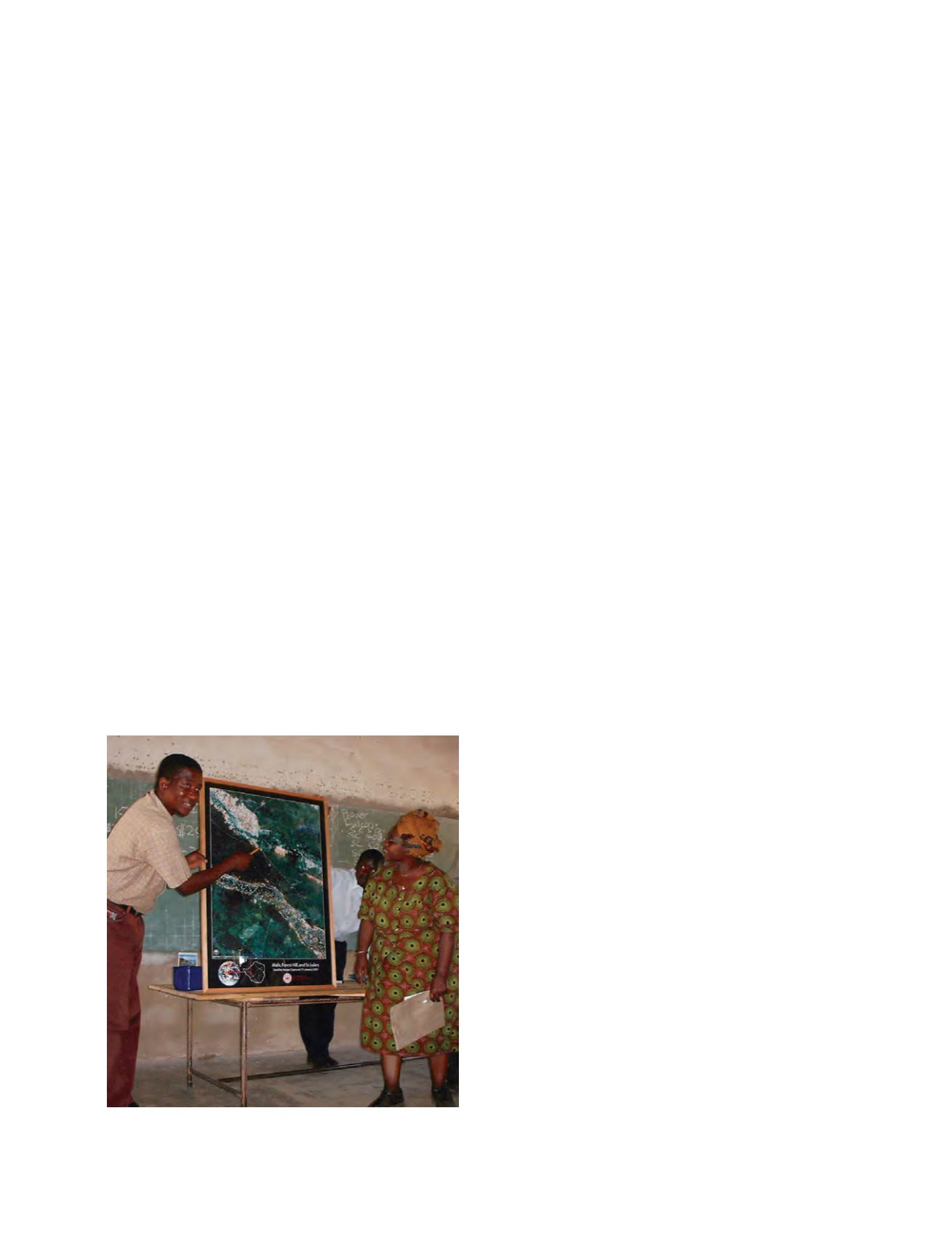
An agricultural extension officer discusses local soils and
precipitation at a forecast workshop
Photo: Anthony Patt