


 177 / 218

[
] 175
5. Estimate the number of instances (e.g. people, transac-
tions) where behaviour is changed
6. Combine the results of steps 4 and 5 to estimate a total
benefit of information.
Benefit measures
Many metrics can be used to measure interactions between
hydrometeorological systems and humans. Although it is
possible to measure the effect of people on hydrometeoro-
logical systems, the focus here is on measuring the effect of
those systems on people. These effects include the number
of lives lost to natural disasters, along with measures of
economic activity (e.g. output, employment) or economic
welfare (e.g. willingness to pay), in weather-sensitive indus-
tries or activities.
The distinction between measures of economic activity and
measures of economic welfare is important. Measures of activ-
ity, even if expressed in monetary units, do not tell us the value
of the activity. These measures do not tell us what people would
be willing to pay for that activity. Welfare measures, on the
other hand, are specifically designed to quantify what people
are willing to pay for something. As a result, welfare measures
of benefits are appropriately compared to the costs that people
pay for those benefits.
Programmes that save lives pose a special and important
problem in benefits estimation. Saving lives may be seen as
desirable regardless of costs. Public and private decisions,
however, routinely make implicit trade-offs between costs and
risks to human life. In policy analysis, economists do not put
a value on any specific individual’s life – instead they look at
how much people are willing to pay to reduce the risk of people
dying in future events. For instance, suppose a study deter-
mines that one million people in a city are each willing to pay
USD50 per year on average for a programme to reduce the
chance of death by 1 in 100,000 per year – say from 20 in
100,000 to 19 in 100,000 each year. Total willingness to pay is
thus USD50 million (USD50 × 1,000,000) and the programme
would save ten lives per year on average; thus, the people of the
city are willing to pay USD50 million to prevent ten deaths. So
the value per statistical life (VSL) is USD5 million. The US
Environmental Protection Agency, for example, uses a similar
VSL in cost-to-benefit analyses of programmes that reduce
mortality risk, such as reducing air pollution.
There are three general approaches to estimate the benefits
of hydrometeorological information using welfare measures:
• Stated preference
• Economic modelling
• Data analysis.
The value of weather forecasts to US households
Because weather forecasts have the properties of public goods,
little market data exist on the value that households place on
hydrometeorological information. Economists can use two basic
approaches to estimate the economic value of ‘nonmarket goods’:
revealed preference methods and stated preference methods.
Revealed preference methods are applied to actual behaviour
and market transactions. Such information may reveal the values
implicitly placed on a nonmarket good in the context of the
choices people make about market goods. In stated preference
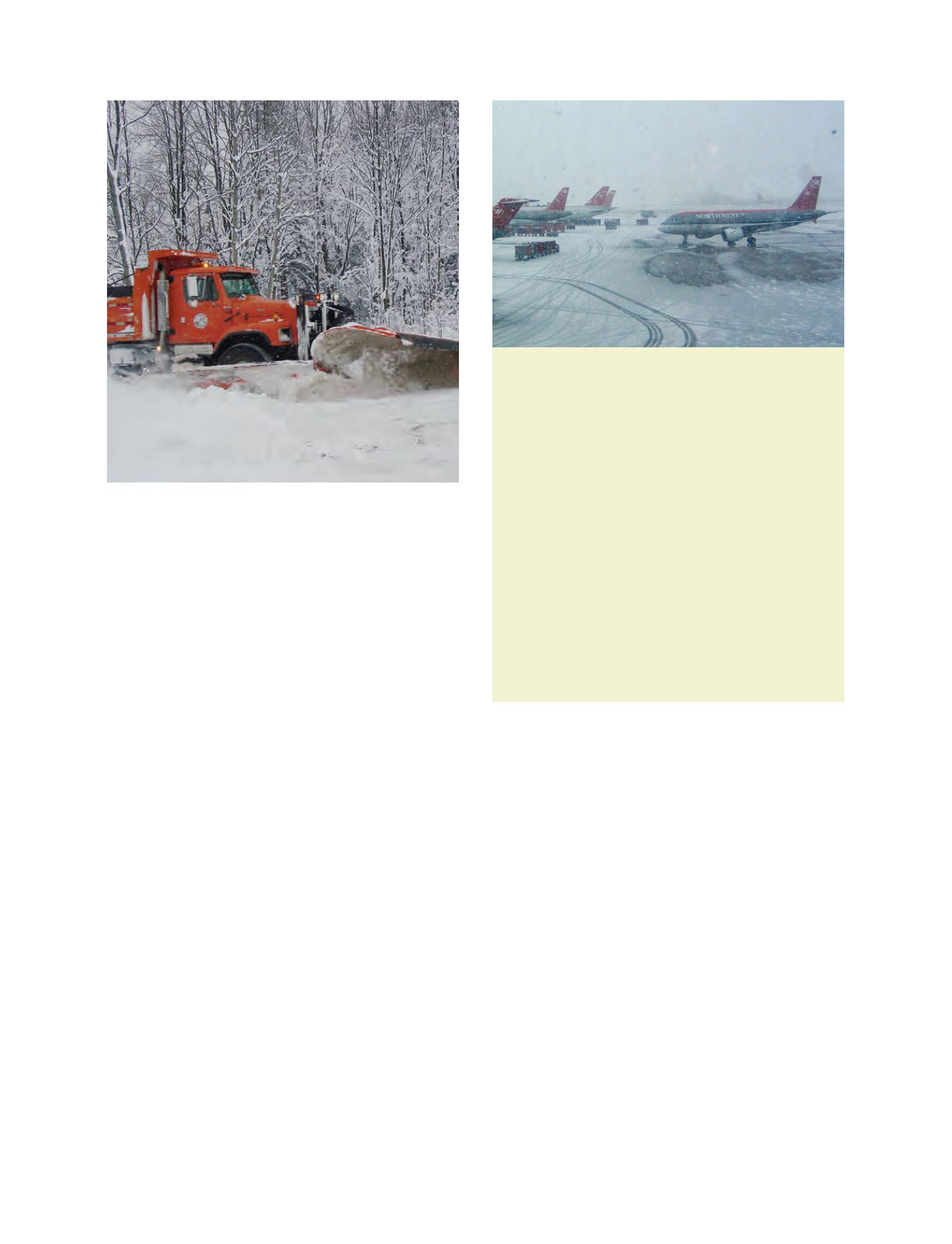
Forecasting of snow and snow events
Potential benefits from better forecasting of snow and snow
events include:
• Improvements in frost forecasts (up to USD6,000 per hectare
per year for fruit orchards)
• Long-range stream flow forecasts (over USD170 million per
year in hydropower benefits for three river systems)
• Temperature predictions (over USD500 million per year from
natural gas and electric utility providers)
• Icing diagnostics at airports (exceeds USD600 million per
year at US airports)
• Predictions of road ice formation and fog (exceeds USD29
million per year from rerouting trucks in the US)
• Marine forecasts of winds and waves (exceeds USD95 million
per year from transit time savings and cargo loss reductions
in US coastal waters).
Source: Adams, R, Houston, L and Weiher, R.
The value of snow and snow information
services
. Report prepared for NOAA’s National Operational Hydrological Remote Sensing
Center, August 2004.
Transport and agriculture are among the sectors that benefit
most from accurate snow warnings
Photo: NOAA