



 176 / 218

[
] 174
T
HIS ARTICLE BRIEFLY
introduces methods for assessing
the economic value of hydrometeorological information
provided by National Meteorological and Hydrological
Services (NMHS).
Weather, water, and climate information and forecasts
(hydrometeorological information) help people avoid the danger
of hazardous weather conditions and reduce the costs associated
with unfavourable weather or climate conditions. It also allows
individuals to take increased advantage of favourable conditions.
In most cases, any number of people can use this information
without diminishing its value to other users, meaning that the
information is ‘nonrival’. In addition, it is inherently difficult to
prevent people who have not paid for the information from using
it, meaning that the information is ‘nonexclusive’. For these
reasons, hydrometeorological information and improvements to
it are appropriately treated as ‘public goods’.
Because hydrometeorological information is a public good,
economists would generally agree that competitive markets
would not provide it at socially optimal levels. Consequently,
there is justification for paying for its provision from public
revenues and distributing it to anyone who wants it, charging
only the marginal costs of its distribution. We note that in the
United States, a limited number of private companies have
successfully found a role in distributing weather information
by tailoring its presentation to appeal to wide audiences, or
by meeting the specialized needs of particular users.
However, the public good status of hydrometeorological
information alone does not justify making it widely available.
Instead, if we are to determine the right kind and amount of
information to produce and disseminate, we must understand
the costs and the benefits of the information. If the total benefit
accruing to users exceeds the total cost of producing the infor-
mation, then the service is justified.
Although the cost of producing hydrometeorological infor-
mation is usually straightforward to estimate, the benefits
typically are not.
Steps in benefit estimation
To quantify the benefits of hydrometeorological information,
we need to consider how humans and hydrometeorological
systems interact, how access to hydrometeorological informa-
tion improves these interactions, and how we measure
improvements in the interactions.
If information is to change the interactions between hydrom-
eteorological systems and humans, that information must make
it possible for people to change their behaviour in ways that
produce better results, on average, over time. When accessing
the benefits of such information it is helpful to apply a six-step
process:
1. Identify the hydrometeorological system/human interac-
tion affected
2. Identify the changes in human behaviour that may result
because information is available or improved
3. Choose one or more measures that will be used to quan-
tify the benefits of changes in behaviour
4. For the measure(s) chosen, estimate the change (or
expected change) in the benefits, in each instance where
behaviour is changed because of the information content
Methodologies for assessing the
economic benefits of National Meteorological
and Hydrological Services
Jeffrey K. Lazo, National Center for Atmospheric Research
Thomas J. Teisberg, Teisberg Associates
Rodney F. Weiher, Chief Economist, National Oceanic and Atmospheric Administration
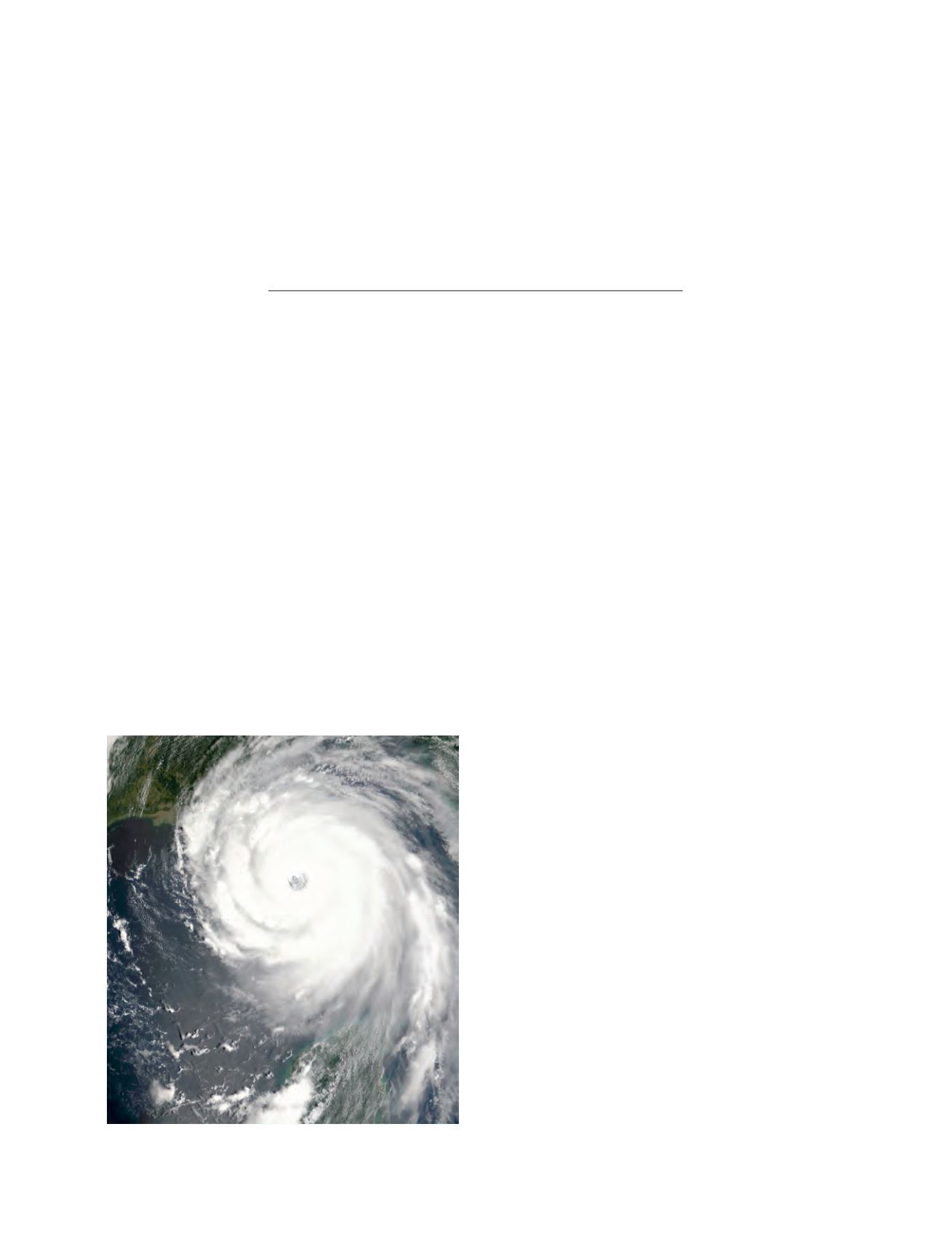
Hurricane Katrina from space
Photo: NASA