



 173 / 218

[
] 171
T
HE FIRST RECORD
of dust phenomenon in Korea was
found during the reign of the Silla Dynasty’s King Ahdalla
(174 A.D.) and was called ‘Woo-To’. At that time, people
believed that the god became so angry he lashed down dirt
instead of rain or snow. Since then, the Asian Dust has been
considered an unavoidable natural phenomenon in Korea,
which comes uninvited every year.
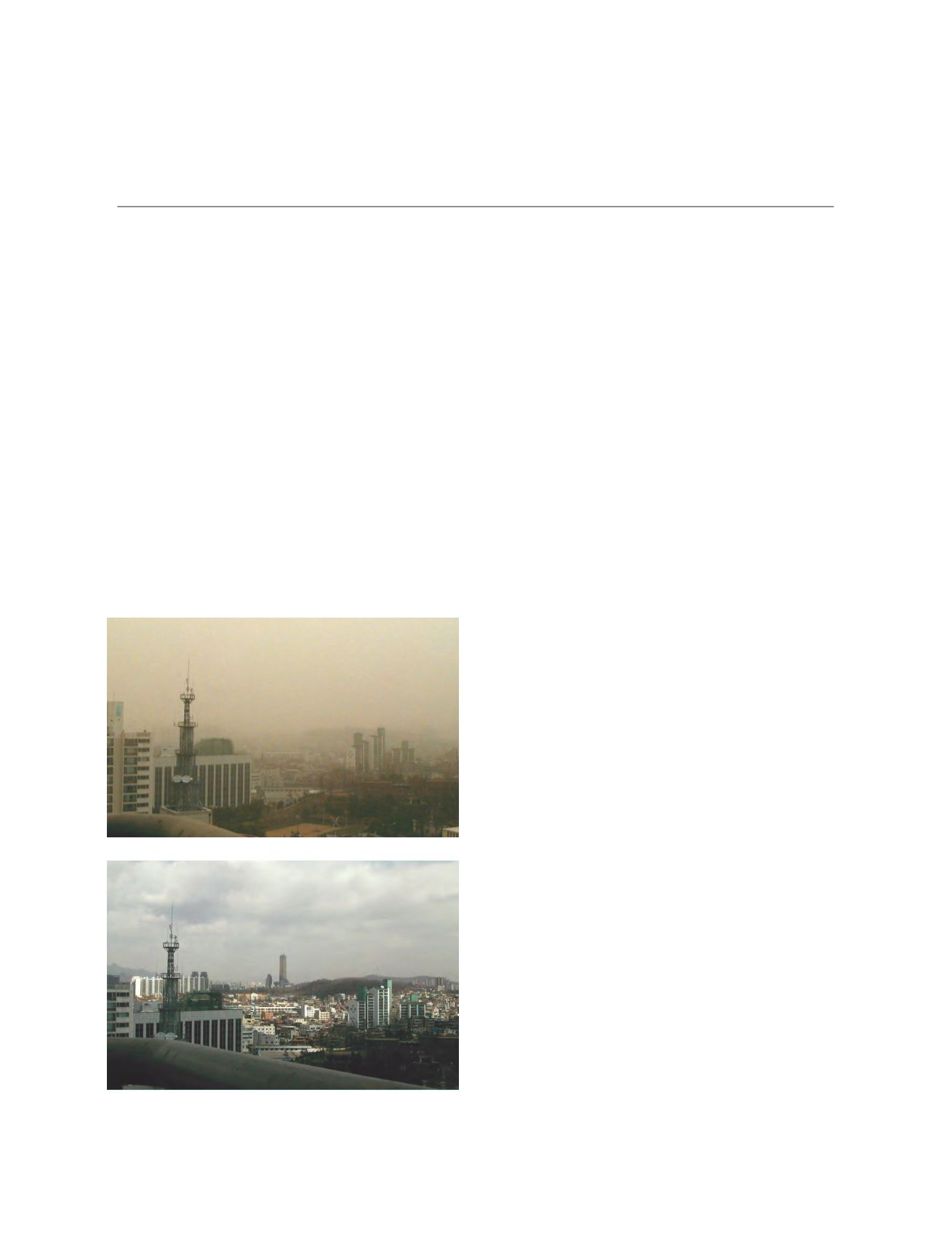
However, unprecedented severe Asian Dust, about forty times
more severe than usual, attacked Korea in March 2002 and
caused the temporary closure of 4,373 primary schools, 164
flight cancellations and the reduction of working hours in facto-
ries for semi conductors and other precision products.
Following this, both the media and the general public
demanded that the government should take all possible
measures to reduce the impact of the Asian Dust Storm.
The most fundamental measure to protect Korea from the Asian
Dust was to forest the desert areas in China and Mongolia, which
are deemed to be the source of the Asian Dust. However, as deser-
tification progresses faster than forestation, the best way for the
Korea Meteorological Administration (KMA) to protect the people
from the Asian Dust was to more accurately predict the density of
the Asian Dust which comes from China, and provide quantified
information on it. For this, the establishment of an observation
network for the Asian Dust in China is needed.
In cooperation with the Korea International Cooperation
Agency (KOICA) and the Korea Ministry of Foreign Affairs and
Trade (MOFAT), KMA negotiated with and persuaded the China
Meteorological Administration (CMA) to establish the joint
monitoring network of the Asian Dust. About three years later
KMA and CMA accomplished this and have shared the Asian
Dust data observed at the five joint monitoring stations in real
time since March 2005. The observed data from the KMA-CMA
joint monitoring stations is used as input data for the numeri-
cal prediction model for the Asian Dust. Since then, it has been
possible to produce more accurate and quantitative forecasts.
The Meteorological Research Institute (METRI) of KMA
developed the trajectory model that has been used routinely to
forecast the air stream movement including dust since 2000.
The trajectories are initiated in the source region on the isen-
tropic surface of 295K, 300K, and 305K.
Recently, KMA raised the forecast accuracy of the Asian Dust,
named the Asian Dust Aerosol Model (ADAM), which was
jointly developed by METRI and Seoul National University.
After the installation and optimization of ADAM on the KMA
supercomputer, KMA has made great strides in producing more
rapid Asian Dust forecasts. ADAM is operating routinely to fore-
cast the dust concentration after 48 hours at intervals of three
hours.
The KMA-CMA joint network proved its real capability in
April 2005. The extremely severe Asian Dust affected the Korean
peninsula again on 20 April 2005. But the situation was quite
different from that in 2002. It was possible for KMA to issue
and deliver the pre-warning report of the Asian Dust to the
media and related agencies on 19 April, giving them time to
take measures and prepare for the events of the next day.
Even though the thick dust covered the sky over the Korean
peninsula on 20 April, following the countermeasures made on the
previous day, industries had already changed filters of the air clean-
ers before the dust attacked Korea, and primary schools allowed
the students to return home after morning classes on 20 April.
This clearly illustrates that the people coped with the event calmly
and systematically. It was a striking contrast to the case of 2002.
KMA is processing the project in cooperation with CMA to
extend the joint monitoring network in the northeast area of
China for better monitoring and forecasting of the Asian Dust
which moves from the Inner Mongolia to the north area of the
Korean peninsula. CMA agreed with KMA on the extension of
Saving the public from the Asian Dust Storm
Nam Jae-Cheol, Korean Meteorological Administration
(a) 10:00 LST 21 March 2002
(b) 10:00 LST 23 March 2002
During and after the dust in Korea
Photos: KMA