



 168 / 218

[
] 166
C
HINA HAS ONE
of the fastest growing economies in the
world. Between 1990 and 2004 its gross national
product has increased by a factor of seven. This growth
in economic activity is accompanied by a strong increase of
emissions from tropospheric pollutants, leading to extra pres-
sure on the environment.
The European Space Agency (ESA) and the National
Remote Sensing Centre of China (NRSCC – an entity under
the Ministry of Science and Technology of the People’s
Republic of China) have cooperated in the field of Earth
observation application development for the last ten years.
The cooperation has now taken on a new momentum with
the creation of a dedicated three-year Earth observation
exploitation programme called Dragon. Within Dragon, the
Royal Netherlands Meteorological Institute (KNMI) has been
working on the Air quality Monitoring and Forecasting In
China (AMFIC) project to analyse the air quality in China
using a ten-year data set of satellite observations of nitrogen
dioxide (NO
2
).
NO
2
is an important precursor of smog and is formed mainly
by combustion of fossil fuels. Using a chemical transport
model, concentrations measured by satellites can be connected
to nitrogen dioxide emissions. Model calculations show a trend
in increasing NO
2
emissions over China, which is proportional
to the country’s economic growth. The calculations also show
that the consequences are not limited to China but affect the
entire global environment.
Atmospheric nitrogen oxides
Nitrogen oxides (NOx, the collective name for NO and NO
2
)
play an important role in atmospheric chemistry. They have
both natural sources (lighting and soil emissions) and anthro-
pogenic sources (biomass burning, fossil fuel combustion).
Nitrogen oxides are bad for the health of both humans and
animals. They irritate the lungs and lead to lower resistance to
respiratory infections such as influenza. Frequent exposure to
high concentrations may cause acute respiratory illness.
Another serious problem caused by NOx is the formation of
aerosols and tropospheric ozone (i.e. smog), which also has
harmful health effects.
The most significant source of nitrogen oxides is the combus-
tion of fossil fuels, mainly by traffic and large power plants,
but the burning of biomass and lightning are also important
contributors. Close to the ground surface, the lifetime of NOx
is just a few hours, which is why NO
2
concentrations will be
highest close to the source.
Satellite observations of the increasing
nitrogen dioxide emissions in China
Ronald van der A, Bas Mijling, Jeroen Kuenen, Ernst Meijer, Hennie Kelder, KNMI
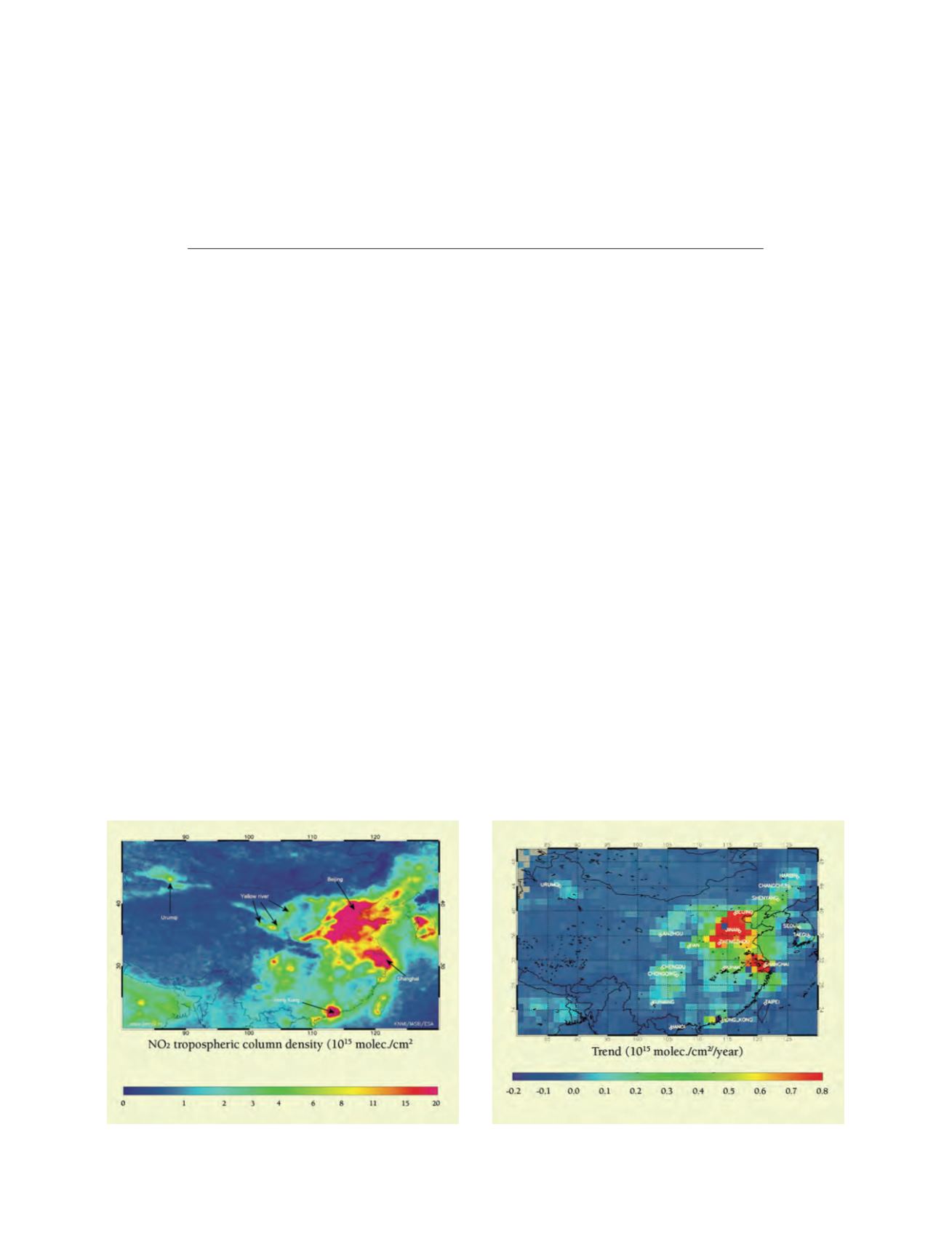
The yearly average tropospheric NO
2
density measured by
SCIAMACHY for 2004. High values are measured above the major
cities. The industrial area around the yellow river (Huang He) is also
noticeable and highlights the river stream
Source: KNMI
Trend of the NOx concentration over China for the period March
1996 – November 2005
Source: KNMI