



 164 / 218

[
] 162
• Continuous supply of its satellite data and products free
of charge via the EUMETCast dissemination service
• Providing AMESD with support in the maintenance and
upgrading of receiving stations and equipment
• Continuing its training programmes for African National
Meteorological and Hydrological Services personnel
• Providing managerial support to the committee in charge
of supervising the project
• Offering, through its biennial African User Forum, an
opportunity for the African user community to meet,
discuss and exchange information and ideas about AMESD
and EUMETSAT data and products.
AMESD’s plan for securing sustainable development
The AMESD programme has four main areas of focus:
• Providing the African user community with better access
to Earth observation, field and ancillary data, as well as
the infrastructure, local capacity and services necessary
to sustain long-term environmental monitoring
• Setting up operational regional information services to
support and improve decision-making in environmental
management. AMESD will focus on five themes as
requested by the Regional Economic Communities:
– Water resources management in the region of the
Communauté Economique et Monétaire de l’Afrique
Centrale (CEMAC)
– Crop and rangeland management in the region of the
Southern African Development Community (SADC)
– Land degradation and desertification mitigation, and
natural habitat conservation, in the region of the
Intergovernmental Authority on Development (IGAD)
– Marine and coastal management in the region of the
Indian Ocean Commission (IOC)
– Agricultural and environmental resource management
in the region of the Economic Community of West
African States (ECOWAS).
• Establishing national, regional and continental environmental
information processes, frameworks and activities enabling
African governments to meet their obligations regarding
international environmental treaties more effectively and
participate in strategic global environment surveillance
programmes such as Europe’s Global Monitoring of the
Environment and Security (GMES) initiative and the Global
Earth Observation System of Systems (GEOSS)
• Organising specialised training and staff exchange
programmes to maintain the technical capability of African
AMESD stakeholders in the long-term, with the aim of
ensuring self-sufficiency.
AMESD: a continued support from the European
Commission
The European Commission is supporting the use of Earth
Observations technologies for the operational monitoring of the
Environment in Africa since many years. Following the funding
of the PUMA project in 2001, the European Commission will
finance AMESD at a level of 21 Millions of Euro from the
European Union’s European Development Fund (EDF).
AMESD’s key players
The programme’s principal partners include the European
Commission, EUMETSAT, the Commission of the African Union,
the five participating African Regional Economic Communities
(CEMAC, SADC, IGAD, ECOWAS and IOC) and the Secretariat
of the African, Caribbean and Pacific Group of States (ACP).
AMESD will be presided over by a programme steering
committee, which will supervise the initiative’s implementa-
tion. This will be comprised of representatives of the regional
economic communities, the ACP Secretariat, the delegated
regional authorising officer nominated by the Commission of
the African Union and his/her deputy, as well as representa-
tives of the European Commission, the World Meteorological
Organization and EUMETSAT.
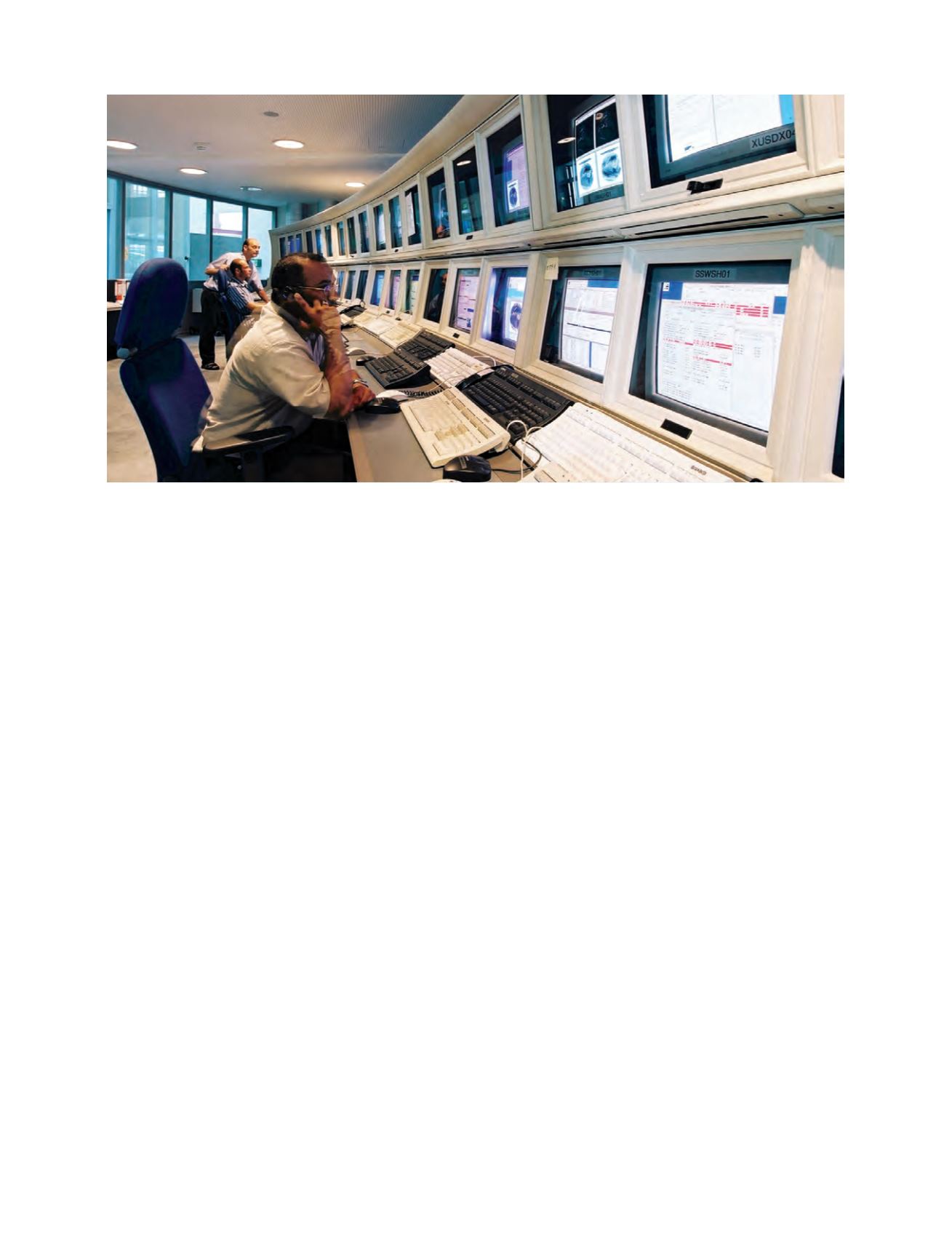
The Meteosat Transition Programme (MTP) control centre in EUMETSAT headquarters, Darmstadt, Germany
Photo: Copyright EUMETSAT