



 159 / 218

[
] 157
Once the forecast is given at the COFs the responsibility
for dissemination is left to the national, provincial and local
governments. Often training is minimal, funding is low, and
forecasts get caught up in the bureaucratic process. By the
time they have reached the end user they are incomplete or
too late. Radio has been identified in many studies as a
primary source of forecast delivery; however, workshop
participants pointed out an inability for listeners to ask ques-
tions or receive clarification. The most effective
communication method will constitute a two-way process
with active participation from the end user.
Often, the form of the forecast offers little help to the recip-
ient. In some cases, the information may conflict with
indigenous methods and can be met with distrust. The prob-
abilistic forecasts offer no information on temporal
distribution of precipitation. Many farmers are accustomed
to the accuracy and detail of the ten-day updates they regu-
larly receive from NMHS, and expect similar detail for the
seasonal forecasts. Other times the spatial scale may be inap-
propriate and require adjustment. There have been cases
where NMHS have waited until the season started to scale
down the forecast for fear of being incorrect. Training must
be available at all levels of the dissemination process.
These results, though preliminary, offer insight for future
research. The main objectives of future studies should be to
support and enhance existing successes while improving fore-
cast design, communication, and training for both users and
producers. A need exists to tailor forecasts based on the specific
requirements of national agencies and smaller user groups. More
effective means of mass communication need to be developed,
including sensitising the media to act as a responsible partner
in the dissemination process. Lastly, every project should work
towards enhancing regional ownership of the processes that are
now internationally sponsored. This can be achieved by devel-
oping frameworks for regional and national funding and
identifying sustainable sources for COFs and other outreach.
The responsibility of scientists and policy makers remains to
provide the information and education necessary for the end
users to gain the most benefit from utilizing the forecasts. The
end users’ opinions, their ability to use the forecasts, and the
benefits they ultimately derive from them, should be the most
important measure of success.
the ability to ask questions regarding the forecast process, and
gain a better understanding of the terminology of the forecasts.
Other research efforts have focused on improving the process
of creating and adjusting forecasts for specific applications.
Within the health sector, new understanding of the link between
malaria and temperature and precipitation, has led to the devel-
opment of malaria forecast models. These models combine the
seasonal forecast with daily ground monitoring and allow offi-
cials to predict malaria outbreaks months in advance. In Kenya,
daily monitoring is being utilized for hydroelectric manage-
ment on the Tana River and is combined with information on
sea surface temperatures to create river flow models.
In hopes of evaluating the effectiveness of these efforts, NOAA
has engaged a team from Boston University and the
International Institute for Applied System Analysis to conduct
two research tasks. First, the team is conducting a meta-analy-
sis of the published and unpublished empirical findings from
the past decade. Second, the team is gathering feedback from
governmental and non-governmental agencies within the
region. The primary goal of the work is to organize and evalu-
ate the results around a set of thematic issues present at both the
top and bottom of the process. Within each issue they will
describe the state of knowledge that existed prior to the start of
the NOAA programmes. Next, the methodologies of the
research are examined and presented alongside the results,
allowing the reader to assess the reliability of the work. Most
importantly they are attempting to identify gaps in the current
state of knowledge, which will provide a stimulus for future
research. The purpose is not to answer definitively the ques-
tions associated with these issues, or promote application in
any particular sector, but to offer a neutral assessment for
policy-makers.
The preliminary findings have shown common achievements
and setbacks through nearly every sector. The majority of
successful applications occur where end users have a high level
of education, regular exposure to the forecasts, or work in a
sector with well-established links to climate scientists. But it is
clear that knowledge of the forecasts is not limited to the
educated. Media coverage of the 1997-1998 ENSO events drew
widespread attention to the existence of the forecasts; however,
the amount of use among less educated groups is limited due
to issues with communication and dissemination.
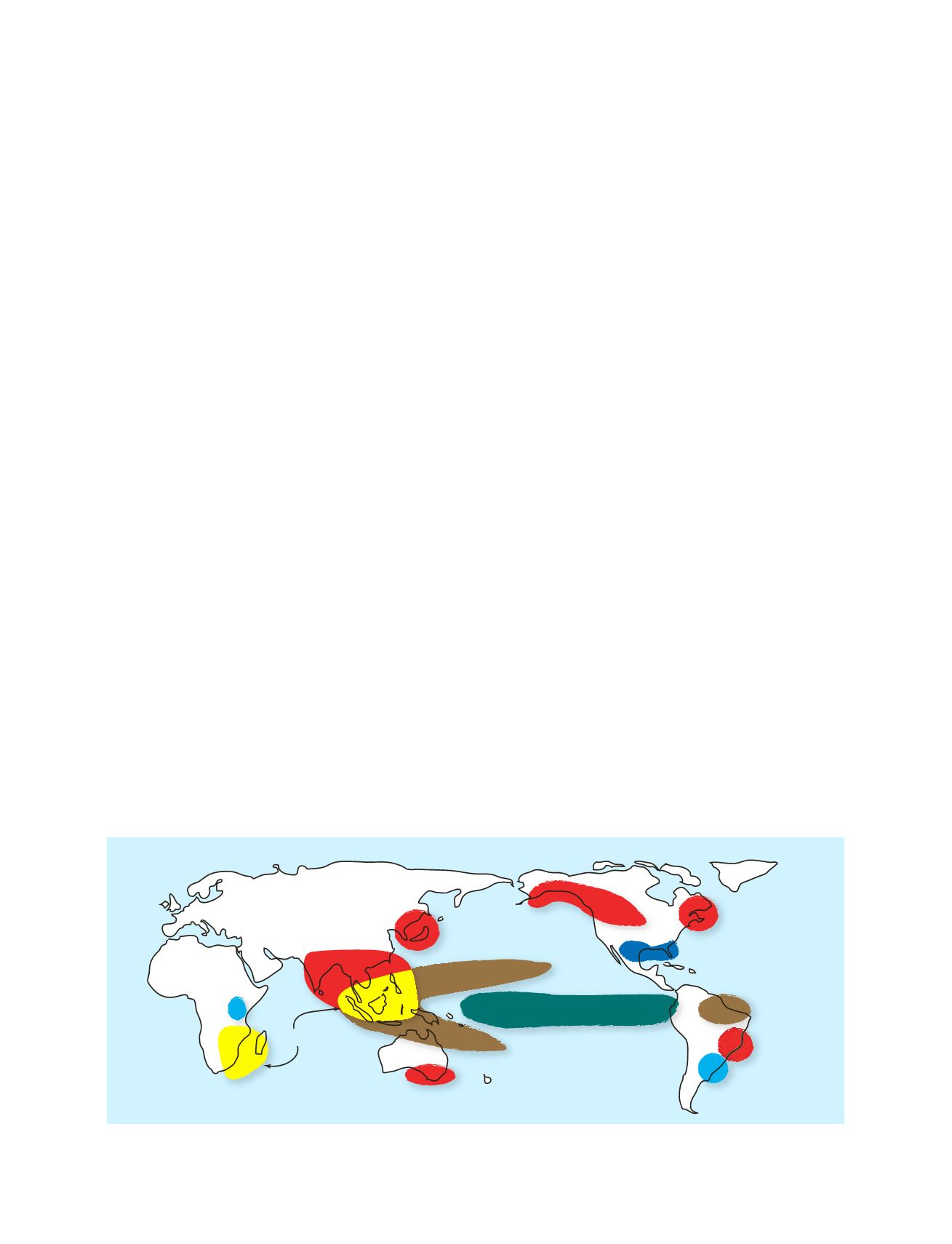
Global effects of El Niño, showing conditions over Africa
Wet & Warm
Wet
Wet
Dry
Dry
Dry & Warm
Warm
Warm
Warm
Warm
Warm
Dry
Wet & Cool
Warm
Source: IRI