



 162 / 218

[
] 160
S
UB
-S
AHARAN
A
FRICA
is home to many of the world’s
developing nations – and to some of its poorest, for
whom life is precarious. Crop failure, environmental
degradation and increasing competition for scarce natural
resources caused by extreme weather events and climate
changes are posing unprecedented threats to economies, liveli-
hoods and traditional ways of life.
Weather forecasting capabilities across the continent have
been greatly enhanced in recent years by initiatives such as
Preparation for the Use of MSG in Africa (PUMA), the first
pan-African technology project focusing on Earth observation
funded by the European Union. PUMA has made available data
and products from the latest satellites of the European
Organisation for the Exploitation of Meteorological Satellites
(EUMETSAT), enabling African National Meteorological and
Hydrological Services (NMHS) to provide accurate weather
forecasts, monitor extreme weather events, improve disaster
management and forestall drought and starvation.
The African Monitoring of the Environment for Sustainable
Development (AMESD) initiative takes PUMA a stage further
by significantly extending the use of remote sensing data to
environmental and climate monitoring applications. AMESD,
in which EUMETSAT also plays a key role, is financed out of
the European Union’s European Development Fund. Like
PUMA, AMESD is an international cooperation project with
the objective of providing all African nations with the resources
they need to manage their environment more effectively and
ensure long-term sustainable development in the region.
The European Union’s strategy for Africa
Peace, security and good governance are prerequisites for
sustainable development in Africa. Accordingly, the European
Union’s strategy for Africa addresses actions in areas that are
critical to creating the necessary environment for economic
growth, stability, trade and infrastructure. In particular, the strat-
egy promotes investment in sectors which impact directly on
the United Nations Millennium Development Goals (MDGs).
These goals aim to eliminate poverty, promote sustainable devel-
opment and improve the health, education and well being of
the world’s developing and impoverished nations.
Earth observation technologies have been identified as vital
tools in the MDGs’ pursuit of sustainable development, espe-
cially with regard to the environment. AMESD is, therefore,
expected to play an essential role in the implementation of the
European Union’s strategy for Africa.
AMESD would also be the precursor of the extension of
Europe’s Global Monitoring of the Environment and Security
(GMES) initiative to Africa, as requested by key African deci-
sion-makers in the Maputo Declaration signed on 15 October
2006 at the seventh EUMETSAT African User Forum in
Mozambique.
AMESD builds on PUMA’s success
PUMA laid the groundwork for AMESD by providing the
NMHS of all African countries with the equipment, training
and support required for receiving the latest space-based
images and products from EUMETSAT via the EUMETCast
distribution system.
In creating a successful pan-African network with opera-
tional access to state-of-the-art satellite technology, PUMA
provided each country with the means to develop their own
applications with the potential to enhance quality of life
The African Monitoring of the Environment for
Sustainable Development Initiative: a timely
initiative to save an endangered continent
Paul Counet, the European Organisation for the Exploitation of Meteorological Satellites
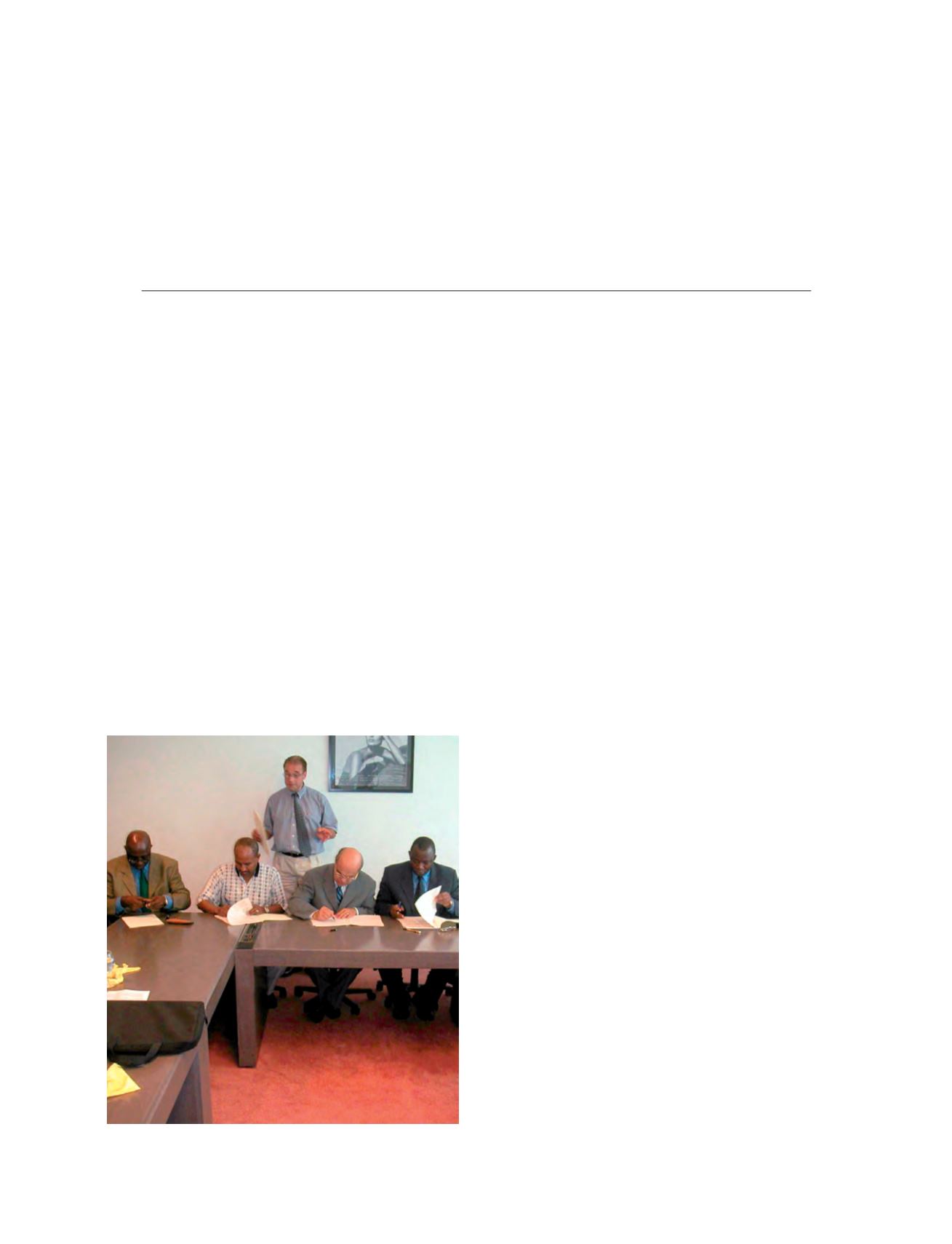
Signing of the Dakar Declaration, 29 September 2002
Photo: Copyright EUMETSAT