



 172 / 218

[
] 170
Prior human ecology/climate studies
–MEPA conducted several
studies on the conditions of the nomads over the last two
decades of the twentieth century. One of these was
Environmental
Support of Nomads
(ESON), a pilot study conducted from 1994
through 1997 in close collaboration with the Office of Arid Lands
Studies of the University of Arizona. The objective of the study
was to provide information to Nomads and other pastoralists
that would assist them to use the marginal range resource in a
sustainable and economically viable manner. These studies were
conducted to investigate the situation of the Bedouin nomads
in the Kingdom, including their socio-economic, cultural, and
geographical aspects. The ESON study culminated in the publi-
cation of a major work clarifying the condition of the nomadic
population in the pilot study area, and suggested areas where
MEPA might concentrate further efforts to improve the sustain-
ability of the Bedouin culture.
Ongoing PME activities
Having conducted studies on Nomads in the past (as MEPA),
and with an improved understanding of the needs of the
nomads, the PME is undertaking a number of major initiatives
intended, to assist the condition of the nomads. Some of these
activities are listed below.
Human ecology
– Starting in 2007, the PME will be under-
taking a national programme of human ecology and urban
development in the Kingdom of Saudi Arabia. Based on the
second article of the Saudi Environmental Law, PME has been
given responsibility for environmental planning related to
industry, agriculture, urban development and other matters.
According to article ten of the Saudi Environmental Law, the
national programme of ecology and urban development will
be responsible for the environmental planning, management,
and conservation of rural and urban areas in the Kingdom.
Public awareness
– The Kingdom of Saudi Arabia recently
announced the opening of a first ever environmental televi-
sion channel. A public-private partnership, this channel will
be broadcasting general items of concern about the environ-
ment, including meteorology and climatology. This soon-to-be
pan-Arabian channel is now broadcasting throughout the
Kingdom, and demonstrates a commitment to get information
from the PME to users throughout the Kingdom.
Cloud seeding
– Understanding the paucity of water in the
peninsula, the Kingdom continues to undertake experiments
in cloud seeding to optimize the geography and timing of deliv-
ery of precipitation to rural areas. Previous experiments on
cloud seeding were in the Abha area in 1989 and 2004. This
year, experiments are being conducted in the central region of
Saudi Arabia.
Critical issues
The geographical-geological-climatological context of Saudi
Arabia includes a marginally usable resource for agriculture
and pastoralism, due to the lack of water, extreme heat, and
strong seasonal climatic variability. The socio-economic context
of Saudi Arabia includes rapid change from rural to urban habi-
tation, relative impoverishment of the rural population, and a
switch from domestic pastoral use of rangelands to more
market-oriented herding with subsequent destruction of the
environment. In order to maximize the use of the desert range-
land resources, optimization is required. This must include
aspects of rangeland management, information transmission
and sharing, and perhaps economic incentives to modify
pastoral behaviours. Since desert life is essential to the culture
of the Arabian peninsula, there is great public demand for its
preservation and extension.
Critical issues include the need to acquire, process, analyse
and disseminate climatic information, including those in the
following areas;
• Global and regional climate change
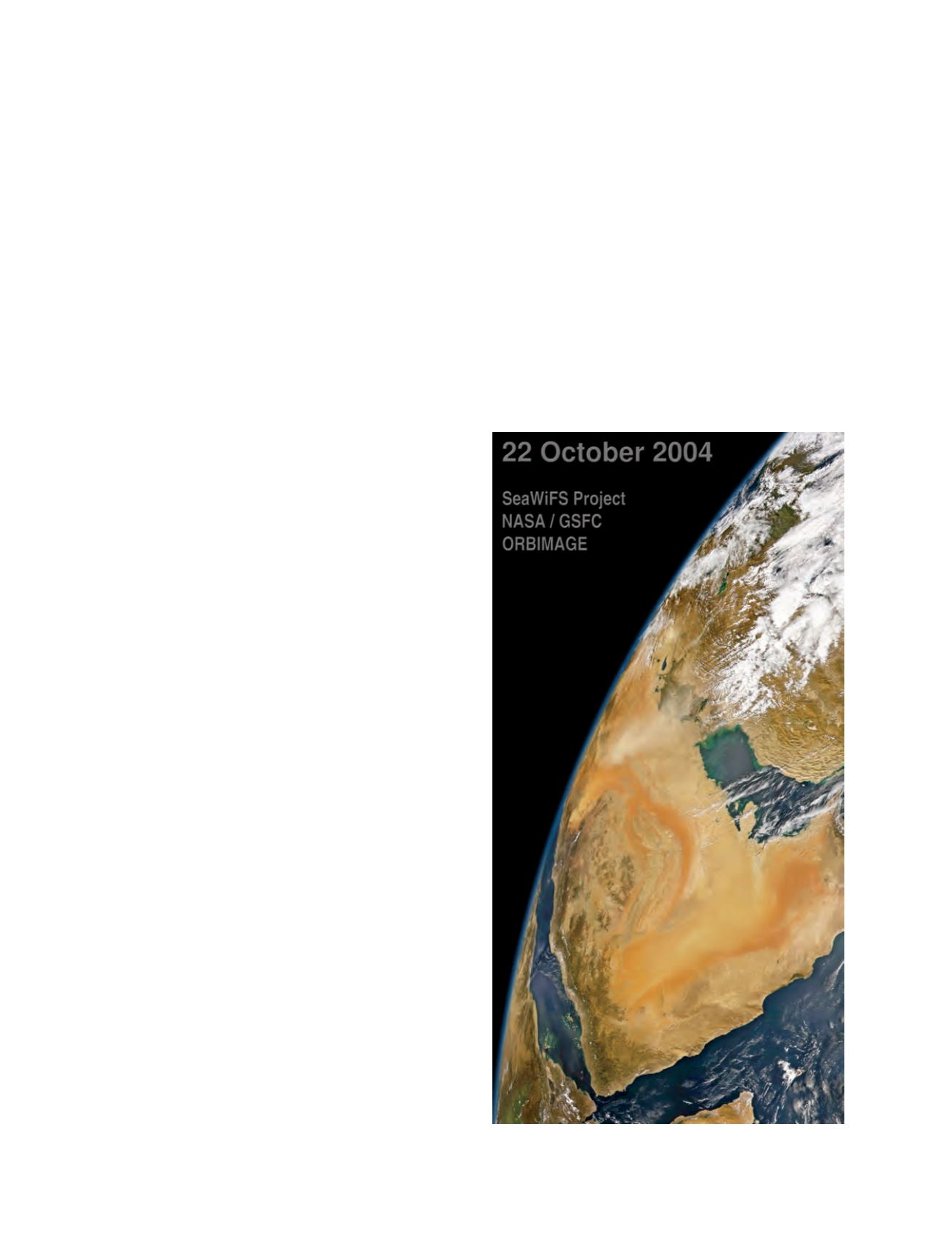
• Natural disasters: dust storms associated with “Shamal”
or northern and “Aziab” or southern winds and droughts
• Rainfall: patterns and intensities
• Agriculture and pastoralism
• Nomadic status: socio-economic, geographical, and
cultural aspects.
As indicated in the discussion above, PME has initiated projects
to facilitate acquisition, analysis, availability, dissemination,
and use of data by appropriate stakeholders at all socio-
economic levels within the Kingdom.
The SeaWiFS Project is among the initiatives supported by PME