



 181 / 218

[
] 179
E
VENTS OF
1997-1998 marked an important turning point
in the application of climate forecasts in southern Africa.
It had been known for several years that it was possible
to issue a rainfall forecast for the summer growing season up
to six months in advance, based on the developing under-
standing of the statistical relationship between the El
Niño-Southern Oscillation (ENSO) and rainfall patterns over
the region. But making these forecasts is an imprecise art, and
the development of several competing forecasts had led to
confusion among decision makers over which forecast to trust,
and what actions to take in response. In 1996, key players in
the early warning community for the region began to plan for
a single regional consensus forecast. This was to be followed
by the National Meteorological and Hydrological Services
(NMHS) issuing national forecasts consistent with the regional
forecast, with the forecasting community taking a proactive
role in communicating these predictions to users. With support
from several international donors, including the United States
National Oceanic and Atmospheric Administration (NOAA),
the Southern Africa Drought Monitoring Centre hosted the
first Southern African Regional Climate Outlook Forum
(SARCOF) in Kadoma, Zimbabwe, in September 1997.
The participants at the 1997 SARCOF had something impor-
tant to say. In the first half of 1997, it had become clear that an
intense El Niño was developing, suggesting the high likelihood
of drought over much of the region. By June, alarms bells were
ringing, and organizations such as the Famine Early Warning
System (FEWS) began to track the development of sea surface
temperatures. Participants at SARCOF issued a forecast of a
high probability of drought for much of the region. Over
Zimbabwe, for example, the prediction for the important
January-February-March rains was of a 50 per cent chance of
below normal rains, a 35 per cent chance of near normal rains,
and a 15 per cent chance of above normal rains. The media
reported that the ‘mother of all El Niños’ was developing, and
warned of catastrophic crop failures to come. Many subsistence
farmers then restricted their planting to a small area of their
fields, either by choice or because they were unable to obtain
credit. When summer rains fell that were in the near normal
range, there was widespread criticism of the NMHS, namely
that they had misled people into taking inappropriate actions,
leading to a lower harvest than would otherwise have occurred.
Potential value of forecasts to farmers,
and barriers to adoption
In the months and years following these events, a number of
studies suggested that forecasts could be of use to farmers if
used correctly. Farmers could optimize across the range of seed
varieties – trading off potential yield for water requirements
and growing season length – and by changing the crop density,
the time of planting, and the application of fertilizer. At the
same time, however, these studies suggested that a number of
factors prevented farmers from making these optimal choices.
First, farmers may not trust the forecasts, based on their expe-
riences in past years. Events in Zimbabwe following the
1997-1998 season, and in Brazil following a similar experience
in the early 1990s, suggested that a perceived error of one fore-
cast could lead to lower trust for years to come, and an
Evaluating the value of seasonal climate
forecasts for subsistence farmers:
lessons from NOAA applications
research in Zimbabwe
Anthony Patt, International Institute for Applied Systems Analysis, Austria
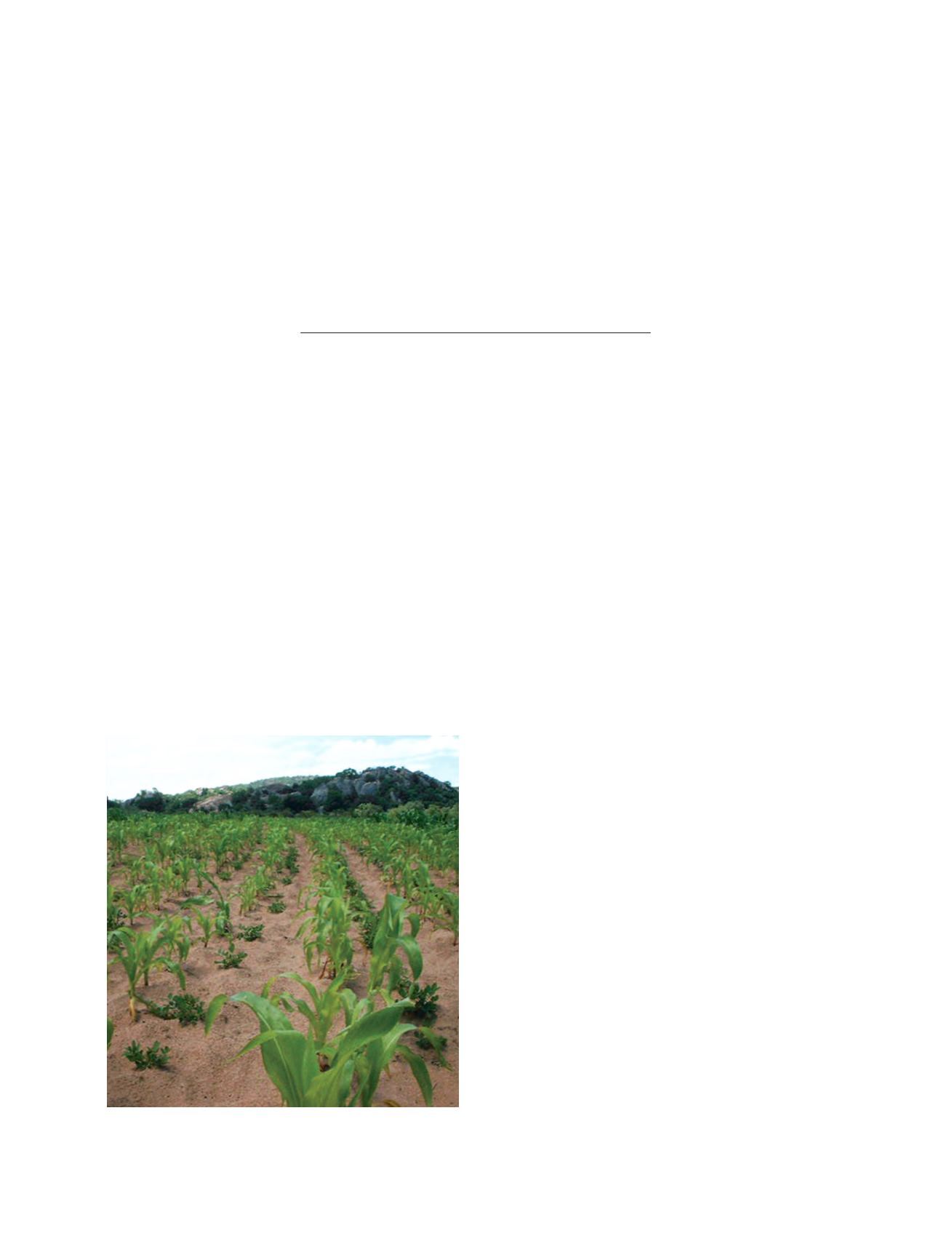
Seasonal climate forecasts can help subsistence farmers plant
appropriate crops, such as short-season maize and groundnuts
Photo: Anthony Patt