



 187 / 218

[
] 185
conducive to transdisciplinary research that includes experts
from meteorology, hydrology, statistics, decision science,
economics, psychology, sociology, anthropology, geography
and other communities. Such research would benefit from the
greater engagement of users. Participatory research methods
have received considerable attention in the climate change
adaptation community
14
and are no less relevant for weather
information over shorter timescales.
Relative to the academic and professional communities,
NMHOs will have an equal if not greater role to play in guiding
the next generation of studies – one that goes beyond the
provision of financial support necessary to advance theory,
methods and techniques. A significant but latent potential of
this research lies in its ability to shape the future and planning
context of NMHOs. Understanding the value of providing
hydrometeorological and climatological information could be
a fundamental input to measuring and improving services or
making critical decisions with respect to the application of new
technologies and changes to existing monitoring networks,
observation strategies, communications, computer infrastruc-
ture, human resource management and priorities for research
and development.
Instead of only using ad hoc valuation studies to justify
past investments, NMHOs could incorporate a more system-
atic, strategic and long-term approach to designing,
conducting and applying societal and economic valuation
research. This is a substantive shift that will involve devel-
oping an internal capacity that is closely integrated with the
academic and professional research communities. Advances
being made in Canada,
15
the United States, and elsewhere
through WMO programmes such as THORPEX,
16
are encour-
aging. Hopefully, in hindsight ten years from now, we will be
able to admire and measure our tremendous foresight in terms
of saved lives and user benefits – however, much remains to
be done.
For all of the past improvements in weather forecasting,
achieved through the development of numerical modelling and
investments in global observations, telecommunications,
science, and forecaster training,
1
one is left wondering whether
a concomitant degree of value has been imprinted on society.
This may be because, until recently, the societal and economic
value and use of weather information has been under-studied,
rarely measured, and often assumed to exist by those purport-
edly funding or conducting societal problem-oriented
atmospheric research.
2
A small but growing body of literature
has emerged over the past 40 years to address this significant
need by documenting and estimating the use and value of
weather information.
In
Economic Value of Weather and Climate Forecasts
, Katz and
Murphy provide one of the most critical and comprehensive
collections of referenced work and critique a wide spectrum
of methods available to determine economic value (e.g. contin-
gent valuation, market-based cost-loss functions, cost-benefit
analysis, etc.).
3
Elsewhere, recent examples of sector-specific
studies on aspects of agriculture,
4
energy,
5
health,
6
forestry/fire
management,
7
transportation,
8
and water resources manage-
ment
9
are complemented with broader evaluations of multiple
sectors and public or households’ willingness to pay for
weather services.
10
Such studies most often examine the value
of information that is currently received or that could be
obtained with some specified level of improvement in quality
(i.e. precision, accuracy, delivery frequency or medium). Other
researchers have examined a particular component of the moni-
toring and forecast system, such as the impact of an expanded
network of Doppler radar infrastructure in Canada,
11
or
Weatheradio.
12
The future of weather-related economic valuation research will
no doubt continue to be influenced by advances in general
economic theory and applications by academics and profession-
als. The most critical necessity is an improved treatment of
assumptions concerning the decisions and behaviour of potential
users of weather information. In order to move beyond the flawed
static linear model of decision-making which assumes that more
information with greater precision and accuracy automatically
leads to better decisions and desired outcomes (reduced risk or
enhanced benefits), greater consideration of the user’s problem
and decision-making context will be required, including:
• Outcomes or consequences of concern to the user (e.g.
safety of citizens, units of production, profitability) and
associated measures (e.g. casualty rates, crop yields, etc.)
• Important relationships between weather, climate and
outcomes (i.e. source of key variables, transfer functions
or ‘events’)
• Responses or alternatives available for the user to manage
risks or take advantage of opportunities (including char-
acteristics of those responses such as tactical/operational
or strategic; frequency, duration, flexibility)
• Role of weather or climate information in current or
potential responses (i.e. how is it used; required levels of
precision, accuracy, frequency, etc.)
• User values, beliefs, and worldviews
• Organizational, socio-cultural, financial, technical, legal,
and political factors in user environment that may
constrain or facilitate adoption of response options.
This type of understanding is not neatly contained within one
academic silo
13
– a key challenge is to foster an environment
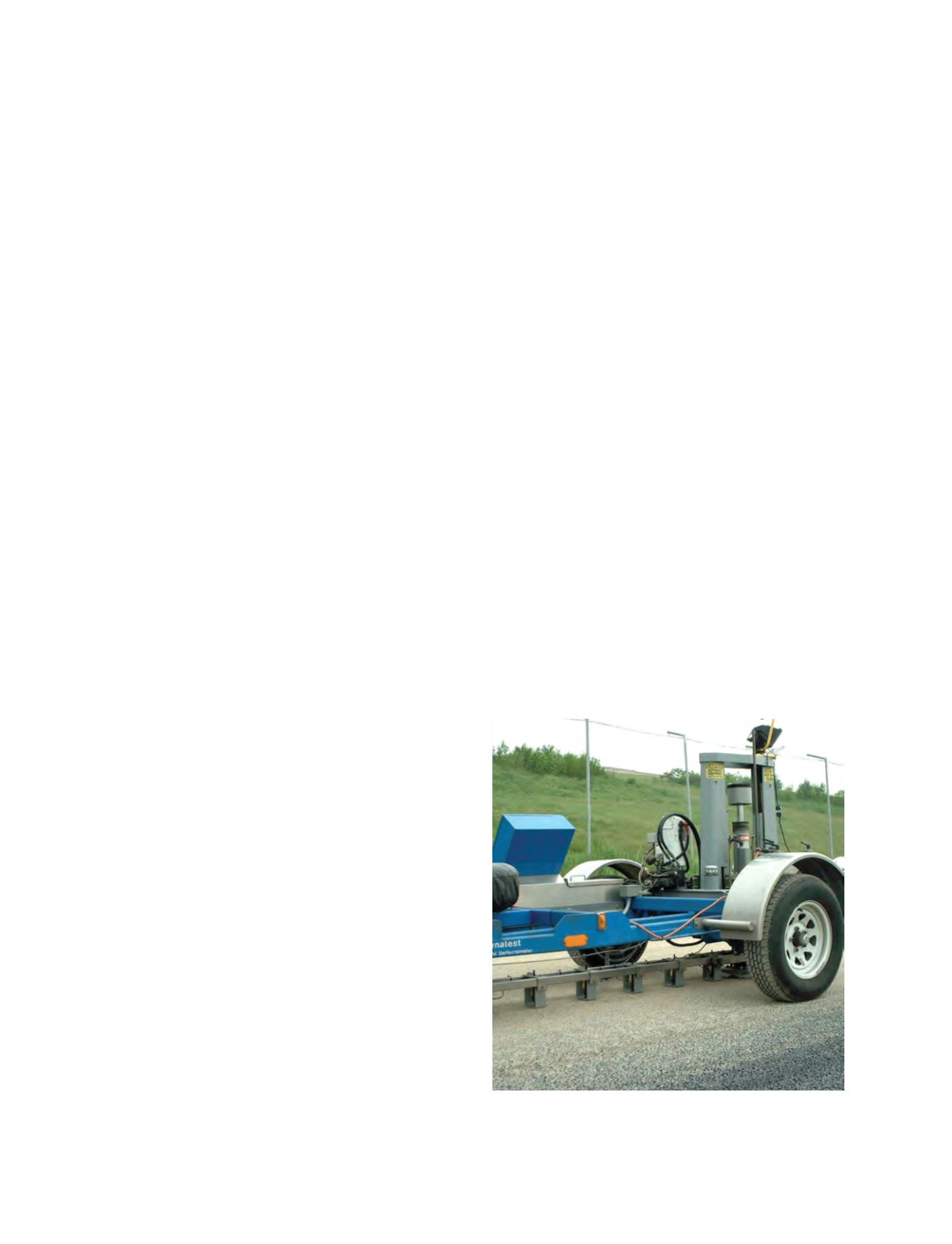
A Falling Weight Deflectometer is used to assess the strength of a road.
Weather information is important for calibrating such instruments and
in predicting seasonal weaknesses in pavements
Photo: S. Tighe