



 61 / 218

[
] 61
developing a five year strategic plan for disaster mitigation and
management of the agricultural and food sectors as a part of a
comprehensive disaster management (CDM) strategy.
17
Food
and livelihood security in the face of natural disasters is the
key to the CDM strategy.
Other efforts in the mitigation of disaster management
include the development of flood plain maps for some
Caribbean territories through the Japanese funded Caribbean
Disaster Management project.
18
CIMH was one of the key insti-
tutions involved in the production of these maps. It is expected
that this activity will be expanded to vulnerable areas in all
Caribbean countries.
Five year strategic plan for
agrometeorology in the Caribbean
CIMH is developing a strategic plan for agrometeorology in
the Caribbean. In the light of the erosion of preferential
markets, the need to diversify agriculture in the Caribbean, the
greater emphasis being placed on food security, and the chang-
ing patterns of the Caribbean climate, it is imperative that
meteorology play a greater role in agriculture than it has in the
past. The main aim is to provide valuable products and infor-
mation to the farming, decision-making and policy
communities in an effort to develop sustainable forms of agri-
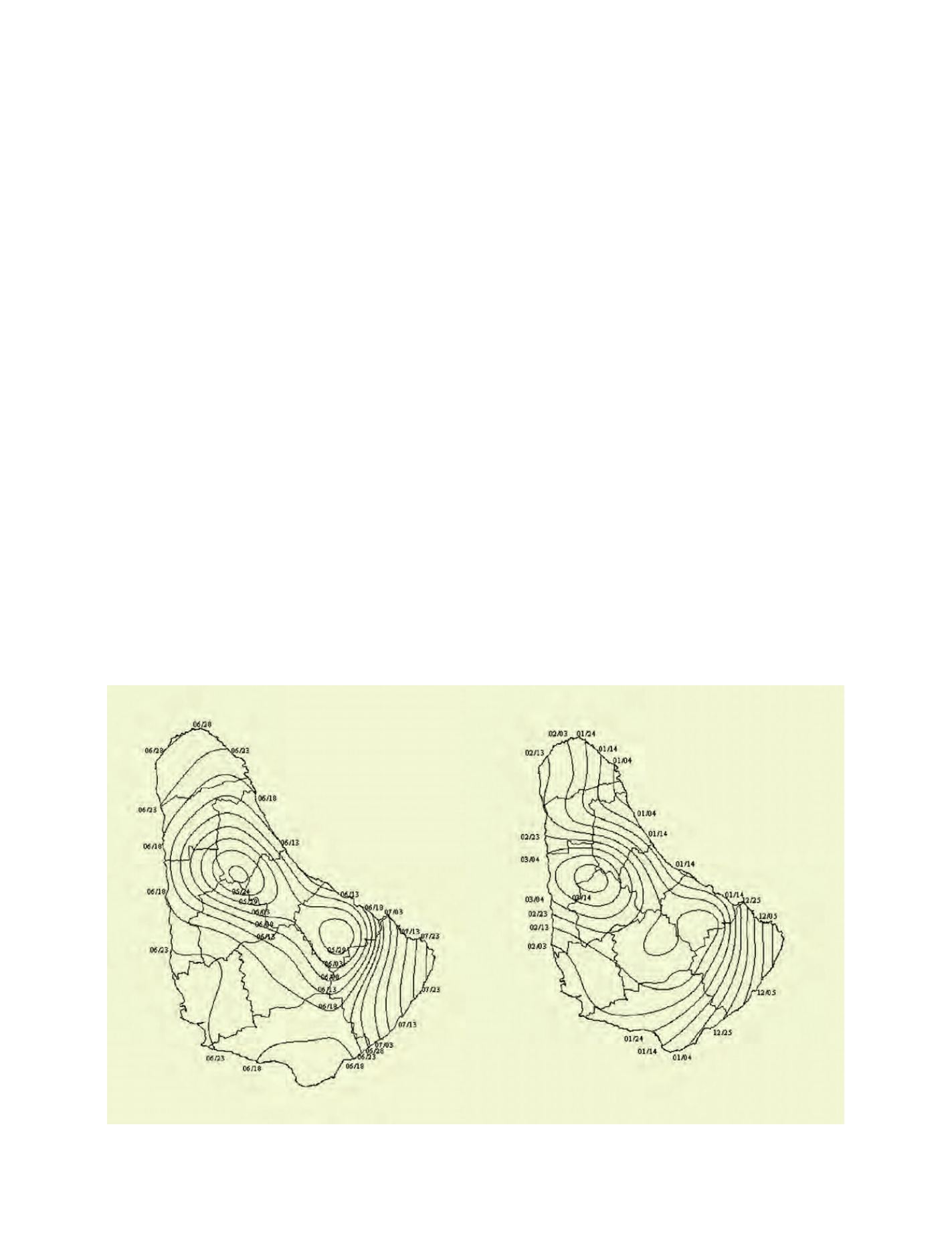
culture in the region. The figure below, which shows the
beginning and end of the rainfed growing season of hot peppers
in Barbados, is an example of such products. This illustrates
that planting and harvesting of the pepper crop under rainfed
conditions would be better at different times according to the
location of the farm. Important in the strategy is a proposal to
revamp the focus of meteorological services to tailor informa-
tion and products for the productive and supportive sectors
like agriculture and water resources. Capacity building in the
meteorological services and agricultural institutions is a key
component of the strategy. CIMH has a wealth of experience in
the region in capacity building.
The main achievements expected by the end of the five-year
period (2007-2012) are:
• Trained personnel in meteorological services and key agri-
cultural institutions in agrometeorology
• Dialogue and collaborative links developed between
national and regional institutions
• Links developed with national and regional projects with
agrometeorological implications such as MACC and
GECAFS.
• Expansion of the network of persons within the collabo-
rative and dialogue forum CarAgMet
19
• Improved agrometeorological databases and data collec-
tion networks
• Pilot study sites using agrometeorological information that
can be used as examples of the benefits of such informa-
tion. Proof of concept will be illustrated mainly through
cost-benefit analyses and social improvements.
CIMH will be the regional institution implementing the strat-
egy and will be engaging key regional stakeholders such as the
Caribbean Community Climate Change Centre, the Caribbean
Agricultural Research and Development Institute and the Inter-
American Institute for Cooperation in Agriculture, farmer
cooperatives and ministries of agriculture. Through its strate-
gic planning and research and development roles in projects
in the region, CIMH is poised to be one of the key regional
institutions in the revival and efficient management of the agri-
cultural sector in the Caribbean.
Start and end of the rainfed growing season of Capsicum chinense ‘West Indies Red’ in Barbados (work in progress)
Source: Caribbean Institute for Meteorology and Hydrology (CIMH)