


 63 / 218

[
] 63
Most of the world’s water – approximately 97.2 per cent –
has little potential for human use because it is salt water. This
means that just 2.8 per cent of the world’s water is potentially
useful for humans, and most of this is locked up in ice sheets
at the poles or as deep groundwater. The fresh water accessi-
ble to humans amounts to a paltry 0.26 per cent of the total
available water.
Sustainability of water resources: the issues
Even in an ideal world the natural variations in the hydrologic
cycle from day-to-day and place-to-place would result in huge
discrepancies in the amount of available water. In addition,
human impacts on the hydrologic cycle can be dramatic, and
increases in the global population have put major constraints
on available fresh water supplies. For example, the global
runoff per capita in 1970 was (on average) 12,900 metres
3
. By
1995, this had decreased to 7,600 metres
3
due to increases in
the global population. This is still a lot of water, but it repre-
sents a global average, and not the amount available where the
population pressures are the greatest. Human activities can
modify the local hydrologic cycle and can seriously pollute the
water, rendering scarce water supplies unusable. Changes in
Image: NASA
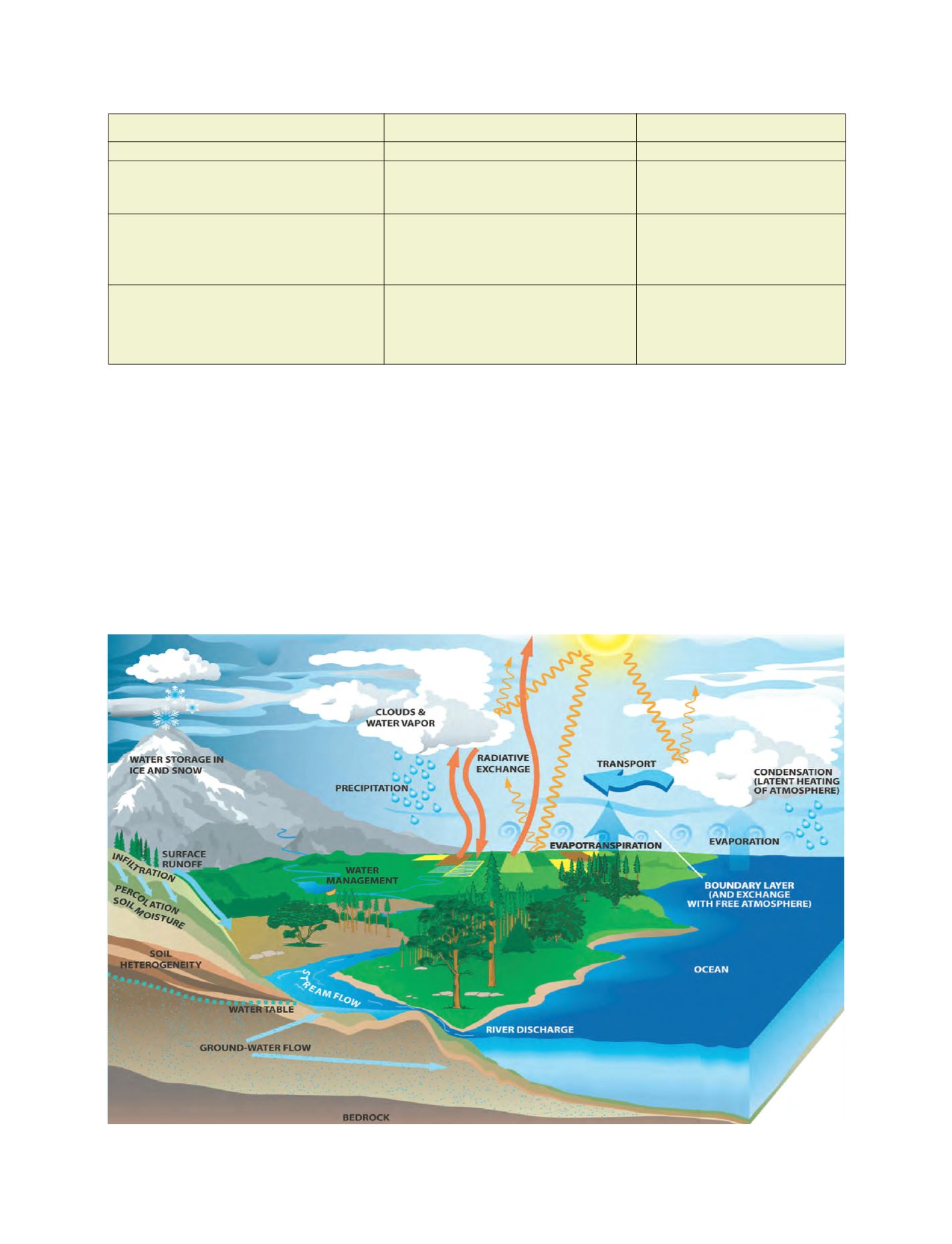
A schematic of the major features of the hydrologic cycle
The world’s water supply
Location
Volume, cubic km
Per cent
Total water
1,358,000,000
100
Oceans
1,321,000,000
97.2
Atmosphere
12900
.001
Icecaps and glaciers
29,100,000
2.15
Subsurface water
Soil moisture
66,700
.005
Ground water (near surface)
4,168,000
.31
Ground water (deep)
4,168,000
.31
Surface water
Fresh water lakes
125,000
.009
Saline lakes
104,000
.008
Rivers and streams
1250
.0001
Source: NASA