



 68 / 218

[
] 68
national significance of this long-term drying trend, it is impor-
tant that we move to address these knowledge gaps and to take
climate change into account in long-term planning.
When it comes to understanding and mitigating climate
change, the Bureau has a number of key roles. In the first instance,
the Bureau has a particular role in informing policy makers about
the scientific basis for climate change. Secondly, information on
historical climate variability and change is available to help
government and industry better comprehend how climate vari-
ations might affect their interests. Thirdly, the Bureau promotes
the formulation of more effective strategies to lessen the adverse
impacts and exploit the opportunities.
Regular briefings of government ministers and their advisers on
current climatic conditions and outlooks support government
planning and the development of policy priorities and responses.
The production of special statements has continued to evolve to
meet the growing demand for concise factual data relating to
significant climate anomalies or short-term weather events that
break long-standing records. These statements have also formed
the basis for press statements and briefings to external agencies.
The Bureau also collaborates with the Australian Greenhouse
Office and the Commonwealth Scientific and Industry Research
Organization to develop and implement scientific agenda on
climate change research and communication strategies for
informing governments and industry.
El Niño/Southern Oscillation and its effects
Australia’s rainfall climate consists of about three good years and
three bad years out of ten. These fluctuations have many causes,
but the most significant is the Southern Oscillation. This is a
major air pressure shift between the Asian and east Pacific regions
– its best-known extreme is El Niño. The opposite extreme is
known as La Niña.
The Bureau produces a national Seasonal Climate Outlook
every month, which gives the likelihood of warm or cool, and
wet or dry conditions occurring in the subsequent three months.
The Bureau’s coupled climate model, the Predictive Ocean
Atmosphere Model for Australia (POAMA), is used to provide
eight-month forecasts of the likely evolution of El Niño/La Niña
processes in the Pacific Ocean. The value of this modelling system
has been demonstrated in recent years, with an excellent long-
lead forecast of the decay of the 2002-2003 El Niño event, and a
successful long-lead prediction of the persistent above-average
sea-surface temperatures that prevailed through the second half
of 2004 and early 2005.
One major impact of variable rainfall and El Niño is drought.
The Bureau’s Drought Watch Service has been a key component
of national drought management since 1965. It is based on a
nationwide daily rainfall measuring network and established rela-
tionships between rainfall deficiency and the severity of recorded
drought. This information assists government, business and the
-2
-1
0
1
2
1920
1930
1940
1950
1960
1970
1980
1990
2000
Mean T Anomaly (˚C)
Year
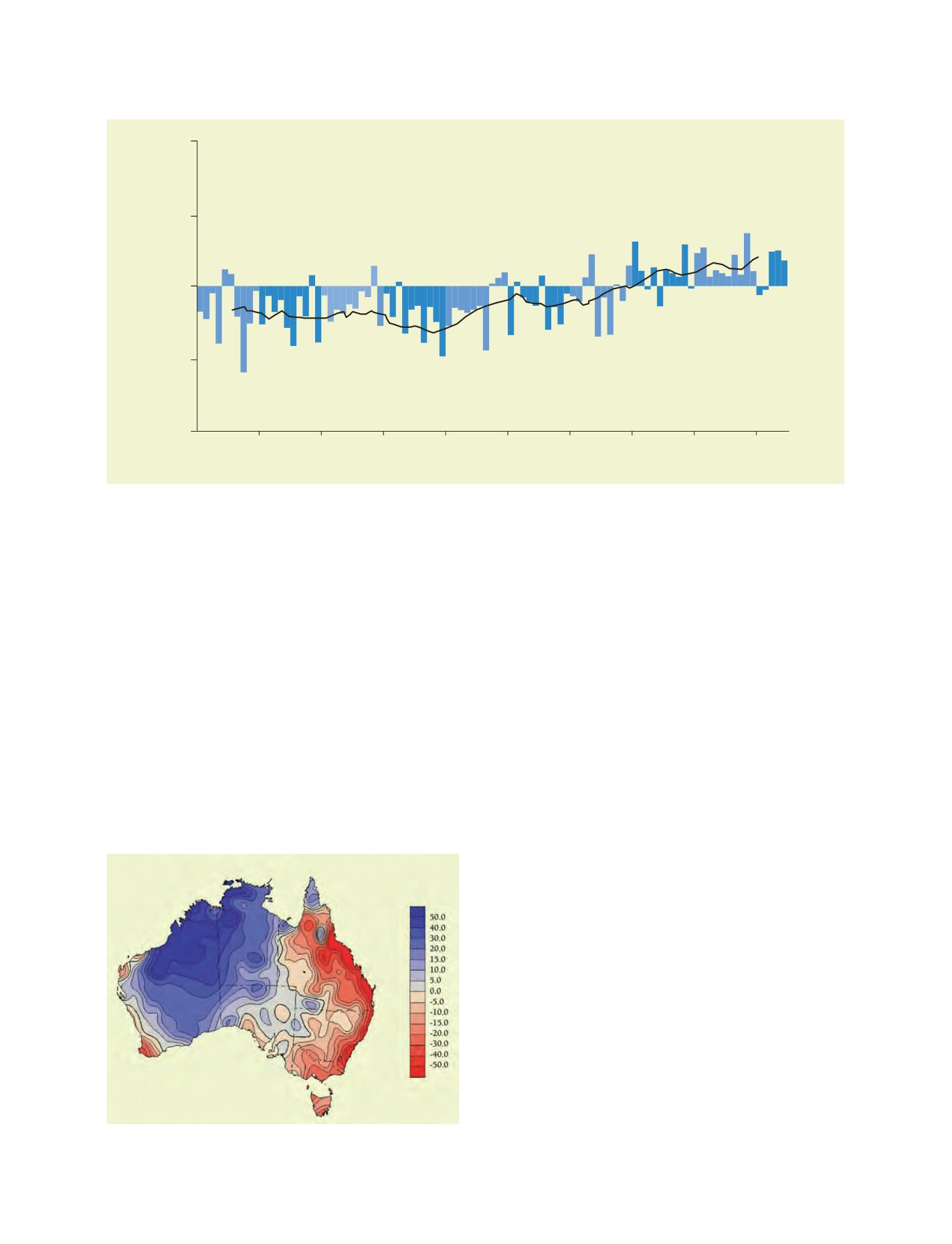
The Australian annual mean temperature (blue bar) and five-year running mean temperature anomaly from the 1961-1990 long term mean
Source: Bureau of Meteorology
The trend in annual rainfall over the interval
1950 to 2003 (in mm per decade)
Source: Bureau of Meteorology