



 74 / 218

[
] 74
S
INGAPORE IS A
small island nation located just north of
the equator. With a land area of 699 km2 and a popula-
tion of 4.4 million, Singapore has been ranked by the UN
as the 170th among a list of 190 countries in terms of fresh
water availability. This is not because of a lack of rainfall (2,400
millimeters per year), but because of limited land to catch the
rainfall. As a densely populated city, the pressure of competing
land uses such as those for industry, housing, recreation and
commerce abound. Water supply is but one facet of society
that requires the use of scarce land. Thus, there exists a crucial
need for a comprehensive planning strategy to holistically deal
with water cycle management as part of overall urban plan-
ning and management.
The development of Singapore’s local supply sources began
in the mid-19th century, with the first reservoir completed in
1867. Then known as the Thomson Reservoir, it was later
renamed the MacRitchie Reservoir. In the early years,
Singapore’s water supply came from water catchments in
protected areas, characterized by limited development and pris-
tine water. However, with economic growth and population
increase, the lack of land availability meant that the develop-
ment of water catchments in other non-protected areas had to
be looked into.
The Public Utilities Board (PUB) was set-up as a statutory
board on 1 May 1963 to take over the responsibility of provid-
ing water, electricity and piped gas from the former City
Council. PUB embarked on a programme of building estuarine
reservoirs in the 1970s, impounding a slew of mangrove
swamps and rivers to increase Singapore’s water storage capac-
ity. The 1980s saw PUB move into urbanized areas, with the
development of reservoirs that utilize storm water runoff. The
higher level of impurities in urban storm water runoff meant
that urbanized catchments were previously infeasible, but
through the advancement of treatment technologies, such
water could now be harvested.
PUB was reorganized in 2001 to become Singapore’s national
water agency, overseeing the management of the entire water
loop, from the supply of potable water, to the collection and
treatment of used water, and the management of the drainage
system.
In addressing the need to manage water resources compre-
hensively, PUB’s water management strategy includes both
Singapore integrated water management
Singapore Public Utilities Board
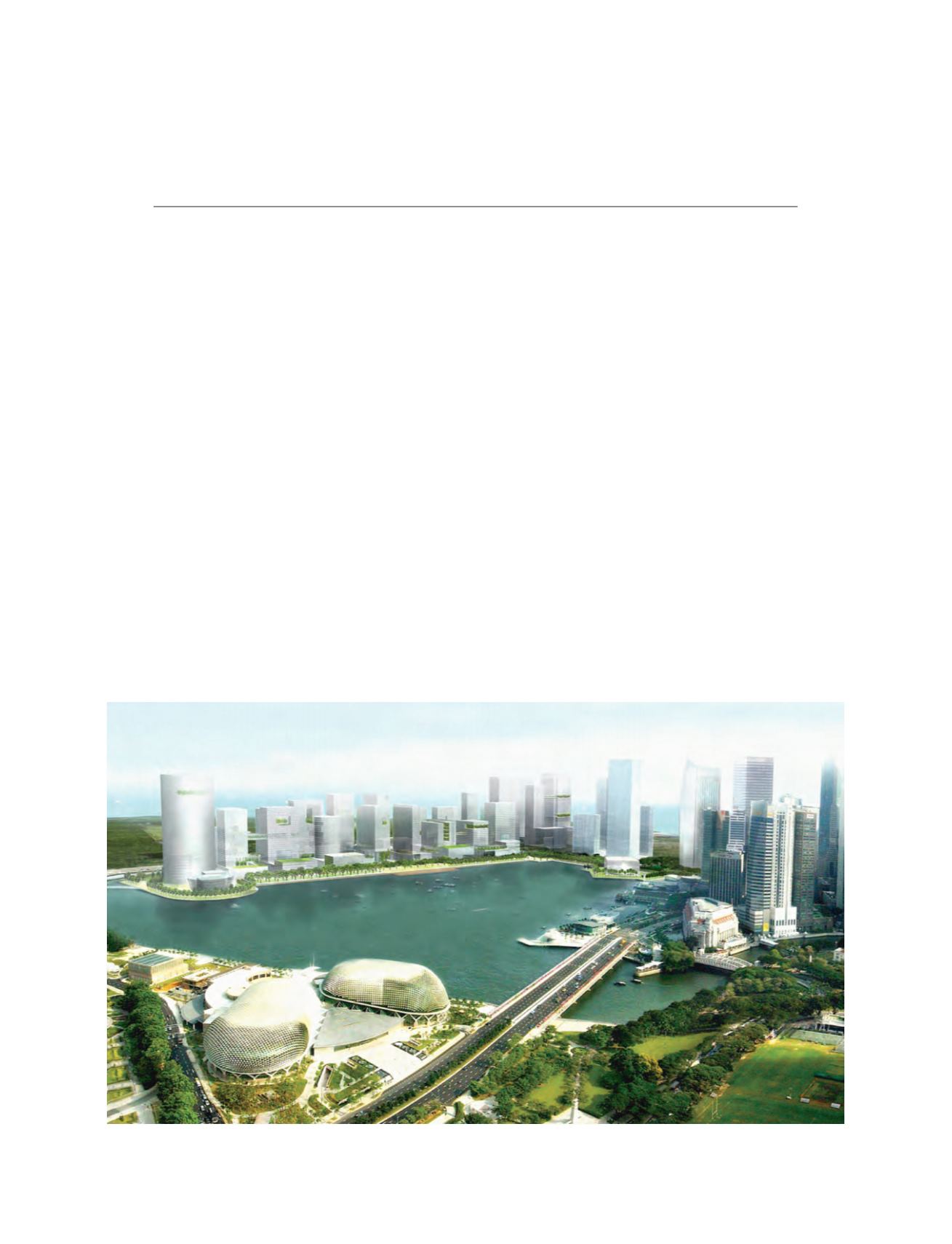
Marina Barrage: ‘the reservoir in the city’
Photo: PUB – Singapore’s National Water Agency