



 73 / 218

[
] 73
to stop subsidence with current technology. In the case of south-
ern Ping-tung Plain, the saltwater intrusion rate averages 300 to
500 metres annually. The affected area of deep aquifer was about
115 km
2
, and 85 km
2
of it was at shallow free water depth. As
a result of this intrusion, 3 billion metric tons of groundwater
capacity is regarded as unfit for drinking or irrigation.
These recent changes in temperature, precipitation patterns,
rainy days, flood intensity, drought severity and frequency,
intensity of storms, extreme weather conditions, and depen-
dence on aquifers for freshwater are all compelling indications
of the climate changes occurring in Taiwan, Province of China.
Taiwan, Province of China’s precipitation averages 250cm
per year, but with varying topography and a monsoon climate,
its rainfall is highly variable. These phenomena create great
stresses for water resource management. Water bodies are also
home to countless fish and plants, and the impact on these
ecosystems should not be ignored. Water policy planners
should not merely focus on adapting water resource manage-
ment to climate changes, but also on pervasive pollution,
depletion of groundwater supply, falling of groundwater tables
and damage to ecosystems.
It is vital that water policy makers implement simultaneous
efforts in a number of areas, including:
• Enacting and enforcing laws and regulations regarding the
sustainable use of water resources
• Investment in and development of new technologies and
processes to enable the more efficient use of existing water
resources
• The protection and preservation of ecosystems.
In conclusion, in pursuing a sustainable society, it is inarguably
necessary to create a universal environmental ethics guide to
manage not only water resources, but the environments and
ecosystems dependent upon it.
Mongolian high pressures. Climate patterns are further compli-
cated by Taiwan, Province of China highly varied topography.
The island is only 36,000 km
2
but has more than 200 moun-
tain peaks over 3,000 metres in elevation. The highest peak
reaches nearly 4,000 metres above mean sea level.
Rainfall mainly occurs during the typhoon season (from June
to September), accounting for about 60 per cent of annual
precipitation in the north and 90 per cent in the south of
Taiwan, Province of China. This uneven distribution causes
water availability problems in some areas, creating a challenge
in terms of water resource management.
Annual mean precipitation averages 250 cm and has varied
very little since the 1940s, but the amount has increased in
northern Taiwan, Province of China and decreased in southern
Taiwan, Province of China relative to the long-term average.
In the same period, however, the annual number of rainy days
has decreased significantly across the island as a whole. The
decrease was more pronounced in the southwest region than
the northern region, and exacerbated by a high runoff ratio.
The intensity of tropical storms has increased over the last
fifty years, posing flooding risk, especially in lowlands that
have experienced substantial land subsidence, and accelerating
landslides in foothill residential areas.
Typhoon occurrence in Taiwan, Province of China averaged
3.5 events annually over the last 100 years, but the ten most
severe typhoons during this period have occurred in the last ten
years. Of five droughts occurring during the last 100 years,
four were during the last 50 years.
These changes in weather patterns, together with other
factors, have had a severe impact on water resource manage-
ment. Dependence has increasingly shifted from surface water
to groundwater over the last 25 years. This change is, in part,
due to changes in seasonal distribution patterns of precipita-
tion, surface water pollution, and increased demand in water
supply.
Water quality is an equally important issue when consider-
ing water availability and strategies of water resource
management. River pollution is the top factor in reducing water
intake from surface water. Industry, agriculture, and untreated
municipal sewage discharge are major sources of river pollu-
tion. The proportional length of river considered highly
polluted has increased from less than 20 per cent in the early
1980s to about 40 per cent. As of 2002, only one third of river
length was classified as clean. Official reports showed that the
most seriously polluted rivers were found in the southern
region, where dry winters were prevalent and water was
required for irrigation and aqua-cultural practices.
Groundwater accounts for nearly one third of total water
consumption in Taiwan, Province of China. This annual
consumption amounts to 5.7 billion metric tons with annual
natural recharging rate of 4.0 billion tons. Over-pumping of
groundwater results in many environmental problems.
Twenty per cent of flood plain area, or nearly 2,700 km
2
, has
experienced land subsidence to varying degrees. Subsidence
averaged 1.9 metres and could have been up to 3.3 metres in
some areas in 2004. The groundwater tables of the 171 metre-
deep monitoring well in ShiKang have dropped at 1.2 metres
per year, totaling over 12 metres between 1994 and 2004. The
damage caused by land subsistence is extensive.
Saltwater intrusion into inland areas presents other environ-
mental and socio-economic problems when excessive pumping
of freshwater from aquifers is practiced. It is almost impossible
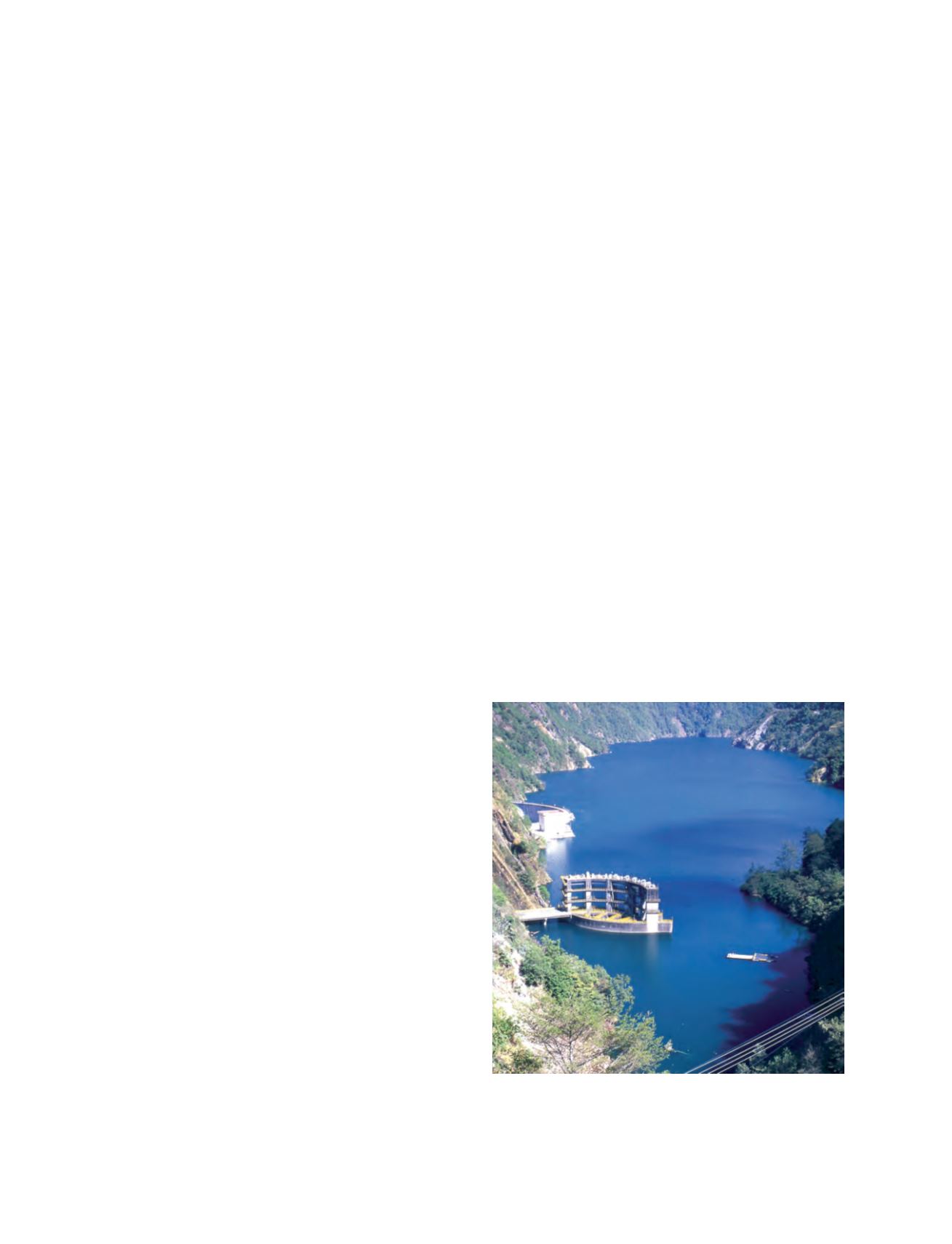
Photo: courtesy of Dong-kun LIAO
Reservoirs supply slightly less than 30% of total water consumption in
Taiwan, Province of China. Te-chi Reservoir, highest in elevation at 1,245
meter a.s.l. and one of the 49 reservoirs, was designed for electricity
generation and water supply for central Taiwan, Province of China