



 70 / 218

[
] 70
I
NAUGURATED IN
1987 on the Bafing River in Mali, the
Manantali dam controls approximately half of the river flow
downstream in the valley of the Senegal River. Shared prop-
erty of the member states of the Organisation pour la Mise en
Valeur du fleuve Sénégal (OMVS), this structure responds to
multiple goals which contribute to the sustainable develop-
ment of the sub-region.
The first challenge of the water management of the Manantali
dam is an economical one, targeting a yearly energy production
of 800GWh, guaranteed for nine out of every ten years for three
countries of West Africa: Mali, Senegal and Mauritania. But
there is also the challenge of dealing with environmental
considerations contributing to the maintenance of the ecolog-
ical equilibrium of the catchments of the Senegal River, or to
socio-economic goals such as securing and improving the
income of local populations thanks to the traditional agricul-
ture allowed into the valley. The traditional flood recession
cultures, which are sown in the ground that was submerged
once the waters have receded, will remain vital to the valley’s
inhabitants for a long time yet. Their yield depends on the
extent of the flood. The ecological equilibrium of the Senegal
valley, also linked to the annual flood and very important in
the arid context of the region, must be preserved.
The provision of drinking water for the main towns of the
sub-region including the capital cities of riverside countries
like Dakar (or neighbouring Nouakchott) is strongly related
to the optimization of dam management. Support for the navi-
gability of the river, still in progress, is also a crucial aspect of
the life all along the river.
The
Charte des Eaux du fleuve Sénégal
(OMVS- May 2002)
defines the clauses used for an interdependent, fair and partic-
ipating management of water resources. It is essential and the
reference for all actors and users of the cross boundary Senegal
River’s basin.
The water resource management of the Manantali dam is
notably based on the scheduling of water releases in order to
flood the downstream valley and consequently to allow reces-
sion cultures (traditional) which need this resource.
Additionally, the maintenance of a stable minimal water level
during the December-June period is also considered. The
amplitude of the water release which defines the potential
cultivable surfaces once the waters have receded is proposed to
the Minister Council of OMVS by the Permanent Water
Commission which brings together, on 20 of August each year,
all the stakeholders and decision makers concerned with the
catchment’s water resources.
This crucial decision leads to the scheduling of water
releases, and to sufficient flooding for permitted recession
culture surfaces which totally depend on them. These water
releases are mainly issued during September. However, the
impact of the flood on the other objectives is mainly related to
the remaining water stock at the end of the rainy season, which
is highly dependent on the targeted hydrogram during the
flooding episode. Obviously, one tries to minimize the impact
of this decision on energy production as well as on low water
level monitoring. Consequently, the potential amount of rain
during the September-October period (which is the end of the
rainy season) is a crucial piece of information for the dam
manager and the Water Permanent Commission in order to
anticipate the partial restoration of water stock into the dam
and consequently to issue a better decision for concurrent uses
of the water during the dry season (from November to May).
Seasonal forecasting in West Africa:
a strategic partnership for a the
sustainable development of a cross
boundary river catchment
Axel Julie, OMVS & JP Céron, Direction of Climatology, Meteo-France
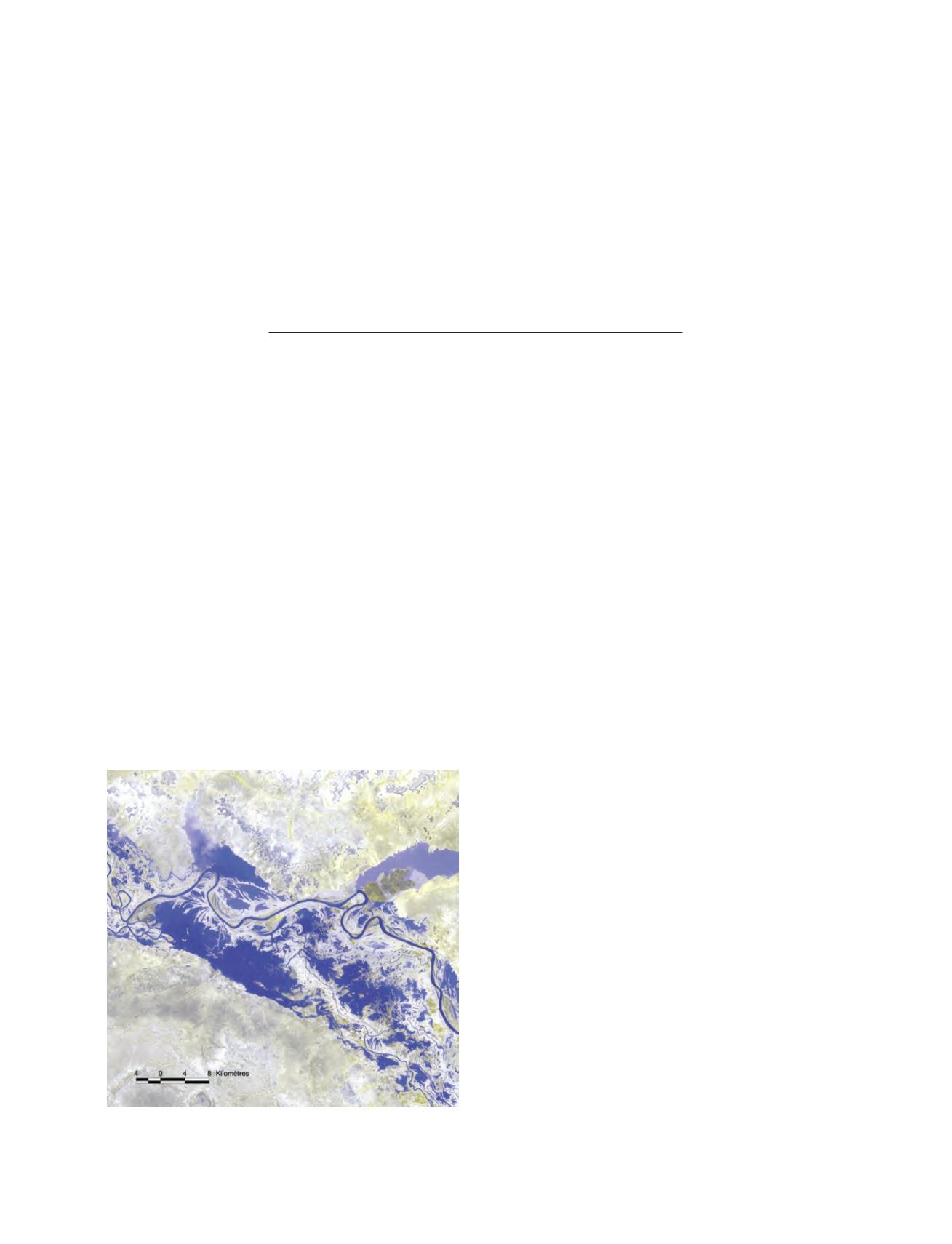
Artificial flood of the floodplain of the Senegal river in October 1999.
Region of Kaédi (Mauritania)
Photo: IRD and OMVS