


 62 / 218

[
] 62
R
ECENT SPECULATION ON
the possible past existence of
water on Mars reinforces the idea that our home planet,
with its abundance of surface water, is unique in our
solar system. So much so that Earth is known as the blue
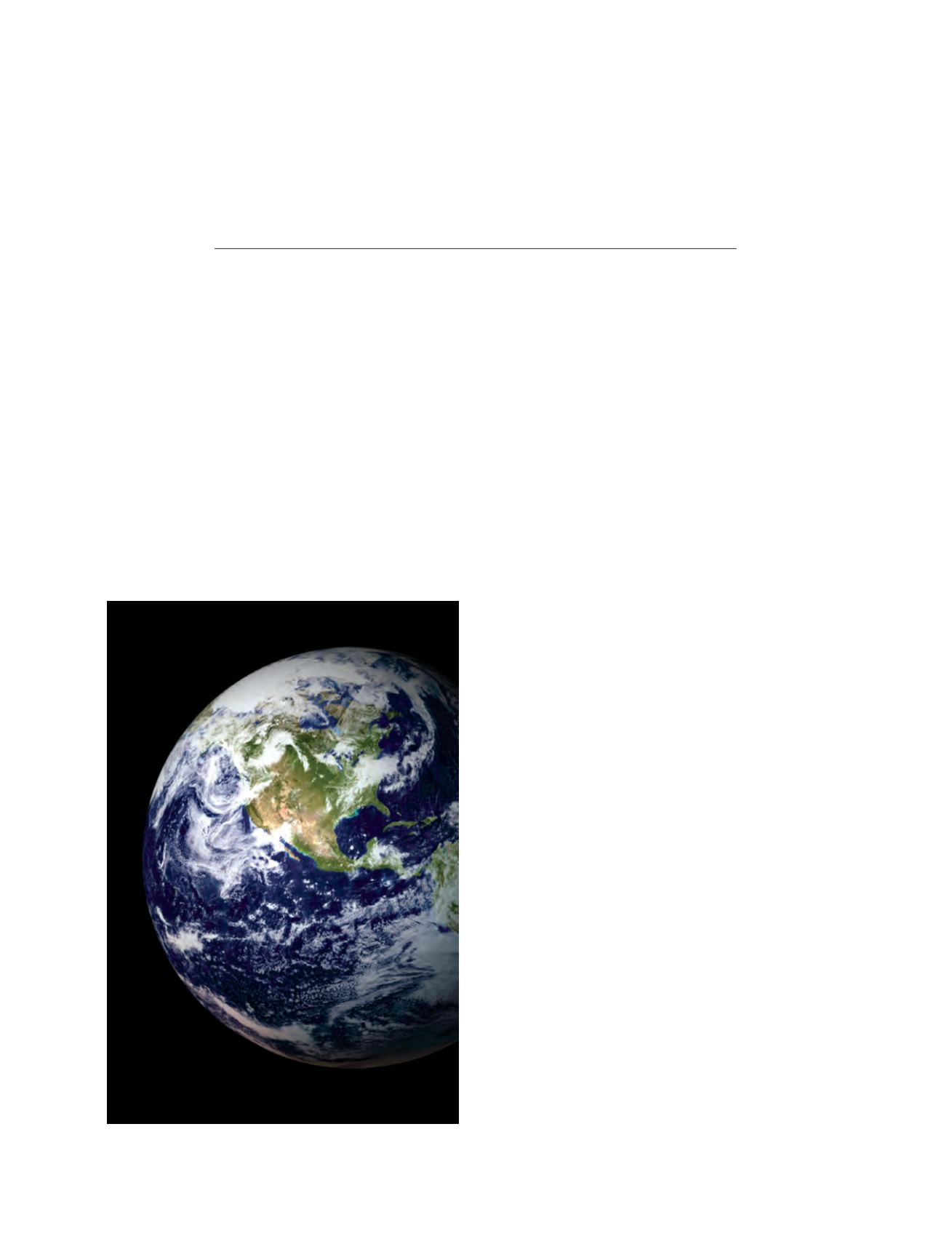
planet. Earth as seen from space reminds us of a fact we some-
times take for granted – the Earth is a world of water. These
images show that roughly 70 per cent of the globe is covered
by water. One only has to look at the land surfaces to under-
stand the regional differences in the distribution of water.
Lush green areas reflect regions of adequate water resources
and yellow-brown regions are indicative of perpetual water
shortages.
Life on Earth began in water and, other than oxygen, water
is the single compound most necessary for sustaining life. Some
simple organisms can exist without air, but none can survive
without water. Great civilizations arose around abundant water
and subsequently disappeared from the lack of it. Over millions
of years water has shaped and reshaped our planet through
glaciers, erosion, and sedimentation. In today’s society, water,
along with other nutrients, is vital to making soil suitable for
producing the food we eat; it also powers the machines of
modern technology and provides a medium for the transport
of people and goods.
What is it about water that makes it uniquely indispensable?
Water has a variety of unusual properties that help to set it apart.
As a chemical it is odourless, colourless and without flavour, as
well as being compound of unusual stability. It can exist simul-
taneously in three phases, as a gas, a liquid and a solid. When
frozen, it expands rather than contracting; contrary to almost all
other substances. It can also absorb and release more heat then
most other substances. These qualities allow for the establish-
ment of an astonishing mechanism that we call the hydrologic
cycle – an endless recycling process of the water in the Earth’s
systemwhere water is used, disposed of, purified and used again.
The water cycle is tightly linked to a global energy cycle that
distributes the sun’s radiant energy over the Earth’s surface. The
energy cycle is responsible for providing the heat necessary to
change liquid water into water vapour – evaporation from
oceans, lakes and from plants – and this heat is released during
a reverse process known as condensation-precipitation.
Consequently, weather systems in the atmosphere move enor-
mous quantities of water and energy around the globe. The
impact of the water cycle is not limited to weather. Water is a
very powerful solvent that is responsible for transporting chem-
icals over the land and into lakes and oceans. Thus, the water
cycle is linked to the other major cycles necessary for life – for
example the carbon and nitrogen cycles – and their ecosystem
functions.
A global water balance
The total amount of water on Earth has remained unchanged
for millions of years. The amount of water in various phases
however has changed over the millennia due to glacial forma-
tion and melting.
The hydrologic cycle and the
sustainability of water resources
Shahid Habib, Chief of the Office of Utilization; Stephen Ambrose, Programme Manager,
Disaster Management, Applied Sciences Programme; Fritz Policelli, Technical Manager,
Office of Science Utilization; and Ted Engman, Science Applications International, NASA
The blue planet as seen from space