



 58 / 218

[
] 58
northern Argentina and Meso America) the higher tempera-
tures have interacted with a more aggressive and unstable
precipitation pattern in recent decades. Along the Central
American-Caribbean watersheds, coffee and banana crops could
be additionally stressed if climate change leads to increasing
frequency of storms and heavy precipitation.
4
Ozone depletion
5
also contributes, in the southern part of the continent, to
increased UV levels that impair the growth of some crop species.
Higher temperatures and air humidity will affect the
geographic distribution of insect populations. Also, climate
change is shortening the time to complete life cycle of insects
and pathogenic agents causing diseases.
6
Indirectly climate
change can increase sensitivity of hosts, reduce predators and
competitors. There is some evidence that the risk of crop loss
will increase as a result of poleward expansion of insect distri-
bution ranges. Insect species characterized by high
reproduction rates are generally favoured.
7
The activity of plant fungal and bacterial pests depends on
temperature, rainfall, humidity, solar radiation and dew.
Friederich (1994) summarizes the observed relationship
between climatic conditions and important plant diseases.
8
Humid conditions lead to earlier and stronger outbreaks of
late potato blight (Phytophthora infestans), as in Chile in the
early 1950s.
9
Warmer temperatures would facilitate the shift
the of these diseases into presently cooler regions, especially
to high mountain and temperate ecosystems.
10
Farmers with limited financial resources and basic farming
systems have little adaptive capacity to mitigate or reverse
the impacts of climate change. Mitigation of global warming
impacts require efficient irrigation and water management
systems, management of pests and diseases, and strict control
of climatic risks,
11
adaptation of genetic resources (to change
crop seasonality and increase resistance to pests and diseases),
technological management of pesticides and fertilizers (to
prevent contamination of waters and foods). Some areas will
never be able to adapt to these conditions at the required
speed. Marginal agricultural populations may suffer signifi-
cant disruption and financial loss from relatively small
changes in crop yield and productivity.
12
Estimated net economic impacts of climate change on
crops are negative for several Latin American countries,
13
even when modest levels of adaptation are considered.
Argentina could be an exemption because, as a major
exporter of grain, it should benefit from high world prices
even if yields fall.
Globally, Latin America and the Caribbean will observe
important climatic changes all over the territory. Changes in
South America could be moderated by the important exten-
sion of Oceans in the southern hemisphere. Despite this,
important modification is expected in the behaviour of
climatic oscillation such as El Niño-La Niña, which may
increase climatic variability in almost all continental exten-
sions. Isotherm displacements are occurring faster than
adaptation mechanisms of natural ecosystems; this could
become a severe threat for important biomes of this conti-
nent, mainly in the Amazon basin and temperate rain forests.
The water reserves of this continent are among the most
important in the world. Modification of rainfall regimes and
the retreat of ice bodies could reduce available water in the
coming decades. Global warming will force important adap-
tation in agricultural systems, including the better use of
technology and a shift in crop seasonality.
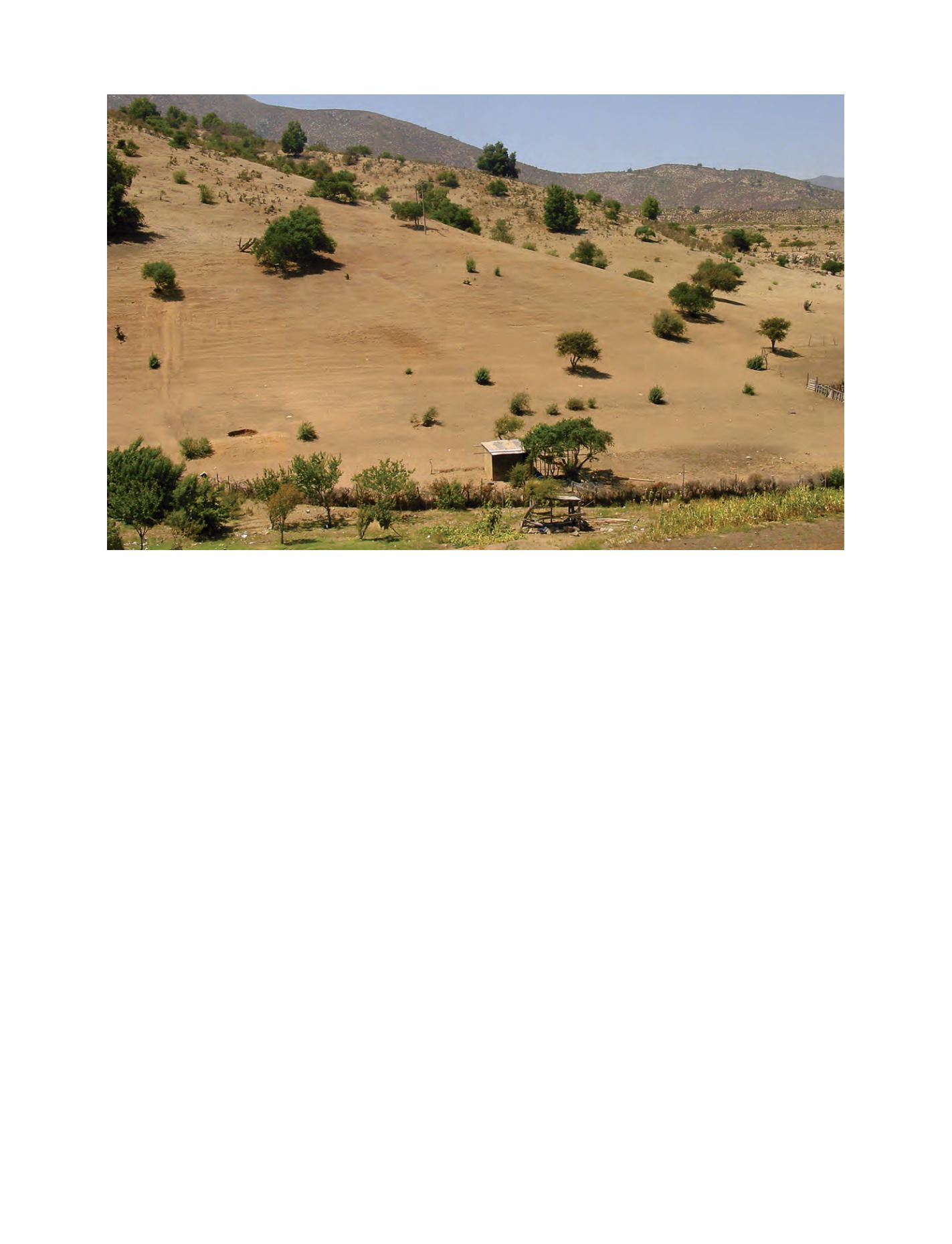
After decades of intensive cultivation, soil erosion and precipitation decrease from 150 to 100 millimeters per year, lands are abandoned provoking
poverty and migrations from the arid Steppes of the Southern border of the Atacama desert in Chile
Photo: Professor Raul Aguilera, Space Studies Centre, University of Chile