



 188 / 210

[
] 186
E
nsuring
W
ork
-F
amily
B
alance
caring responsibilities; parents with children of school age
or younger; employees with a disability; employees aged
55 or over; and employees experiencing domestic violence
or providing support to immediate family or household
members experiencing domestic violence. The amended
provisions also make it explicit that a parent returning
to work after taking parental leave is entitled to request
to work part-time and sets out a ‘non-exhaustive list’ of
‘reasonable business grounds’ on which an employer could
refuse requests. There is still no formal appeal mechanism.
The traditional gender division of labour is proving hard
to shift in Australia and the majority of women find them-
selves primary carers – for children, the disabled and the
frail aged. It is common for Australian women to under-
take part-time or casual work as a strategy to reconcile
their work and care responsibilities. But part-time jobs do
not have the same security and predictability as full-time
employment, nor the same leave provisions. More policy
attention needs to be paid to the provision of regular and
predictable hours and job security as a basis from which
workers can seek the flexibility they need to manage their
caring responsibilities.
20
Gaps and challenges
There have been some important work, care and family
policy reforms in Australia since the International Year of
the Family. The long overdue introduction of a universal
paid parental leave scheme in 2011, followed only two years
later by the announcement of a more generous scheme to
be introduced in 2015, signals the high level of community
and political interest in work, care and family policy in
Australia. Recent childcare reform, and the introduction
and extension of a right to request working time flexibility
for workers with caring responsibilities, underscores the
focus that is now given to this policy area. However, more
change is needed to support workforce participation along-
side social and family relations of care.
Like most OECD countries, the Australian population is
ageing.
21
While attention is given to the increased participation
of women in the paid workforce, much less policy focus has
been given to mature aged workers and the needs of the frail
and elderly. Older workers are being encouraged to work for
longer in a bid to boost productivity and sustain living standards.
This requires workplaces to meet the changing health needs of a
mature-aged workforce and provide support for these workers,
who are often also carers of the frail aged. As workers and carers,
mature-aged employees may need to alter their work hours and
will require access to respite services. As most unpaid care falls
to women, developing a flexible and sustainable aged care system
is critical to women’s labour force participation during periods
of intensive care responsibility for older family members. This is
a policy gap that must be addressed.
The overriding challenge for work, care and family
policy in Australia is the development of a balanced and
rational work/care regime that meets the needs of twenty-
first century workers and their workplaces in a sustainable
and gender-equitable fashion. Work and care policy has
become highly politicized in recent years. This has focused
the attention of politicians and policymakers, but has
sometimes produced short-term populist responses that do
not reflect best practice and are inequitable or financially
unsustainable. The current shape and pace of the develop-
ment of work, care and family policy in Australia raises
important questions about public finances and the balance
of priorities – especially as Australia introduces an expen-
sive new paid parental leave scheme. Australian workers
with family responsibilities require access to a range of
services and institutional arrangements in order to recon-
cile their various work and care responsibilities over the
life course. This remains a work in progress.
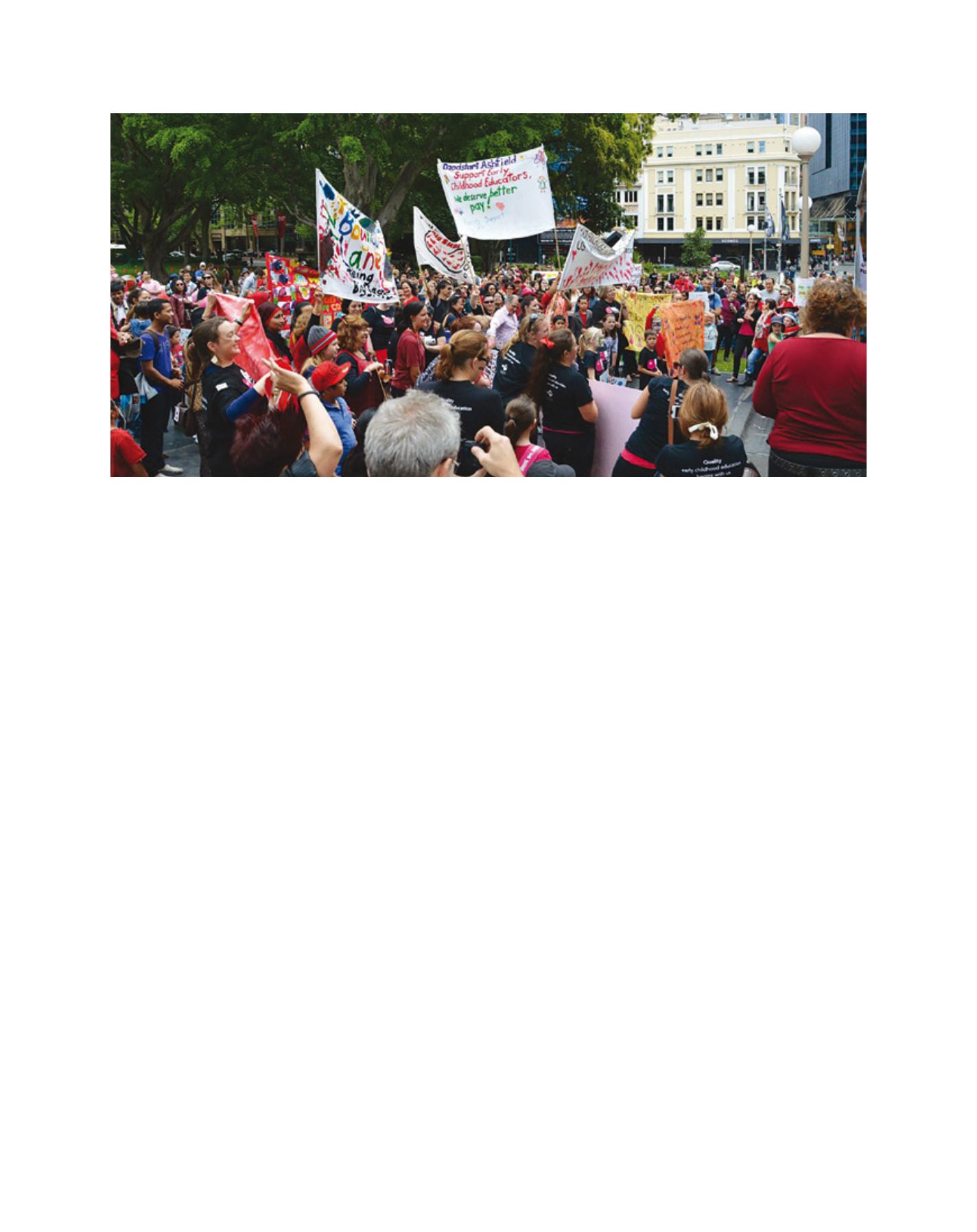
Childcare workers are amongst the lowest paid in the Australian workforce. Workers are active in the campaign for higher wages
Image: UnitedVoice