


 189 / 210

[
] 187
Work and family approaches in Australia
Alan Hayes and Jennifer Baxter, with colleagues from the Australian Government Department of Social Services
and the Australian Institute of Family Studies
E
nsuring
W
ork
-F
amily
B
alance
T
he intersection of family life and the world of work
has been of longstanding interest to Australian
governments, communities and workplaces. Over
the past 20 years labour markets have become more
flexible and the challenge of balancing work with their
education, caring responsibilities and family relation-
ships has become more complex for parents.
The Australian Government understands the importance
of ensuring that women are able to participate as fully
as they choose in the paid workforce, to continue their
careers and to combine work with family life. There follows
a discussion of key measures taken by the Government in
the area of work and family, illustrated by the work of the
Australian Institute of Families Studies (AIFS).
Employment is a vital aspect of well-being for families,
particularly for mothers with young children, and policies
that facilitate parental employment have been a key focus
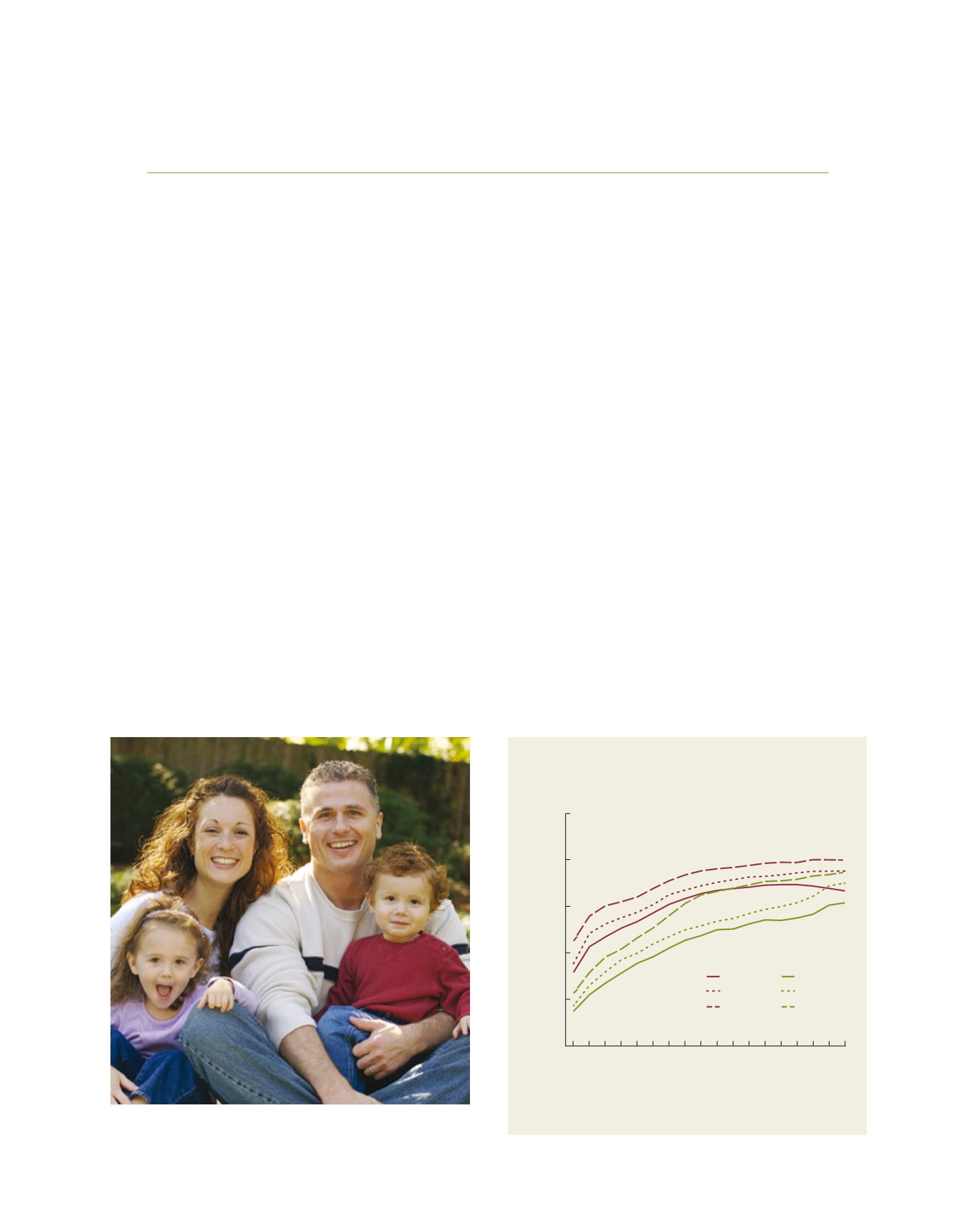
in Australia. Among mothers of children aged under 18
years, employment rates increased from 55 per cent in 1991
to 59 per cent in 2001 and 65 per cent in 2011. This is as
a result of rising levels of women’s educational attainment,
declines in family size, and delays in commencement of
childbearing, with women being increasingly connected to
the labour market before becoming mothers.
Mothers’ employment participation is closely related to
the age of the child. More particularly, some women with-
draw from employment when they have young children
and gradually return to work as their children grow older.
Factors influencing mothers’ return to work include
childcare costs, quality and availability of childcare, work-
place conditions and their own preferences for raising
children, as well as the incentives and effects of the tax and
transfer systems on family incomes. Their decisions often
involve a balance between nurturing children, maintain-
ing family relationships and participating in paid work. A
considerable proportion of Australian mothers, especially
those with young children, prefer to remain at home to care
for their children.
Successive Australian governments have recognized the
additional costs associated with raising children and have
maintained a strong system of family payments. Australia’s
current system of family payments comprises two key
components: Family Tax Benefit (FTB) Part A, which
0
20
40
60
80
Percentage of mothers employed
0 1 2 3 4 5 6 7 8 9 10 11 12 13 14 15 16 17
Age of youngest child
100
1991
1991
Couples
Single
2001
2001
2011
2011
Couples’ and single mothers’ employment rates by
age of the youngest child, 1991-2011
Source:AustralianPopulationCensus,AustralianBureauofStatistics (ABS),variousyears (customdata reports)
Recognition of the additional costs associated with raising children has
resulted in a strong system of family payments in Australia
Image: iStock.com/jpmediainc