


 190 / 210

[
] 188
E
nsuring
W
ork
-F
amily
B
alance
assists low-income and medium-income families with the
costs of raising dependent children to support better family
functioning; and FTB Part B, which assists low-income
and medium-income single parents and partnered parents
where one income is low, to enable families to exercise
choices to balance their labour force participation and
childcare responsibilities.
A key work and family policy focus is to provide support
for mothers and fathers at the time of a birth to assist them
to manage their work and care responsibilities. Australia’s
first government-provided Paid Parental Leave (PPL)
scheme (based on payment of the national minimum wage
for 18 weeks) was introduced in January 2011. The related
Dad and Partner Pay programme provides options for
fathers at the birth of a child to take time away from work
to be with the baby and to assist the new mother. Employed
parents may also have access to paid leave as a condition
of their employment, which may be taken along with PPL.
The majority of Australian mothers prefer part-time work
arrangements (working less than 35 hours per week) to
enable them to combine employment and care for their
children. Mothers are much more likely than fathers to
report using work-family arrangements to care for children,
with 43 per cent of the mothers reporting that they worked
part-time to care for children, compared to only 5 per cent
of fathers. Flexible work is commonly used by mothers
(44 per cent) and fathers (30 per cent), and the next most
commonly reported working arrangement is working at
home (19 per cent of mothers and 12 per cent of fathers).
Mothers who work part-time hours report being less
rushed and pressed for time, and are less likely to experi-
ence negative spill-over from work to family (for example,
through feeling that their family time is more pressured
because of work).
26
37
50
31
70
18
66
16
10
51
41
4
28
12
19
25
24
25
26
24
25
19
23
16
21
8
21
2
15
21
15
39
14
37
16
11
21
51
5
12
11
13
7
15
6
13
8
12
1
16
4
12
2
15
0
20
40
60
80
100
0
20
40
60
80
100
0 1 2 3 4 5 6 7 8 9 10 11
0 1 2 3 4 5 6 7 8 9 10 11
Mother employed
Mother not employed
Percentage of children
Percentage of children
Age of child
Age of child
Preschool (no other formal)
Formal childcare
Informal care only
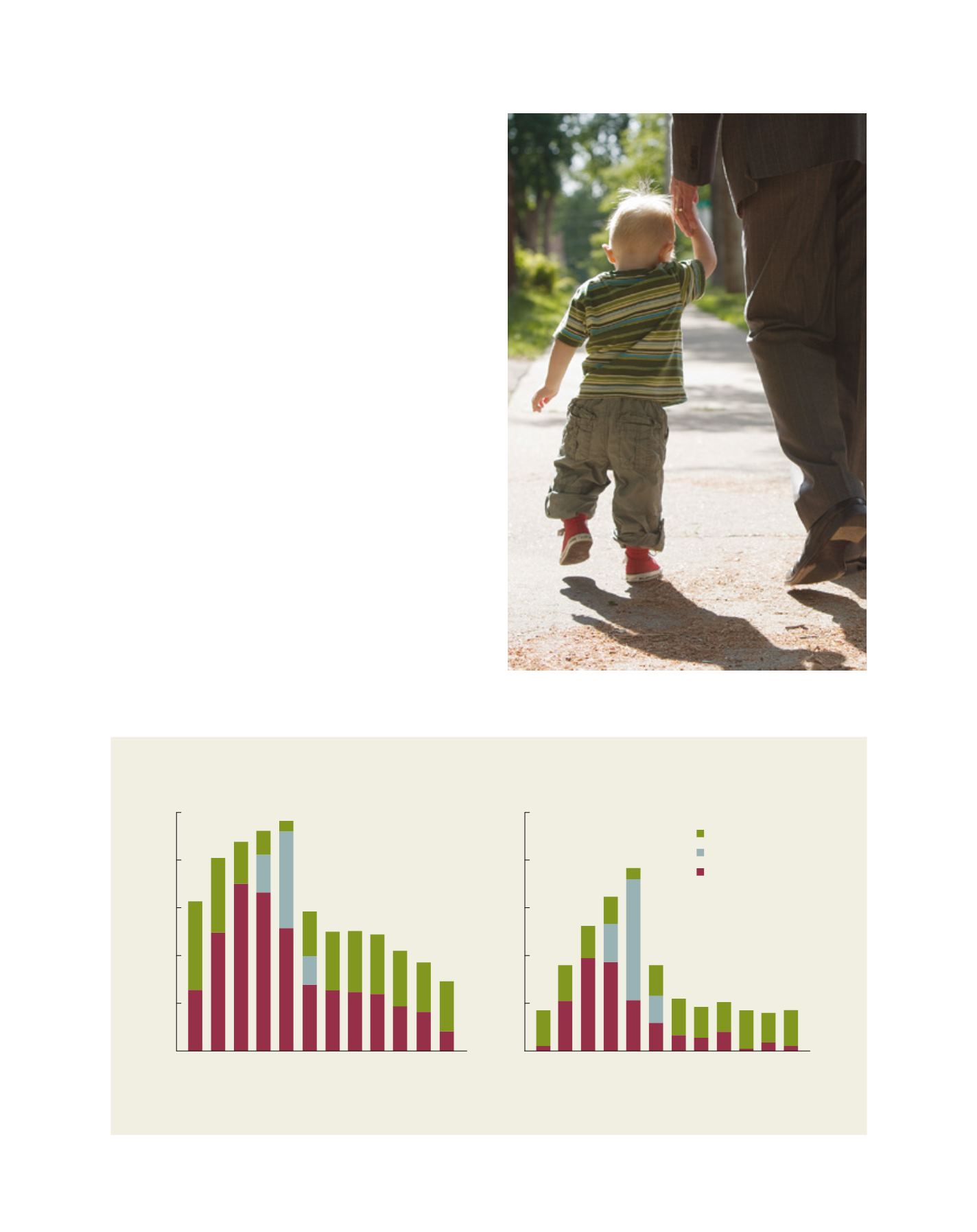
Children’s use of formal and informal childcare or preschool, by age of child, and mothers’ employment status, 2011
Source: ABS 2011 Childhood Education and Care Survey (confidentialized unit record file)
‘Dad and Partner Pay’ provides options for fathers at the birth of a child to
take time away from work to be with the baby and to assist the new mother
Image: iStock.com/ebstock