


 14 / 208

[
] 14
Ecuador: promoting the rights of nature
María Fernanda Espinosa, Coordination Minister of Heritage, Ecuador
T
wenty years after the United Nations Conference on
Sustainable Development in Rio in 1992, the world faces
multiple crises in the realms of finance, economy, energy,
food, climate and environment. These are symptoms of the crisis
of the economic model and the conventional styles of devel-
opment. The weak implementation of commitments to reach
sustainable development shows the world that the structural
causes of unsustainability of the current development model
still remain.
It is important to recognize that the economic system is a subsystem
of the global ecosystem. This implies that the ecological principles
of the Earth’s sustainability are superior to the principles of the
traditional economic system. In consequence, the economic system’s
long-term development should follow the principles of evolution of
the global ecosystem.
1
In Ecuador, discussion of the development model and the biophysical
limits of the planet became a key issue when the Government of President
Rafael Correa took office in 2007, and especially during the drafting of the
new Constitution in 2008, adopted through popular vote.
The Constitution framed the development model in the paradigm
of Buen Vivir (life at its fullest). This concept is in itself an alter-
native to development, which seeks to replace a model based on
economic growth that has led to poverty, inequity and exclusion.
Buen Vivir is a process in construction, based on the traditional
knowledge of indigenous peoples and nationalities.
Buen Vivir implies living in harmony with oneself, with nature
and with others, while building democratic, inclusive, plurinational
and intercultural states. It also requires full respect for the rights
of individuals, communities, peoples and nationalities,
while they exercise their responsibilities interculturally,
with respect for diversity and in harmony with nature.
2
Another main aspect of the Constitution is the
recognition of the Rights of Nature, making this the
first constitution in the world to recognize such rights.
Nature or Mother Earth, where life is reproduced and
carried out, is no longer considered an object but a
subject, with a right to its own existence, maintenance
and regeneration of its vital cycles, structure, functions
and evolutionary processes.
3
Ecuador’s Constitution
is extremely progressive in relation to recognizing the
limits of Nature.
With those two basic paradigm shifts, under Ecuador’s
Constitution, to reach Buen Vivir demands the integra-
tion of five pillars: economic, political, social, cultural
and environmental.
The Buen Vivir paradigm implies work in the follow-
ing areas: improve the quality of life; build a just,
democratic, productive and sustainable economic
model based on the equal distribution of the benefits
of development, the means of production and the
generation of stable and dignifying work; promote
participation with equity and social control; recover
and conserve nature and maintain a safe and sustain-
able environment; guarantee national sovereignty and
promote Latin American integration; promote territo-
rial development with equity; and protect and promote
cultural diversity.
E
nvironment
:
legal
and
ethical
issues
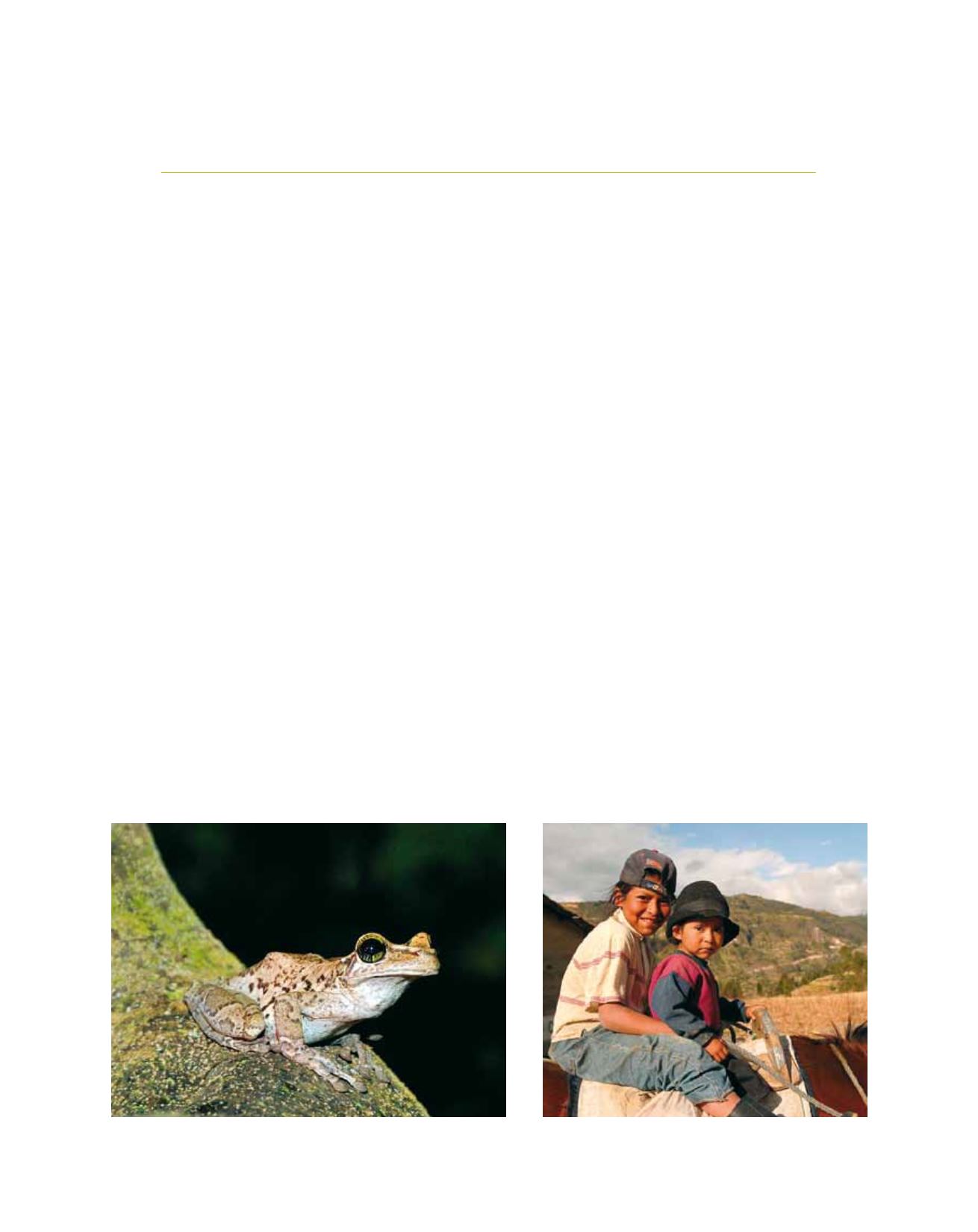
Yasuni National Park
Ecuador highlands
Image: Francisco Caizapanta
Image: Elder Bravo