


 17 / 208

[
] 17
E
nvironment
:
legal
and
ethical
issues
sities, as well as building ‘Millennium Schools’ in impoverished
neighbourhoods and rural areas, with the latest technology and
quality. There is also a programme in place to develop Yachay, the city
of knowledge, which is an innovation cluster for higher education.
In summary, the Government of the Citizens’ Revolution has been
the first one in Ecuador’s history to assume the preservation, main-
tenance and dissemination of our cultural and natural heritage as
an authentic State policy, developed by the Coordination Ministry
of Heritage, in order to reach the society of Buen Vivir.
Ecuador towards Rio+20
After carrying out a participatory national evaluation process in
relation to sustainable development in the country, Ecuador has
developed four proposals for discussion at Rio+20, based on the
principle of common but differentiated responsibilities, equity and
ecological debt.
1. The paradigm of Buen Vivir as an alternative to development,
recovering a life in harmony with nature, in recognition of the
limits of Pacha Mama or Mother Earth
2. The promotion of a Universal Declaration of the Rights of Nature,
to ensure that Mother Earth’s cycles and evolutionary processes
are respected
3. The establishment of a new international economic order and a
new financial architecture. This implies we need to take action
to face multiple crises, including the financial one, and to guar-
antee financing mechanisms for development. Ecuador presents
the following proposals:
• The Daly-Correa tax on oil imports by developed countries
• A new emission of Special Drawing Rights, to make resources
available for sustainable development
• The Net Avoided Emissions mechanism, which
implies compensation for developing countries that
decide not to carry out an activity that causes green-
house gas emissions; this mechanism currently forms
part of the United Nations climate change negotia-
tions
• A tax on international financial transactions
• The Yasuní-ITT Initiative.
4. Develop the fourth pillar of sustainable development,
namely culture, which articulates and generates a
balance among the other three pillars: economic,
social and environmental. In capitalism, culture has
been instrumental in favor of the economy, which
has led to the promotion of homogeneity and thus
the undervaluing of diversity. By considering culture
as one of the main pillars of sustainable development,
the idea is to recover diversity, respect different
cultures as a key element to build sustainable socie-
ties, promote the popular and solidarity economy,
promote respect for human rights and ancestral
knowledge; and promote participation in conditions
of equity, interculturality and respect for nature.
Rio+20 demands bold proposals and decisions, as
the world is at risk. We consider that the proposals
Ecuador presents can contribute to finding solutions,
especially if we consider that they are being built right
now, in order to create a world of social and environ-
mental justice.
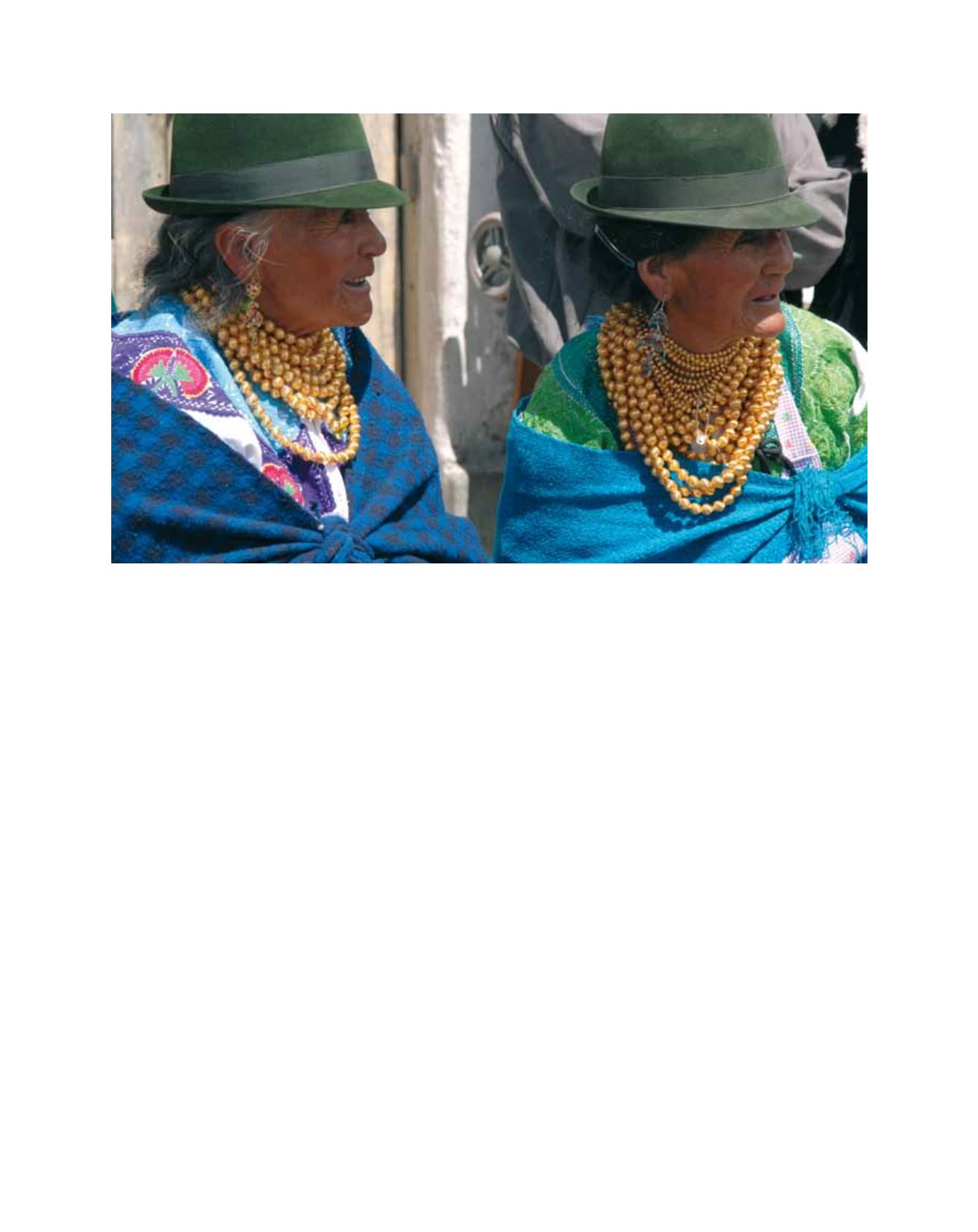
Women in the town of Olmedo in the Ecuadorean Andes
Image: Francisco Caizapanta