


 20 / 208

[
] 20
E
nvironment
:
legal
and
ethical
issues
slump in carbon prices, which itself is reducing much-needed
investment in low-carbon technologies.
7
The first principle of the 1992 Rio Declaration
8
states that
‘human beings… are entitled to a healthy and productive life in
harmony with nature’. This is true, but not the whole truth. Nature
requires such rights as well. We cannot scientifically, ethically
or practically treat the natural world as ‘resources’ and property
to serve our self-selected, self-destructive economic model. The
false dogma of humans over nature needs to shift to allow us to
recognize our interconnectedness with the natural world, and
acknowledge its inherent rights to exist and thrive, which in turn
will protect our own.
An essential step in this direction is to establish a legal system
that incorporates and respects the rights of ecosystems and species
to live in harmony with all other Earth inhabitants. This legal
system would be supported by an evolved economic system that
maximizes social and biological well-being, rather than private
wealth. Only a governance system based on a humble acknowl-
edgment of our place within a web of inter-relationships – one
that recognizes that a healthy Earth is fundamental to contin-
ued, flourishing human existence – can be deemed sustainable.
By acknowledging in law the science of our integration with the
environment, we will create governance structures that guide us
toward sustainable lives and communities.
Such an Earth-based governance system would respect the planet’s
limits, continuously evolving to reflect new science on the workings
and boundaries of Earth’s systems. It would incorporate ongoing
analysis of ethics for the purpose of developing decision-making
criteria, such as use of the precautionary principle of care. Finally,
Earth-based governance would recognize and implement in law the
rights of ecosystems and species to exist, thrive and evolve, and it
would protect the environment’s right to restoration for human-
caused destruction.
Nations and communities around the world are already beginning
to adopt and implement such legal systems. Most notably, in 2008
Ecuador became the first country to adopt a constitu-
tional provision endowing nature with inalienable,
enforceable rights.
9
Its new Constitution states that the
natural world has the right to exist, persist, maintain
itself and regenerate its vital cycles, structure, functions
and processes in evolution.
10
Further, the Constitution
provides the natural world with a right to restoration
that is independent of humans’ right to compensation.
11
Finally, it endows every person, community or national-
ity, the right and responsibility to call for enforcement of
these rights of nature before public bodies.
12
These Constitutional provisions were first tested in
a successful case in March 2011. In this legal matter,
which was brought by attorneys acting on behalf of the
Vilcabamba River, the court found that the river’s consti-
tutional right to flow had been violated by destructive
road development practices and ordered that the river
be fully restored to health.
13
Although restoration efforts
started, they have since lagged, and citizens have stepped
in to ensure judicial inspection of the site and reinvigor-
ated enforcement of the court’s orders.
14
Indigenous peoples are also working to ensure that
these Constitutional provisions become a reality. The
Kichwa people of Sarayaku in Ecuador’s Amazon region
obtain 90 per cent of their food from their local terri-
tory, and so they are particularly vulnerable to damage
to its health. The Sarayaku further espouse the world
view of ‘Kawsak Sacha cosmovisión,’ which incorpo-
rates an understanding of direct contact with Mother
Earth and sees the jungle as a living being, with spir-
itual representatives for each element. The Sarayaku
have been taking action in the Inter-American Court
of Human Rights to protect the jungle’s physical and
spiritual well-being from violently destructive projects
such as mining and fossil fuel extraction.
15
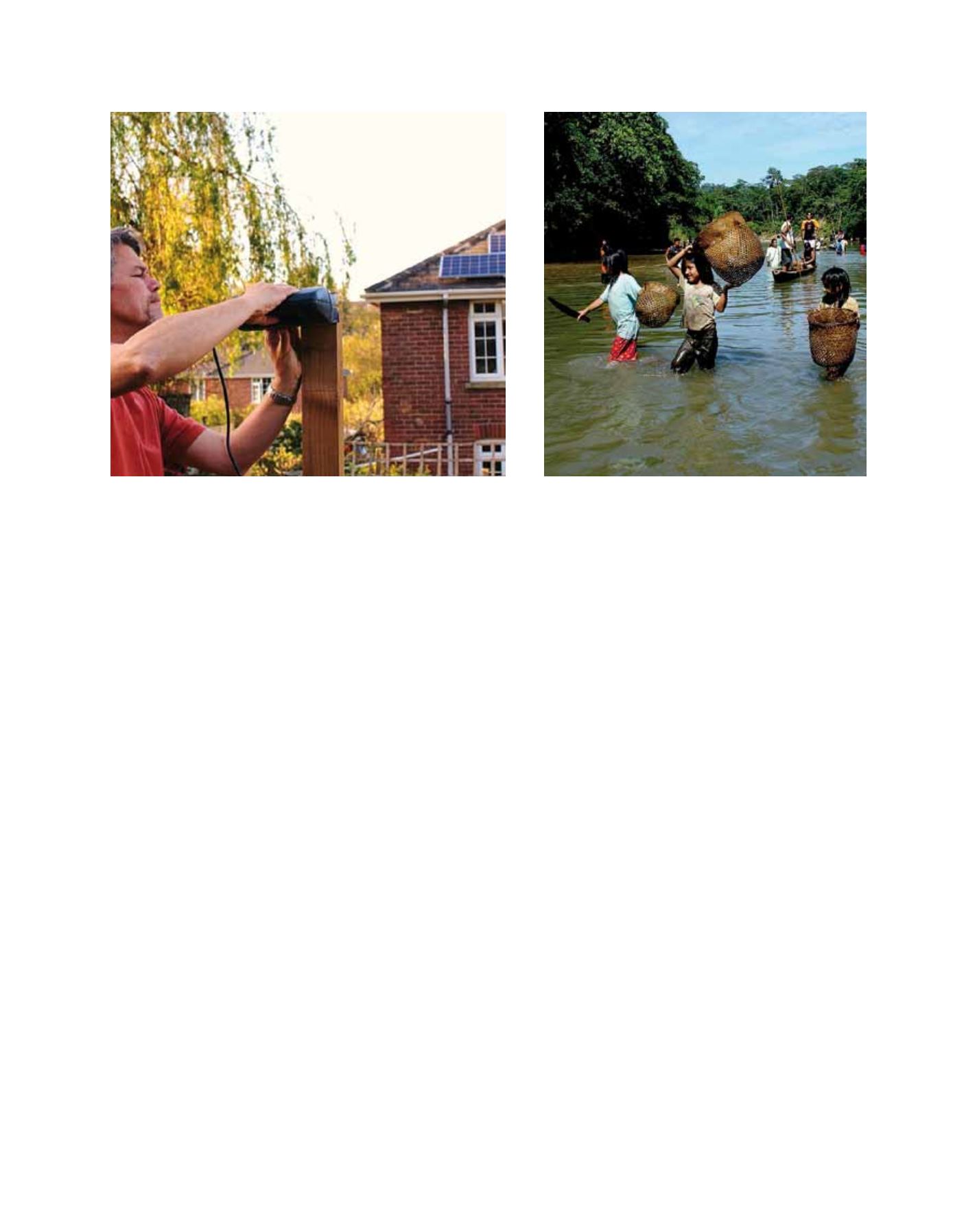
Children of the Kichwa Nation of Sarayaku
Installation of solar systems, Transition Town Totnes, UK
Image: Eriberto Gualinga
Image: Transition Network