



 19 / 208

[
] 19
E
nvironment
:
legal
and
ethical
issues
ently convinced of their inevitability, the discourse has
flipped the status of development and economy from
their proper roles as servant, to master of people and
planet. Protection of nature is regularly subsumed to
the incessant driver of economic growth, rather than
enhanced by evolved economic goals that incorporate
the well-being of all the Earth’s inhabitants.
As one example, in France, the 2012 World Water
Forum in Marseille showcased the privatization
of water – an essential element of life itself – as a
‘solution’ to the world’s water challenges. Thousands
of members representing global organizations that
included conservation, human rights and labour met
in a parallel forum to offer alternative, Earth-based
solutions that recognize the inherent rights of people,
ecosystems and species to water needed for survival.
Their work illustrated the growing financialization of
nature and showed how it leads to dangerously unbal-
anced relationships among humans and the rest of the
community of life on Earth.
Unfortunately, this imbalance is being exacerbated by
other, expanding proposals to ‘save’ the environment
by sweeping it into destructive economic models. One
example involves pricing out elements of the natural
world and trading them to their allegedly ‘highest’ use.
It should surprise no one that the result of this finan-
cial ‘solution’ will focus around money and markets,
rather than the health of the environment. The cap-and-
trade process is just one early example of the impacts
of this strategy. Though the European Commission is
calling for new emissions reductions,
6
states are resist-
ing further tightening of carbon reduction targets and
issuing of fewer trading permits in the face of a record
State concludes,
4
armed conflict will increasingly break out over
water and other essential elements of life. The alternative is to decide
now to choose a governance path that embraces our integration with
the environment and each other.
The United Nations Conference on Sustainable Development
(Rio+20) falls fortuitously, and gravely, at this critical juncture. The
United Nations Environment Programme (UNEP) set the stage for
Rio+20, with its Towards a Green Economy report, which priori-
tizes using economics to improve human well-being while reducing
environmental damage and scarcities.
5
But will this vision of change
– which is rooted in flawed, ‘human over nature’ governance struc-
tures – achieve the world we want?
The Rio+20 focus on sustainable development and green econo-
mies misses the point that development and the economy are not the
end game, but are tools to achieve a larger vision of thriving human
and environmental communities that represent the best of us and
inspire us to evolve further. Thriving human communities include
not just development and the economy, but also healthy food,
clean drinking water, wide circles of family and friends, sanitation,
housing, necessary medical care, democratic governance, education,
meaningful and appropriately rewarded labour, spirituality, and
civic duty, alongside healthy relationships with the natural world,
on which we depend utterly. Thriving environmental communi-
ties similarly require healthy nutrients, clean water, biodiversity,
restoration in the face of destruction, and connected habitats and
migratory corridors, along with healthy relationships with humans,
who have the power to destroy, as well as rejuvenate.
If constructed correctly, development and the economy will serve
thriving, interconnected human and environmental communities
that interplay to create a vibrant planet. Yet inexplicably, despite
the fact that the existing economic system is fundamentally driving
environmental destruction, it has remained relatively immune to
much-needed public debate over alternative models. Instead, appar-
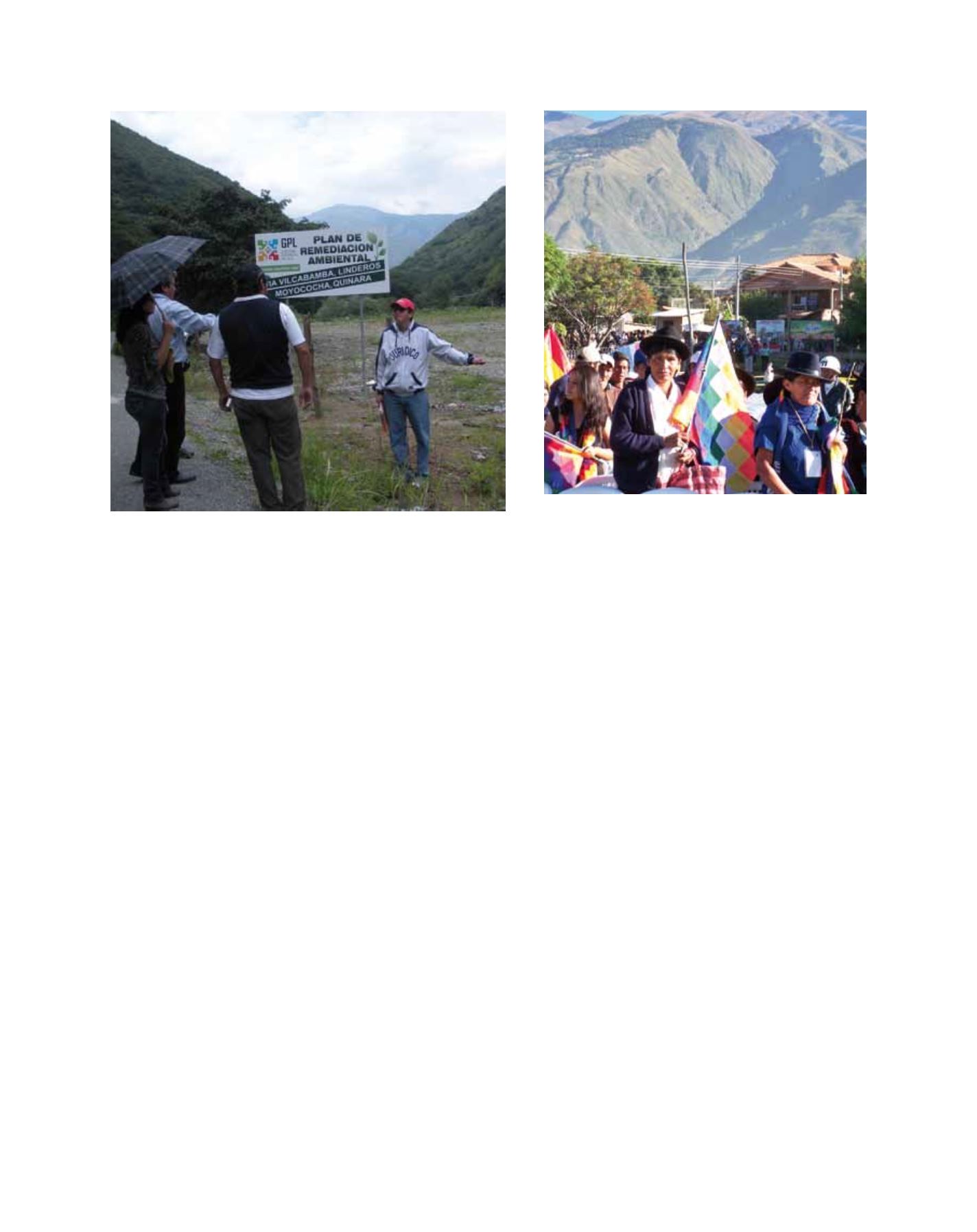
Signs at perimeter of Vilcabamba River restoration site, Ecuador
Image: Fundación Pachamama
World People’s Conference on Climate Change and Mother Earth
Cochabamba, Bolivia April 2010
Image: Patricia Siemen