


 15 / 208

[
] 15
E
nvironment
:
legal
and
ethical
issues
projects and budget definitions, of 6 to 10 Ministries.
The Coordinating Ministry, together with the National
Planning Secretariat and the Ministry of Finance,
defines the budget allocation for the work to be carried
out by the Ministries.
This approach has allowed an adequate integration
of the sustainable development pillars in the plan-
ning process and enabled monitoring of public policy
implementation. Every year, the Coordination Ministers
present a consolidated report to citizens in relation to
the work the ministries have carried out, as well as
responding to any requests for further information and
clarification. This is in line with the fifth branch imple-
mented with the new Constitution, named Citizens
Participation and Social Control (along with the execu-
tive, legislative, judicial and electoral branches).
Ecuador’s innovative work and proposals
In this five-year period, Ecuador has also developed
forward-looking proposals for sustainable development
with strong political impact at a global level.
One of the most innovative proposals is the Yausuní-
ITT Initiative. The main idea of this initiative is to leave
unexploited 846 million barrels of oil in the Ishpingo-
Tambococha-Tiputini camp, about twenty per cent of
National planning and institutional development
This comprehensive approach is further developed in the country’s
National Plan for Buen Vivir, which is the planning instrument that
coherently develops the paradigms included in the Constitution and
integrates the five pillars of sustainable development. It includes 12
national objectives, with goals and indicators, which are monitored,
evaluated and reviewed on a yearly basis and adjusted every four
years. The Plan itself has defined a twenty-year road map that will
guide the country to a production reconversion whereby its main
income will come from biotechnology, bioknowledge and conscious
tourism services, moving away from extractive activities, such as oil
and mining.
The Plan has been developed by Government institutions with the
participation of civil society organizations and social movements. It
guides the work of all public institutions and, as such, is mandatory.
Planning is today a key issue assumed directly by the Government,
whereas before, during the neoliberal years, planning almost disap-
peared, since privatization schemes required the State to pass on its
responsibilities to the private sector.
Another important aspect of Ecuador’s programme has been
to restore the role of Government institutions. Along with the
Ministries that execute policy, there are now Coordinating
Ministries by area, for example: Natural and Cultural Heritage,
Knowledge, Social Development, Strategic Sectors, Economic Policy
and Production. Each integrates the planning process, including
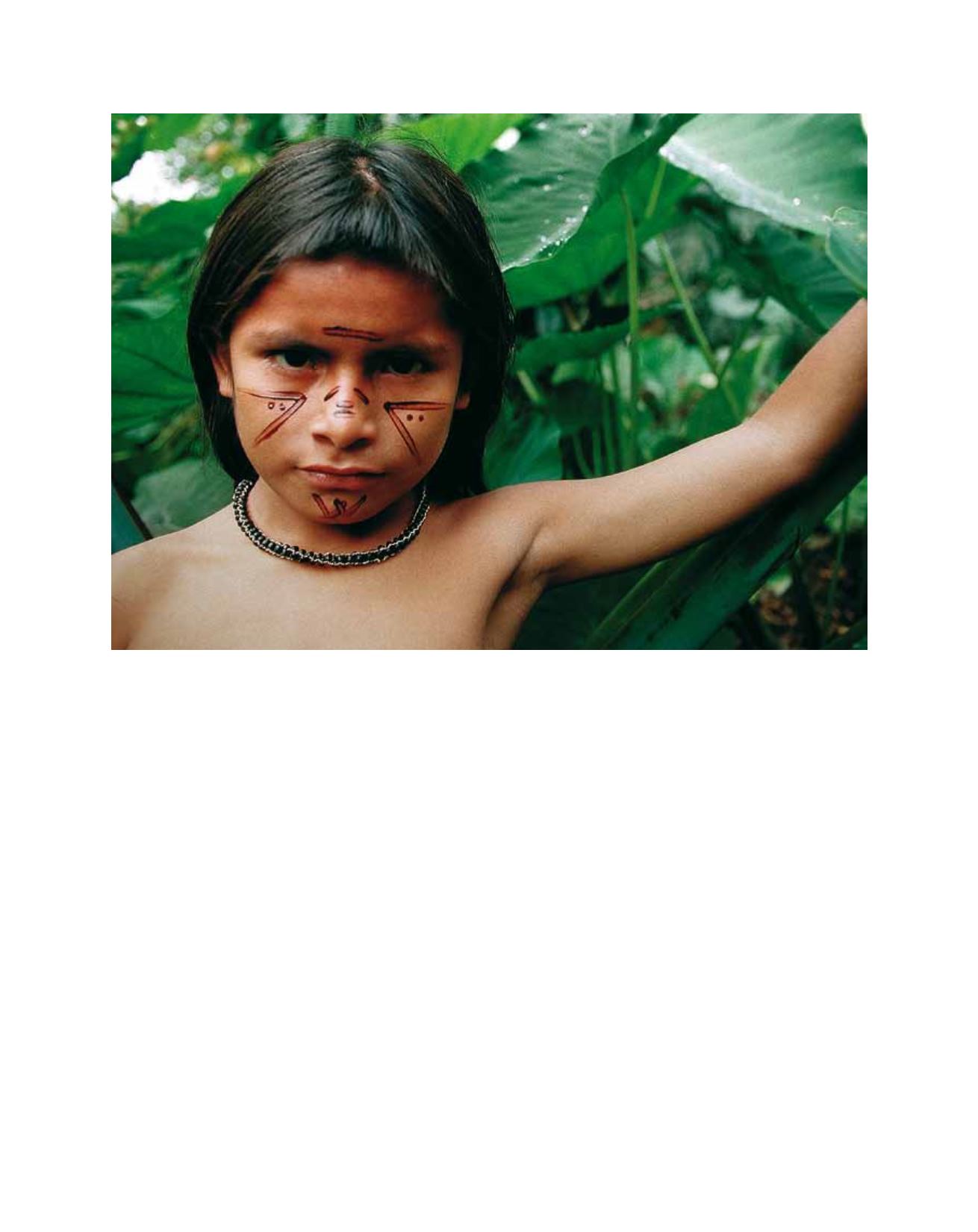
Shuar child, Macuma Community in the province of Pastaza
Image: Francisco Caizapanta