



 23 / 208

[
] 23
E
nvironment
:
legal
and
ethical
issues
ble if humanity does not take to heart, that attaining
and maintaining harmony with nature is the sine quo
non of a sustainable economy and ultimately of the
survival of humanity. “Harmony with nature” is not a
mere catchphrase: it is an imperative goal for society.
To create more amenable conditions for an ecologi-
cally sustainable future demands considerably more
thoughtful reflection, intellectual work and practical
initiatives by governments and civil society.
In determining directions for this requisite and
holistic work, it is important to acknowledge that
the physical and social sciences cannot frame all the
questions and provide all the answers in the quest
for harmony with nature. It must be understood that
Nature has both material and metaphysical dimen-
sions, as well as intrinsic and instrumental value.
Therefore, it is crucial that in both thinking and in
practice a holistic and interdisciplinary approach be
adopted. Protecting nature calls for philosophical
thinking, poetic inspiration and spiritual reflection, in
addition to scientific, economic and social considera-
tions. Deeply disturbed by ongoing destruction of the
environment, former Czech leader and author Václav
Havel wrote:
“The only option is for something to change in the
sphere of the spirit… in the… attitude of man towards
the world and his understanding of… his place in the
overall order of existence… Only a new understanding
Nations on the eve of the twenty-first century, give much attention
to the philosophical and spiritual roots of relations between human-
ity and nature.
6
In 2005, however, the GA decided that 2008 will be the
International Year of Planet Earth,
7
and, in 2009, it designated
22 April each year as International Mother Earth Day.
8
In 2009,
the GA also adopted a resolution on harmony with nature,
9
in
which Member States expressed concern over ‘the documented
environmental degradation and the negative impact on nature
resulting from human activity’, recalled the 1982 World Charter
for Nature, and invited all actors ‘to consider, as appropriate, the
issue of promoting life in harmony with nature’.
10
In preparation for the United Nations Conference on Sustainable
Development (Rio+20), the GA adopted further resolutions on
Harmony with Nature in December 2010 and December 2011.
11
In response to these resolutions, two extensive, thought-provoking
reports were submitted to the GA by the Secretary General and two
interactive dialogues took place, the first in April 2011, and the
second in April 2012.
12
The dialogues brought to light issues that have heretofore been
inadequately addressed by the world community. It is sobering to
consider our planet from the standpoint of the universe, to evoke
the billions of years it took nature to evolve, and to realize human-
kind’s present capacity to destroy it. It is critical to understand the
need for ethics in Nano research, and the wisdom of traditional
cultures in addressing today’s ecological concerns.
Clearly, effectively achieving sustainable development, with
advancement of technology and poverty eradication is hardly feasi-
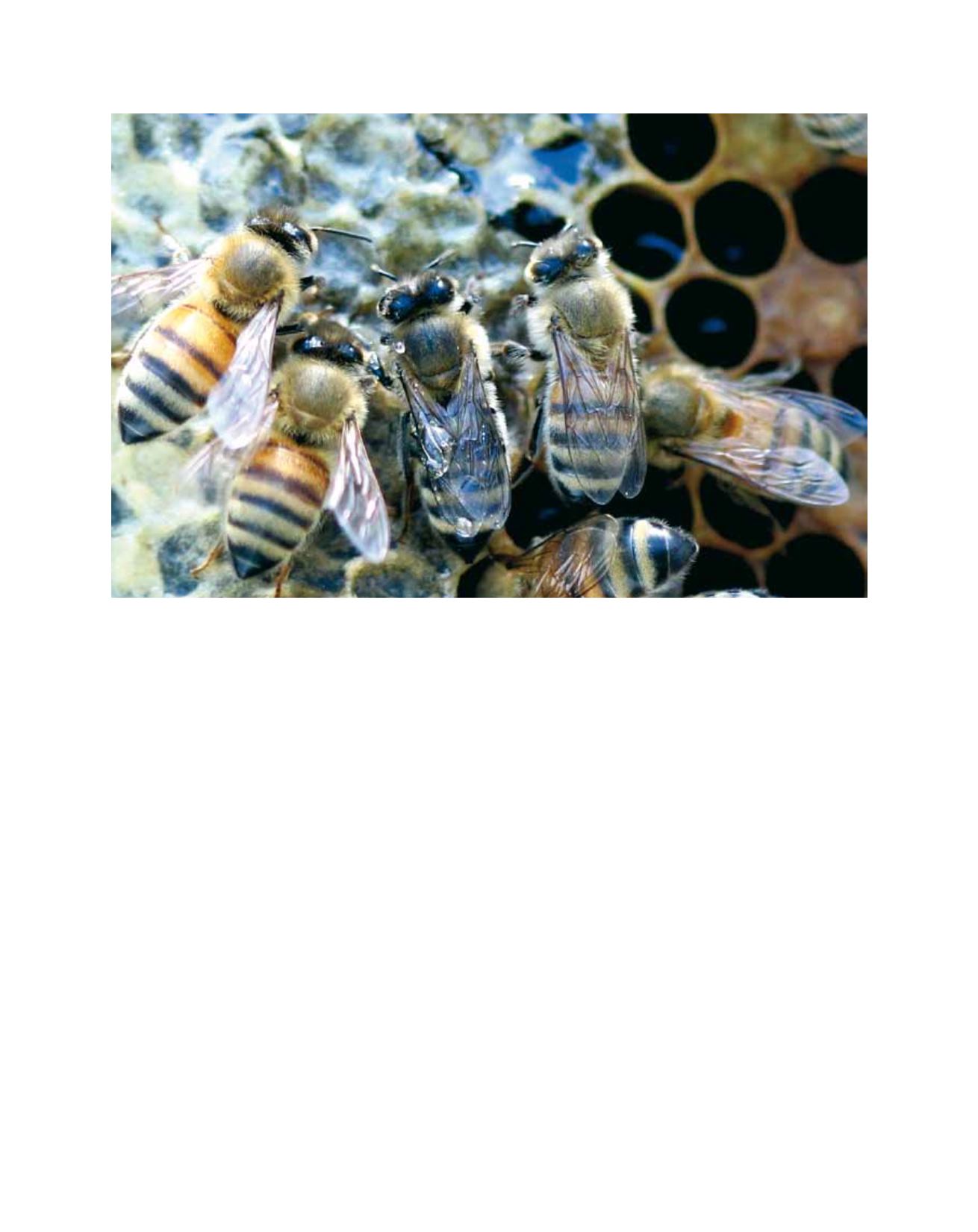
Honeybees are most threatened by loss of biodiversity
Image: Barbara Sundberg Baudot