



 28 / 208

[
] 28
E
nvironment
:
legal
and
ethical
issues
shows that two important conditions, namely trust and reciprocity, can
easily be cultivated through such an approach. Both conditions, which
enable the effective management of local CPR, were shown in research
by Professor Elinor Ostrom, the first woman to receive the Nobel Prize
for Economics. She conducted extensive studies throughout South
and Southeast Asia into why and how self-organizing groups of local
communities arise and successfully manage CPR. When communi-
ties work together and are extensively linked to one another, they can
ultimately achieve a single long-term vision of sustainability. The condi-
tions of trust and reciprocity produce a sense of communion within
the village network and community. GSEI studies also showed that
with shared values based on oriental wisdom, an ethical code would
effectively ensure collective effort.
The best example can be seen in the Ban Pred Nai community in Trat
Province. Led by Venerable Subin Pannito, a local monk who sought
to encourage the rehabilitation of a local mangrove forest into a source
of coexistence and income, the villagers followed Buddhist teachings
together with SEP and created the Sacca Network, which targeted
harmonious economic activities. SEP, a wisdom initiated by the King of
Thailand, comprises important principles of moderation, reasonableness
and self-immunity. Wisdom manifests itself in a balanced way of life.
In addition, Venerable Subin’s teaching of Buddhist concepts such as
‘metta’ (compassion) and ‘sacca vacca’ (right or honouring words), leads
to trust being created amongst community members and
has allowed micro-credit to circulate. To date, the commu-
nity’s working capital has amounted to US$46million, with
more than 2,000 hectares of community mangrove forest.
Moreover, to the surprise of the GSEI research team, carbon
emission measurements have revealed that CO
2
mitiga-
tion in the community is now much more effective. On
average, Pred Nai village annually absorbs up to 2,100 tons
of carbon, which is equal to 1.85 tons of carbon per person.
The average forest carbon absorption rate is 0.91 tons per
year, making the absorption rate twice as high as the base-
line following the activities initiated by Venerable Subin.
According to the GSEI study, success is not limited to
local communities alone, but could also be achieved by
businesses. A case in point is the ChumpornCabana Resort,
which chose to operate through applying SEP concepts.
The resort relies on local communities and supplies its own
operational needs by cultivating and using natural prod-
ucts available in the area, such as the community forest.
By encouraging good governance and integrating the local
community into its business, the resort has managed not
only to become environmentally friendly, but also to gener-
ate both savings and income.
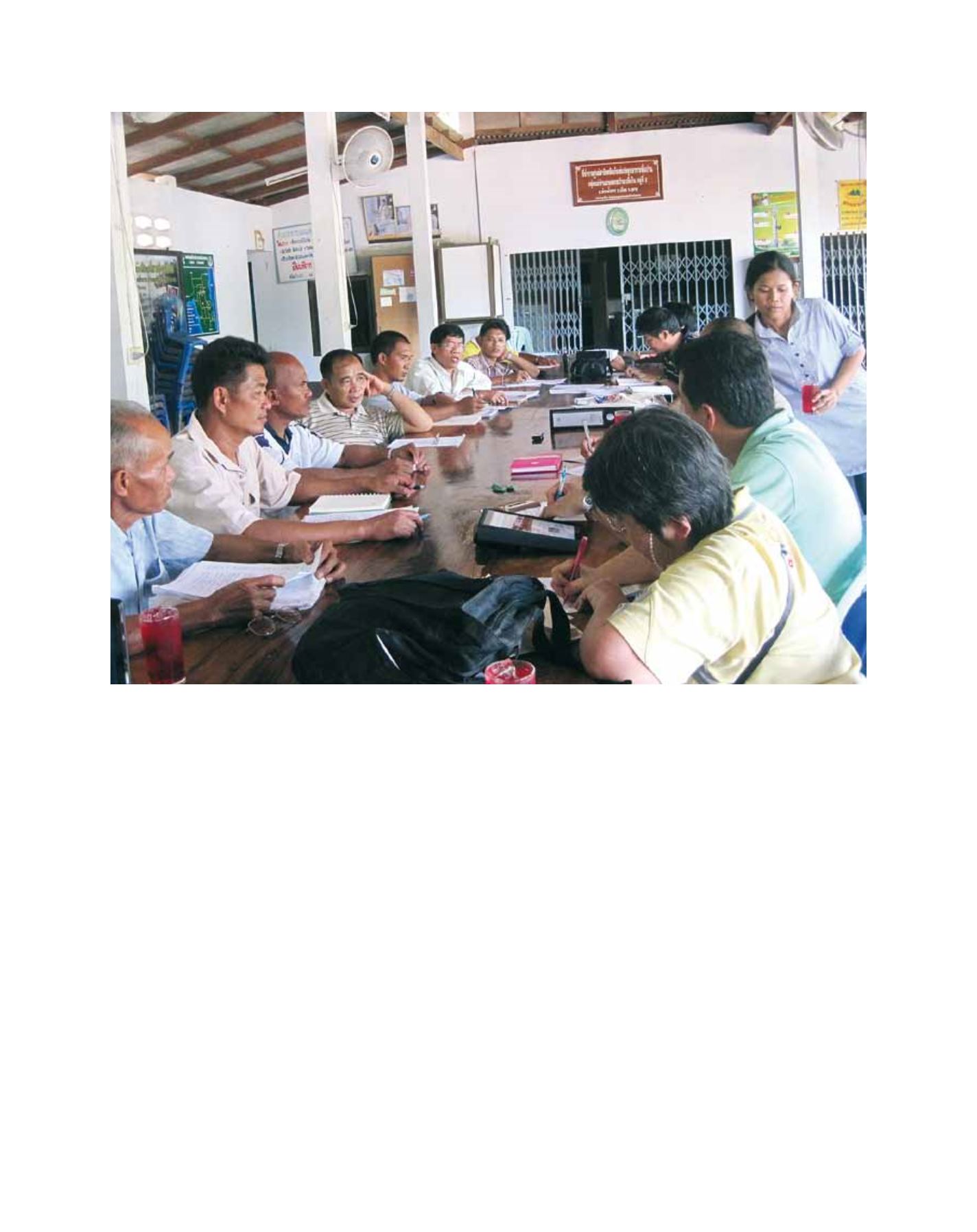
Integrating the local community into business can lead to greater economic success
Image: GSEI