


 34 / 208

[
] 34
P
eople
:
social
inclusion
,
green
jobs
,
education
in policymaking on sustainable development (as women had become
one of the nine Major Groups in Agenda 21
10
) and to practically
implement sustainable development at the local and national levels.
Through our practical activities we are keenly aware of some major
implementation challenges that remain.
During its first 15 years, WECF’s local implementation projects
focused primarily on the former Soviet Union countries which had
opened up after the fall of the Berlin Wall. Now, WECF implements
women’s sustainable development projects around the world.
WECF projects focus on four goals: safe, renewable energy for
all; safe water and sustainable sanitation for all; safe food and rural
development for all; and safe chemicals and health for all. With over
100 local partners in 40 countries, we have provided environmen-
tally-friendly water systems, ecosan toilets, wetlands for waste water
treatment, solar collectors, biogas plants, solar fruit driers, non-toxic
building materials and natural pest-protection products. These local
participatory projects have provided access to sustainable and afforda-
ble services for over 35,000 women, men and children. Among others,
at least 50 schools and some 20,000 pupils have improved water and
sanitation. Together with local women and men and according to
their needs, we develop sustainable technologies which create local
employment while ensuring energy and food security and sovereignty.
These results are good, but not enough. To achieve sustainable
and large-scale improvements, we need to change our political
and economic conditions. We need rule of law, good governance,
and the elimination of current barriers to women’s empowerment,
poverty eradication and environmental protection.
Among the challenges our local partners face are lack of priority for
women’s participation, the lack of access to affordable finance, and
the wrong political incentives from international finance institutions.
But violence against women, intimidation, corruption, lack of press
freedom, perverse subsidies, lack of a functioning legal system and
lack of access to information all help to maintain these
barriers.
WECF therefore empowers its partners politically,
making sure that women are enabled to participate
meaningfully in policymaking and promoting quotas
where necessary. Through its EcoSoc observer status,
WECF helps its partners to present their lessons learned
and their successes to policymakers in relevant United
Nations policy processes such as at the Rio+20 confer-
ence. Currently, WECF is co-chair of the Women’s Major
Group for the Rio+20 process and for the United Nations
Environment Programme (UNEP), and is a core member
of the Gender and Women’s constituency at the United
Nations Framework Convention on Climate Change.
WECF and the Women’s Major Group are promot-
ing the need to go beyond a green economy to a care
economy which would value the contribution of women
and nature to the well-being of our societies. This does
not automatically mean that we need to monetize nature
– but at least in our constitutions we should acknowl-
edge its value and protect our natural resources from
short-term exploitation. Governments must manage
common natural resources in the sole interest of their
citizens, including future generations. There is a concrete
instrument for this, the Public Trust Doctrine, which
allows the governance of global commons beyond
national jurisdiction. The basic concept is that certain
common natural resources cannot be subject to private
ownership and instead are held within a Public Trust.
In a care economy, governments must also protect
women from violence, exploitation and poverty. In prac-
tice, that means full implementation of CEDAW and its
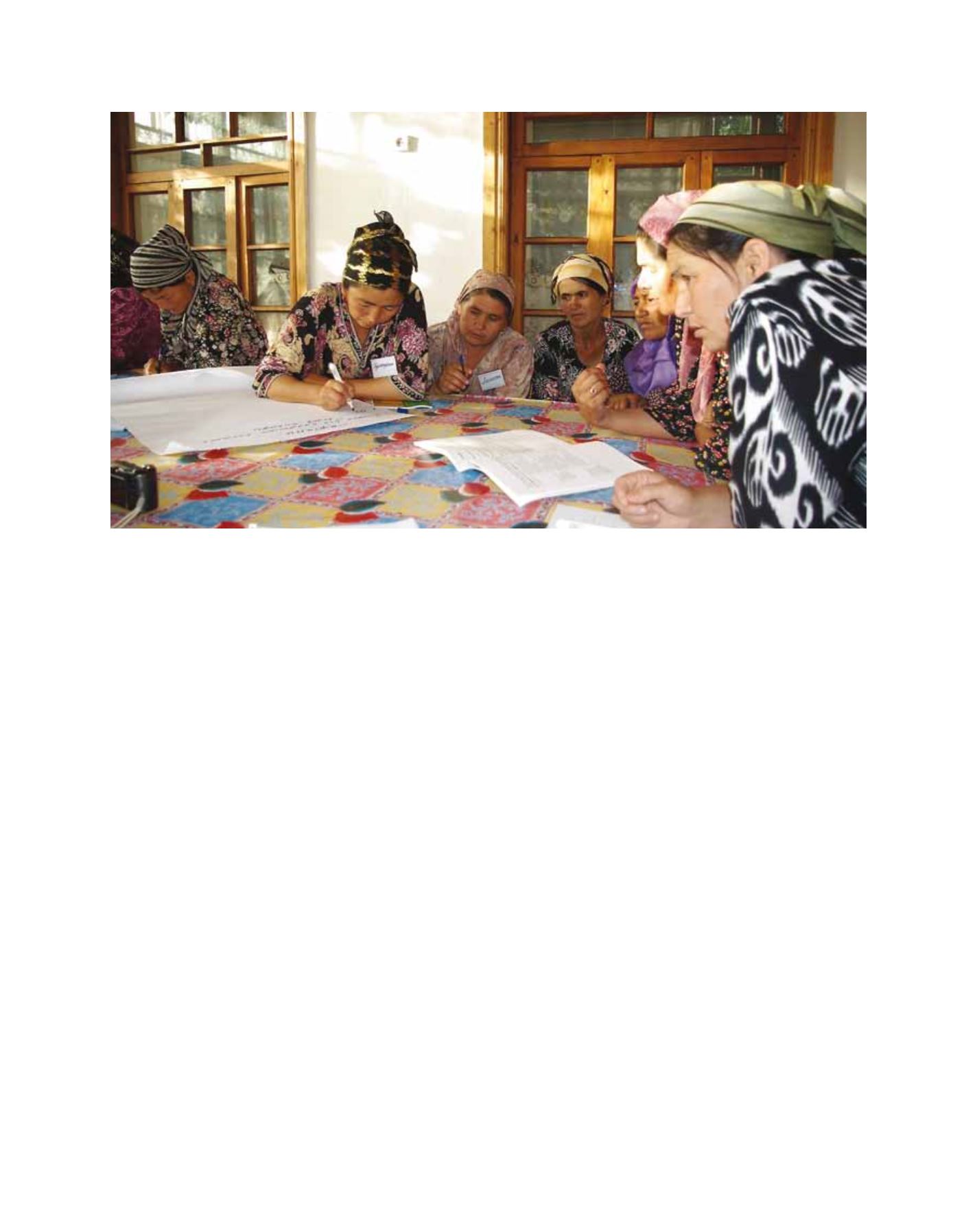
WECF works to give women a voice in policymaking on sustainable development
Image: WECF