



 39 / 208

[
] 39
P
eople
:
social
inclusion
,
green
jobs
,
education
The alternative energy sector was selected as a prior-
ity area for development and in order to put in place
state policy, the State Agency for Alternative Energy
was established for rolling out the national programme.
Among other projects, a solar panel production plant
became operational, with a view to growing the recycla-
ble energy share by up to 20 per cent in 2020.
Although Azerbaijan didn’t achieve the reduction obli-
gation for gas-emission-created warming under the United
Nations Framework Convention on Climate Change, after
Kyoto action was taken to reduce waste. Despite intensive
economic development, waste was reduced to 48 million
tons from 70 million tons in the benchmark year 1990,
with greater importance attached to sustainable develop-
ment principles, including environmental protection and
mitigation of the effect of climatic changes.
The volume of gases was reduced to 298.3 million
m3 in 2010 from 578.6 million m
3
in 2006. The use
of fuel oil in producing electric energy ceased in 2010
and full transition to natural gas was completed with
the conditional fuel spend for production of one unit of
electricity reduced by 30 per cent from 2000.
The outcome of this policy in recent years is that
significant progress was made in all areas, includ-
ing protection of biological diversity, development
of forests, expansion of green space and sustainable
management of water resources and waste.
In water management, the plan is not only to achieve the
Millennium Development Goals – a two-fold reduction
of the number of people not provided with safe drinking
water and sanitary services – but to make these acces-
sible to all citizens. Existing wastewater purifying plants
are a mix of the refurbished, modernized and newly
constructed, with some purifying 1 million m3 of waste-
education. Apart from reforms in science, the application of science
in economy and efficiency improvements and the establishment of
special state institutes for the funding of research projects are impor-
tant components targeting sustainable human development.
Significant initiatives have been implemented in recent years in health
service reforms, including delivery of a high quality medical service,
rationalization of the network and bed capacity of health institutions,
improvement of sanitary and epidemiological services, pharmaceuticals,
medical training and the development of medical science.
To improve the welfare of people, an increasing number of new
projects are being carried out to ensure management of the envi-
ronment by modern methods, with a policy based on sustainable
development principles and Millennium Development Goals.
Future challenges are recognized, such as attaching greater impor-
tance to environmental issues, the implementation of large-scale
environmental projects and creating the circumstances to allow
Azerbaijani citizens to live in a cleaner environment. In recent
years, funding allocated to solving environmental problems origi-
nated from the rapid development of the country’s economy, which
allowed major environmental projects to be undertaken.
As early as 2003, Azerbaijan adopted a national programme for
environmentally sustainable social and economic development. With
environmental sustainability being one of the Goals, sustainable devel-
opment principles were integrated into state policies, with the main aims
identified. The key objective is systematic and efficient implementation
of nationwide investment projects directed at developing the country’s
economy – particularly the non-oil sector – delivering greater satisfac-
tion of people’s economic and social needs, developing the regions and,
maintaining economic security and environmental protection.
Opportunities exist to resolve past environmental problems by using
green technologies. Transitioning to a ‘green economy’ meant many
enterprises not complying with environmental and economic require-
ments were closed and others refurbished and modernized, while new
low-waste and non-waste technologies were introduced.
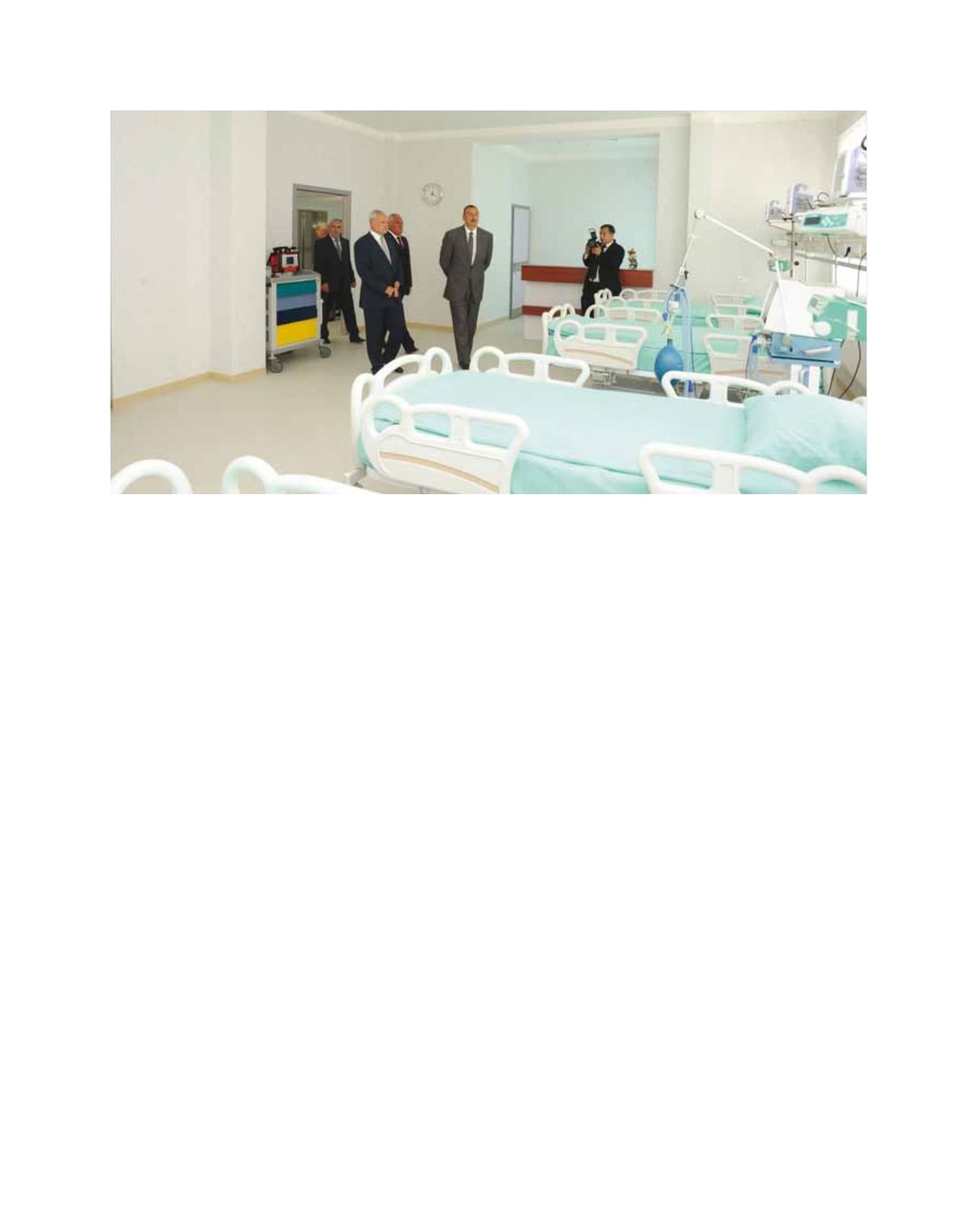
The opening ceremony of Shabran District Central Hospital, Azerbaijan, August 2011
Image: Azerbaijan State Telegraph Agency