



 35 / 208

[
] 35
P
eople
:
social
inclusion
,
green
jobs
,
education
optional protocol in all countries. Furthermore, we need a ‘global
social protection floor’ – assuring women’s access to health services,
water, sanitation, food, energy, housing and employment and a basic
income for women. In many countries, including developing countries,
a social protection floor already exists. Brazil has made great advances
in poverty reduction with social protection floor instruments such as
its ‘Bolsa Familia’, where women in the households obtained a basic
income and access to basic services. India has agreed on a ‘human
rights-based’ approach in development policy, giving women and men
in rural areas the ‘right to employment’ – at least 100 days of guaran-
teed employment. A social protection floor is not expensive, it costs one
to two per cent of GDP. The time has come for a global social protection
floor, financed through additional funding (in particular the Financial
Transaction Tax), but also by global environmental protection levies
such as the kerosene levy and the ocean levy.
Women are the ‘first environment’ for the developing child. Our
grandparents still believed that the placenta protected the develop-
ing child from all unhealthy influences. After more then 50 years, in
which our children have been the guinea-pigs for new technologies and
harmful substances, we know this is not the case. The pollution the
mother receives from food, air or in the workplace enters the placenta.
Therefore, technology is among the key priority issues from a women’s
perspective. The draft outcome document for Rio+20 calls in many
parts for ‘technology transfer’ and the development of ‘green technolo-
gies’. But who decides what green technology is? Is it geo-engineering,
which is already happing in large-scale experiments above the Pacific
Ocean? It is sometimes suggested that women are the enemies of tech-
nology. Many polls show that women want responsible technologies
and, worldwide, women have been the majority of those saying ‘no’ to
nuclear energy and genetically modified organisms. Unfortunately, little
has been learned from previous health disasters. Many governments
still allow lead in petrol, which has led to generations of children with
damaged health. Many countries continue to sell and use chrysotile
asbestos, a recognized killer responsible for over 100,000 deaths each
year, when asbestos can easily be substituted with safe alternatives.
Research shows that women and children are at great risk from
nuclear radiation. A recent French study
11
suggests that children
living near nuclear power plants have higher levels of leukaemia (blood
cancer) – but no legal measures are being taken to protect them.
There are many indications from scientific research that chil-
dren’s health is being irreversibly impacted by harmful chemicals
(Bisphenol-A, brominated flame retardants, phthalates) and new tech-
nologies such as nanotechnology. Our children are all involuntarily
part of a global experiment by industry – and they are not sufficiently
protected by law.
Women also suffer environmental health damage. In some countries
in Africa, breast cancer has become the number one cancer among
women, and kills women of reproductive age. This increase in breast
cancer in Africa cannot be explained by the usual reproductive life risk
factors, but is most probably linked to increased environmental pollu-
tion, possibly including pesticide use, electronic waste and others.
That is why WECF calls for the creation at Rio+20 of an independ-
ent technology assessment and monitoring organization. WECF
calls for a global phase-out of nuclear energy, an immediate mora-
torium on nanotechnology in women’s and children’s products, and
a moratorium on geo-engineering and synthetic biology.
WECF also demands that any new institutional framework decided
on at Rio+20 should aim to achieve gender equality in its govern-
ing bodies, staffing and implementation mechanisms. An established
organization with existing staff, such as EcoSoc, is
unlikely to be able to give sufficient priority to the issue
of gender and sustainable development. WECF therefore
supports the creation of a new Council for Sustainable
Development (CSD). WECF also supports the upgrad-
ing of UNEP to a specialized agency with predictable,
increased funding and a strong gender programme. Both
the CSD and the new UNEP must be given priority at the
United Nations General Assembly.
WECF supports the proposal by Colombia and
Guatemala for Sustainable Development Goals (SDGs),
especially because they will be universal goals – not just
for developing countries, but for all countries worldwide.
The goals are intended to ensure that everybody should
benefit, rather than only seeking to reduce by half the
population living in poverty as is currently the case with
the Millennium Development Goals (MDGs). The SDGs
should be grounded in human rights. It is important that
gender equality and women’s empowerment become part
of the SDGs, and this can be ensured through gender
indicators for each goal – for example, an indicator to
measure how far women have equal access to renewable
energy. Another option is to have specific gender equality
and women’s empowerment goals as part of the SDGs,
building on the experience with MDG3 and MDG5. Such
goals could include indicators that women should have
access to land rights, basic services and finance.
I would like to end with the final words of the Women’s
Major Group submission paper to the United Nations.
12
“The world stands at a cross-roads, and the future
of our planet Earth and its human communities lies
in our hands. United in our diversity we, women from
all regions in the world, call on our governments and
other stakeholders to renew the commitments on equi-
table and sustainable development made at the Earth
Summit in Rio de Janeiro in 1992. We commit ourselves
to contribute to a peaceful and healthy planet, in which
human rights are well respected and women’s voices are
well represented. We request that you act in the spirit of
global solidarity, trust, environmental and social care,
and take our recommendations well to heart.”
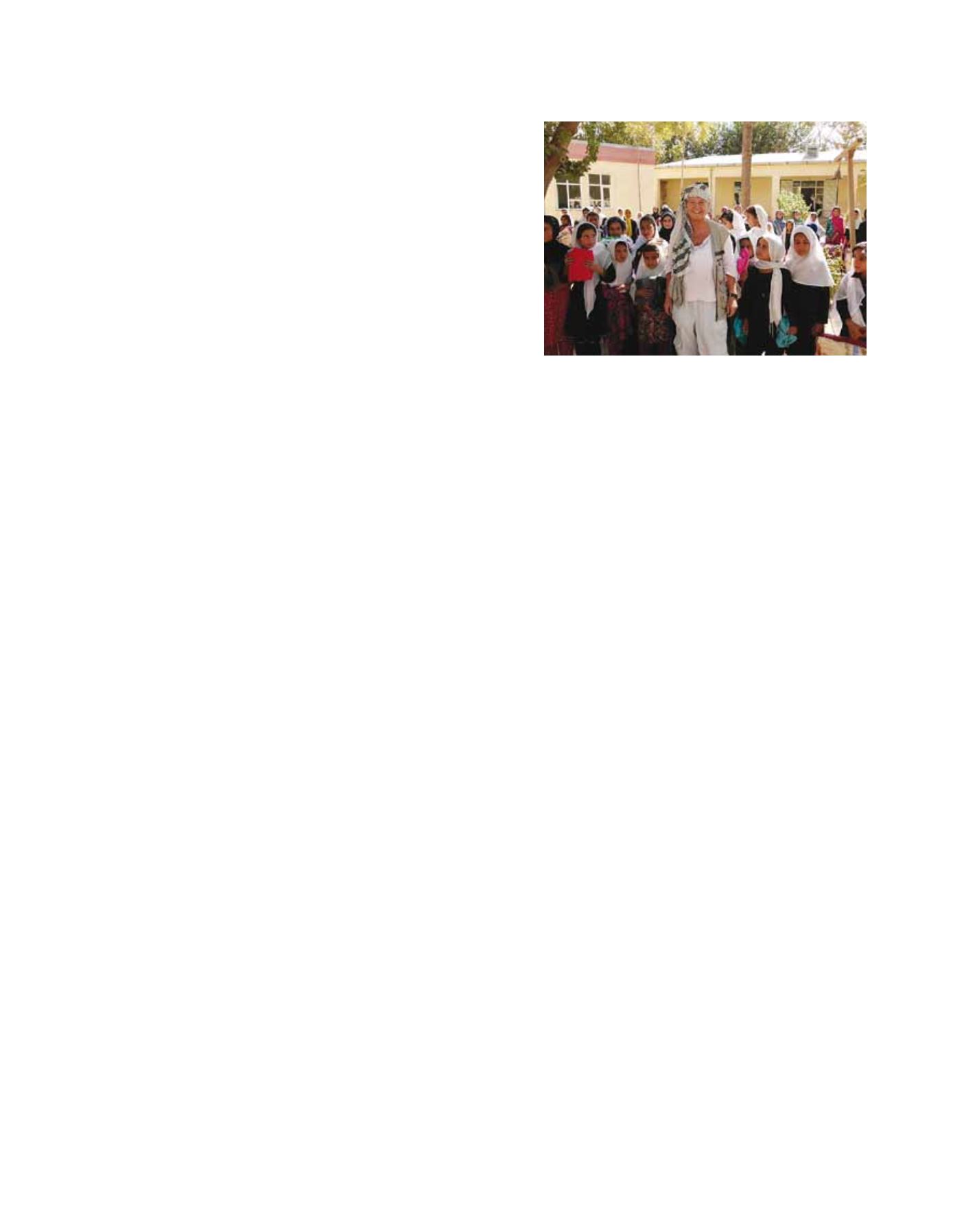
Katachel e.V founder Sybille Schneehage with girls at a school in
Afghanistan built by the organization
Image: Katachel e.V.