



 32 / 208

[
] 32
Social equity, gender equality
and environmental justice
Sascha Gabizon, Executive Director, Women in Europe for a Common Future
T
hroughout the world women are key actors in main-
taining the livelihoods and welfare of their families and
communities, and in making a transition to a more equi-
table and sustainable world. Our economy depends on a healthy
planet. It also depends on women’s economic contributions,
both formal and informal.
Social equity, gender equality and environmental justice must form
the heart of sustainable development and of the outcomes of the
United Nations Conference on Sustainable Development (Rio+20)
in 2012. Twenty years after the first Rio conference, great social and
economic inequities still remain. These especially affect women and
children, who make up the majority of those living in poverty.
On the positive side, all but six countries have ratified the
Convention on Elimination of All Forms of Discrimination Against
Women (CEDAW), and the last country not to allow women to vote
has decided to do so in a few years’ time. Much progress has been
achieved across the world, as many countries have developed poli-
cies and laws that reduce discrimination against women.
But great challenges remain in the implementation of
these policies and in the behavioural changes required
within households, communities and institutions to
promote gender equality. Thus, in many countries,
women’s knowledge, skills and contributions remain
largely unrecognized and undervalued.
Women living in poverty often have to devote many
hours each day to providing basic services for survival:
water, food and fuel. Lack of adequate sanitation is also
a greater burden for girls and women. This leaves them
little time for paid employment. In addition, in many
countries women are not allowed to own property,
have a bank account or hold a passport. It is estimated
that women own less than two per cent of land world-
wide.
1
In many countries, laws and tradition still forbid
women from owning land and resources, thus limiting
their access to finance.
Recent studies show that eliminating gender inequal-
ities is good for societies and economies. The World
Bank states that investing in women is the best way to
invest in the development of their communities
1
and
world gender inequality brings economic costs. The
Food and Agriculture Organization concluded in its
2011 report that by eliminating gender discrimination
in agriculture, food production could be increased by
20 per cent.
2
According to some estimates, women’s unpaid
labour is equivalent to at least half of a country’s
Gross Domestic Product (GDP).
3
The unpaid labour
performed by women is referred to as the ‘care
economy’, signifying the work performed, usually
in the domestic sphere (feeding, clothing, cleaning
and caring for the ill, young and vulnerable), that
enables others to take part in the economy and gener-
ate income. “If the care economy sputters, it will have
serious consequences for both society and its produc-
tivity as it is losing its most important resource and
value generator – people.”
4
Women’s unpaid contributions to our economies
are not valued nor measured, and the same is true for
the unvalued contribution of nature and ecosystems.
This has been shown in the study, The Economics of
Ecosystems and Biodiversity (TEEB), which also demon-
strates that intact ecosystems assure the survival of the
poorest people, who depend for up to 80 per cent of their
livelihoods on functioning ecosystems.
5
The majority of
P
eople
:
social
inclusion
,
green
jobs
,
education
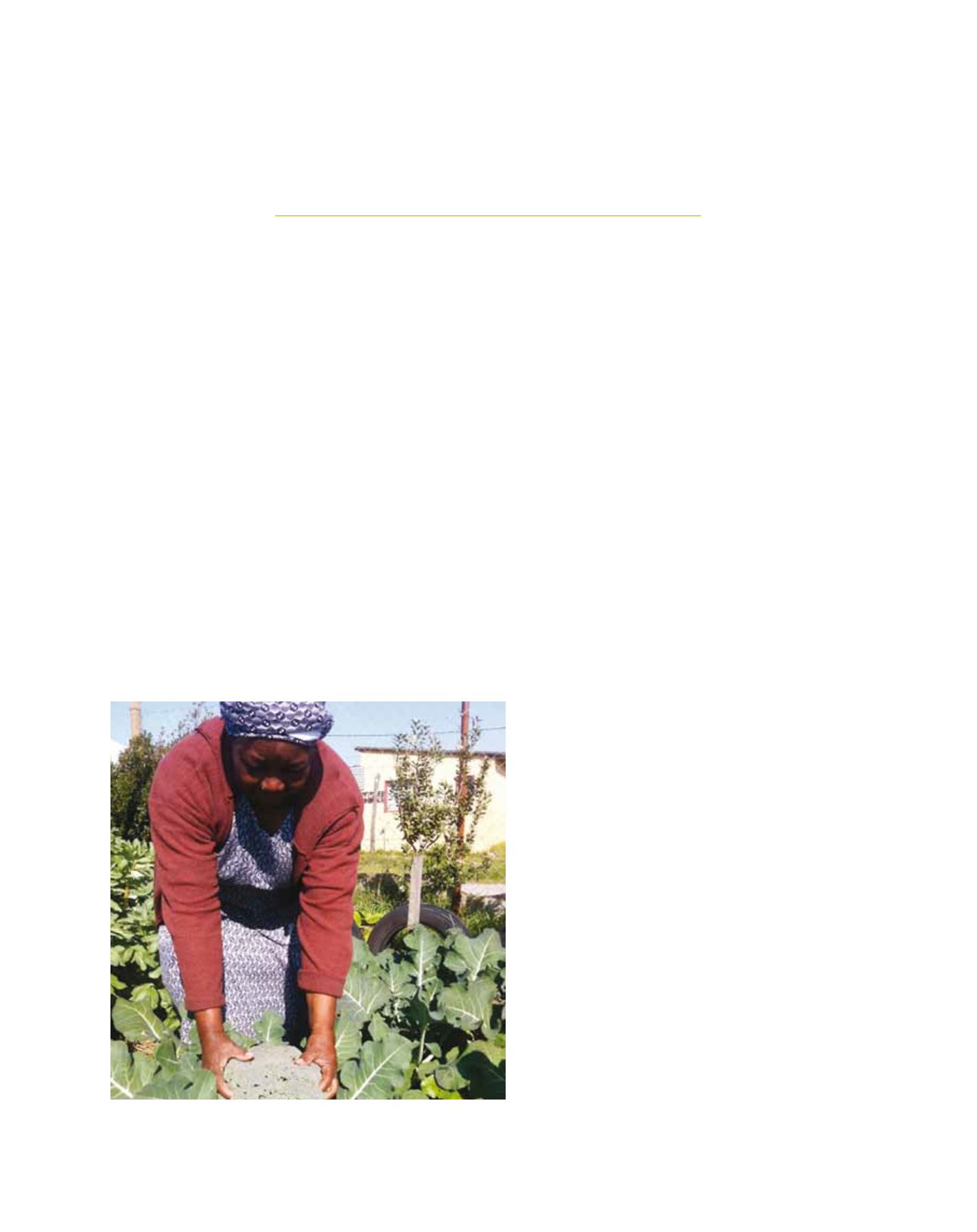
According to some estimates, women’s unpaid labour is equivalent to at least half of
a country’s GDP
Image: WECF