


 33 / 208

[
] 33
P
eople
:
social
inclusion
,
green
jobs
,
education
Building on the Rio 1992 Earth Summit
In 1991, the global women’s movements gathered in
Miami, in advance of the 1992 Earth Summit, and
developed the Women’s Action Agenda for a Healthy
Planet (WAA21).
WAA21 sounds as if it had been written today: “We,
women of many nations, cultures and creeds, of differ-
ent colours and classes, have come together to voice
our concern for the health of our living planet and all
its interdependent life forms. As long as nature and
women are abused by a so-called ‘free market’ ideology
and wrong concepts of ‘economic growth’, there can be
no environmental security”.
8
WAA21 identified 11 urgent Action Areas and
specific recommendations which were used to advo-
cate with policymakers in the negotiations of the 1992
Earth Summit. Partly as a result of these preparations,
governments in Rio agreed to Rio Principle 20 on the
full participation of women in sustainable development.
Furthermore, Rio Agenda 21 devotes an entire chapter
to ‘Global Action for Women towards Sustainable
Development’
9
as well as 145 other references through-
out the text, in 33 of its 40 chapters.
All the Rio Principles remain as valid today as they
were 20 years ago, and we should focus on applying
them to all policies, in particular the Precautionary
Principle and the Polluter Pays Principle, as well as
Principle 10 on access to information, justice and public
participation on environmental matters.
Our organization, Women in Europe for a Common
Future (WECF), was created as a result of the Miami
and Rio women’s engagement, to give a voice to women
the poor – some 70 per cent – are women who depend on a healthy
planet and access to natural resources for their livelihoods.
The main economic indicator used for policy decision-making, the
GDP, is ‘gender blind’. It does not reflect the unpaid contribution of
women or the unvalued contribution of nature to our economies.
In the words of Robert Kennedy, the GDP “measures everything,
except that which makes life worthwhile”. GDP growth does not
necessarily mean more jobs and wellbeing. There have been many
cases of GDP growth which have lead to increasing inequity, deple-
tion of the economy’s natural resource base, growth which did not
benefit women, and even unemployment growth.
The current economic system creates greater inequities
While the wealthy consume more and more natural resources and
are responsible for increasing levels of environmental damage,
the poor are suffering from degradation of their agricultural land,
forests, water resources and biodiversity, and alteration of natural
weather cycles due to climate change. Too much public funding
goes to perverse subsidies for unsustainable and speculative activi-
ties.
6
Almost all countries are growing more unequal, and inequality
is growing both in the North and the South. Too little funding goes
to human capital development and social equity, and too little
reaches women. In times of economic crisis, austerity measures
are often a greater burden on women then on men.
7
The current
prices of natural resources, energy and consumer products do not
include externalities and future costs. Current economic decision-
making is too short-term, and long-term benefits are not valued.
Military budgets and tax spending for bailing out banks are taking
away necessary funding for social development and environmental
protection. The growing frustration of citizens with such inequities
is taking the form of civil society resistance all over the world – such
as the ‘Occupy’ movement.
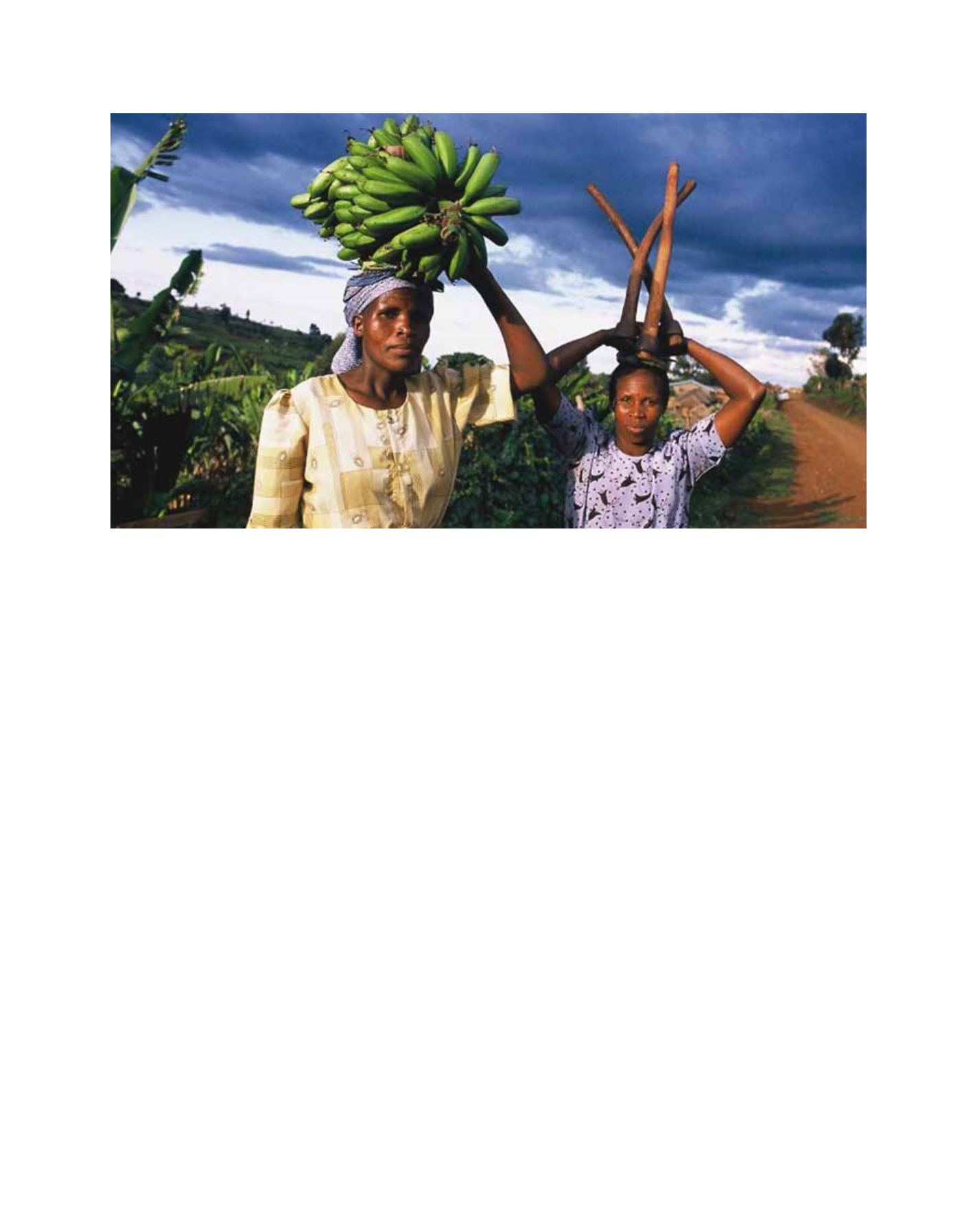
Governments at the Rio 1992 Earth Summit agreed on the need for full participation of women in sustainable development
Image: WECF