



 40 / 208

[
] 40
P
eople
:
social
inclusion
,
green
jobs
,
education
water each day. Sanitary systems have been built in all regions. To
prevent even low-level pollution of the Caspian Sea, a protection system
comprising module-type wastewater purifying plants was established,
meaning shore-to-sea waste flow is prevented for a distance of 100 km.
Major projects are providing people with safe drinking water through
water supply systems in all regions. The installation of module-type
purifying plants began in 2007 –with 221 villages and 400,000 people
provided with drinking water – allowing centralized access to clean
drinking water for even the remotest settlements. At the same time, a
high technology-based plant was built to desalinate seawater.
Annual increases in the intensification of both forest planting and
rehabilitation within forested territories exceeded 1 million hectares
and accounted for 11.8 per cent of land area in the country, up from
11.4 per cent previously. In order to expand green areas in Baku
and the Absheron peninsula, and alongside main motor highways,
4 million trees and bushes of various kinds were planted.
Initiatives within protected natural areas and the creation of an
environmental network means there are now eight national parks,
11 natural state reserves and 24 state wildlife sanctuaries function-
ing in Azerbaijan. From 2003 the protected natural spaces increased
from 478,000 hectares to 882,000 hectares, accounting for 10.2 per
cent of the country’s land area. Rare species at risk of extinction
in their traditional habitats are being reintroduced, with 100 head
of antelope returned in 2011 and – due to the artificial increase
of water-based biological resources over the past 10 years – over
5 billion fish of different species, including sturgeon, farmed and
released into water reservoirs; a sizeable project also included estab-
lishing a twenty-first century zoology park.
To manage hazardous wastes, a dangerous wastes landfill was
established where about 300,000 tons of mercury-containing toxic
wastes were rendered harmless. Hundreds of hectares of oil-polluted
soils were cleaned and rehabilitated, as were lakes.
As a result of initiatives in the past 10 years, Azerbaijan achieved
second place across 132 countries, based on the Environmental
Performance Index (EPI), an international league table
of the environmental sustainability status of nations,
produced from recent research at Yale and Columbia
Universities in the USA.
The biggest obstacles in human development facing
our nation include the occupation of 20 per cent of
Azerbaijani lands following military aggression by the
Republic of Armenia from 1988, the abandonment in
occupied territories of more than 4,000 industrial and
agricultural enterprises along with over 300,000 jobs,
and deportation of over 1 million refugees and inter-
nally displaced people from their settlements. Aggression
against Azerbaijan by Armenian nationalists has resulted
in an extremely negative effect on the economic and
social situation, which has put a strain on employment.
National data shows that internally displaced
people prevail among the unemployed, so to resolve
this, the ‘State Programme for Improvement of Living
Conditions and Expansion of Employment of Refugees
and Internally Displaced People’ was approved, creat-
ing the environment to aid internally displaced people
wishing to engage in entrepreneurial activities and
establish farm enterprises, who are eligible for assist-
ance in mastering new professions and, to facilitate
employment of internally displaced people, increase
production output and reduce poverty.
In the past seven years over 1 million new jobs and
over 40,000 new enterprises have been created under
these wide-ranging initiatives, resulting in unemploy-
ment dropping from 9.7 per cent in 2003, to 5.4 per
cent in 2011. Relevant policy continues to successfully
ensure conditions and support are maintained within
national development schemes, for ongoing sustainable
human development in Azerbaijan.
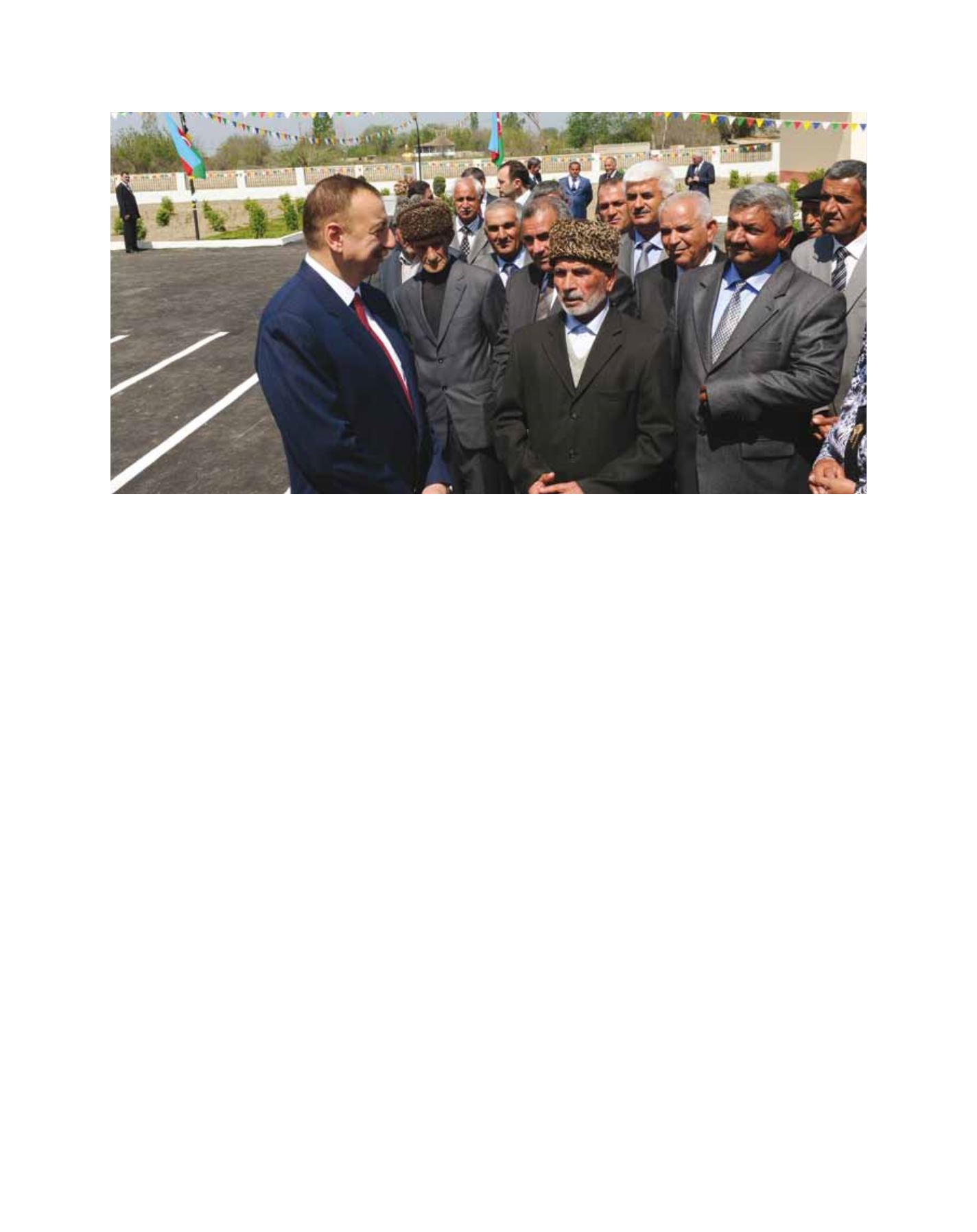
President Ilham Aliyev meets the residents of Gasimbeyli village, Sabirabad city, Azerbaijan, May 2011
Image: Azerbaijan State Telegraph Agency