



 46 / 208

[
] 46
P
eople
:
social
inclusion
,
green
jobs
,
education
Providing clean and safe energy for all is fundamental for a
sustainable planet. Access to sustainable forms of energy must be
enshrined in the mandates of public authorities. We must not leave
this as a responsibility of the private sector. We support universal
access to a basic minimum level of modern, clean and safe energy
services for both consumption and production uses by 2020 and
targets for improving energy efficiency at all levels, with a view to
achieving a 50 per cent decrease in energy intensity by 2020.
Access to water is fundamental to sustainable development and
is a basic human right. The overuse or pollution of water and frag-
mentation of freshwater systems is contributing to reduced quality
of life and increasing instability. Governments must ensure sustain-
able water resource management delivers for the protection and
provision of water services vital for human well-being, biodiversity,
economies and security. Both water and energy are essential rights
and need to be provided as essential public services.
With our NGO allies, we support solutions to the challenges
of food and energy security and demand both conservation and
governance solutions to the challenges posed by the degradation of
our oceans and the threat of water shortages throughout vast areas
of the world.
The good news is that investment in these initiatives means new
and additional jobs.
RIO+20 can make a difference
The world needs to reorient economic priorities towards a new
prosperity for all that respects the human rights of all people and
respects the planet’s critical natural resource boundaries. This is
the basis of the emerging discussion on Sustainable Development
Goals (SDG). As part of the process of developing global goals,
governments, international institutions, business and civil society
need to commit together to a framework where democratic govern-
ance, labour and human rights are respected, and gender equality
achieved. Goals focused on decent work, employment
and social protection for all are fundamental to achiev-
ing sustainable development.
The world’s leaders must accept the urgent need for
transition to a sustainable and environmentally respect-
ful and inclusive economy and direct the process of
transition. Trade unions are working to ensure that
these transformational changes in production and
consumption systems are just and that decent work is
safeguarded and promoted. The principles of the green
economy must be vastly different from those governing
the economies of today.
ITUC argues that the key principles at the heart of
any discussion on a green economy must include equity
between and within countries, opportunities for women
and young workers, decent work for all people includ-
ing formalizing the informal economy and a social
protection floor for all. The ‘Just Transition’ approach
which acknowledges and secures the livelihoods and
jobs of those whose sectors might be affected is central
to these principles.
ITUC, representing the world’s working people and
their unions, calls on leaders to invest in green jobs, to
fund the implementation of a universal social protection
floor and to raise global funding to support these ambi-
tions, beginning with the introduction of a financial
transactions tax. This tax would raise vital resources
and contribute to a more just and equitable world.
Investment in green and decent jobs
In the face of the most bitter crisis in unemploy-
ment, investment in green jobs is urgent. ITUC’s
research, based on the analysis of 12 countries –
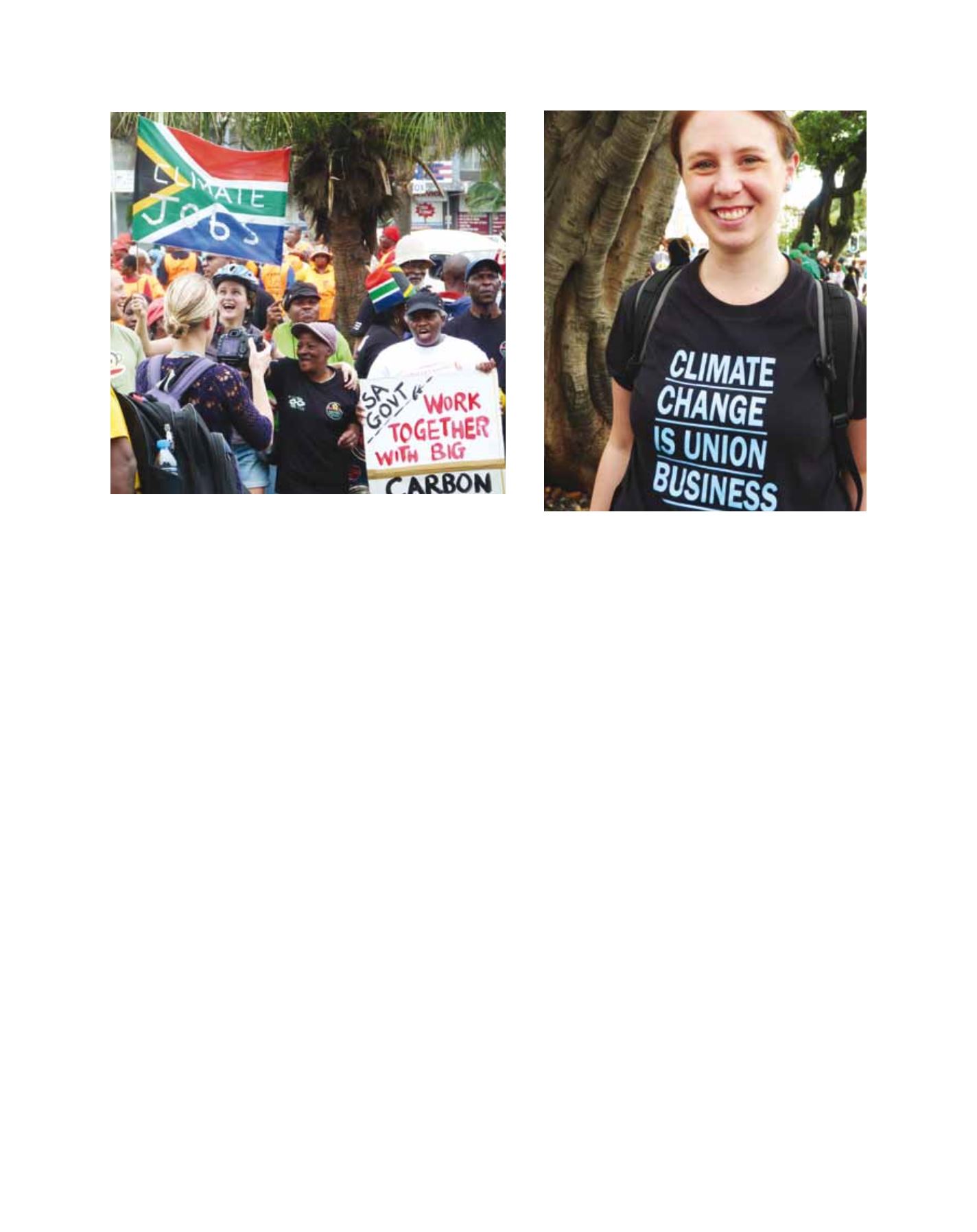
Green and decent jobs go hand in hand. Workers at the rally in Durban, South Africa,
during COP17, November 2011
Climate Change is Union Business. As simple as that!
Image: ©Kristin Blom
Image: ©Kristin Blom