



 51 / 208

[
] 51
Education as a driver for
sustainable human development
Kartikeya V. Sarabhai, Director, Centre for Environmental Education (CEE),
Nehru Foundation for Development, India
W
hen the first major United Nations Conference on
the Human Environment was held in Stockholm in
1972 – at a time when the word ‘environment’ meant
mainly pollution and wildlife – invitations went out to all heads
of government. Only one, the then Prime Minister of India, Mrs
Indira Gandhi, accepted. In her plenary speech on the challenge
facing developing countries, she stressed that:
On the one hand the rich look askance at our continuing poverty,
on the other they warn us against their own methods. We do not
wish to impoverish the environment any further and yet we cannot
for a moment forget the grim poverty of large numbers of people.
Are not poverty and need the greatest polluters?
1
Mrs Gandhi argued that early developing countries “got a head start
through sheer ruthlessness, undisturbed by feelings of compassion
or by abstract theories of freedom, equality or justice… Now, as we
struggle to create a better life for our people, it is in vastly differing
circumstances, for obviously in today’s eagle-eyed watchfulness, we
cannot indulge in such practices even for a worthwhile purpose. We
are bound by our own ideals.”
2
She spoke of development
goals: “The rich countries may look upon development as
the cause of environmental destruction, but to us it is one
of the primary means of improving the environment for
living, or providing food, water, sanitation and shelter; of
making the deserts green and the mountains habitable.”
3
As the worldmet at the 1992 UnitedNations Conference
on Environment and Development (UNCED) in Rio de
Janeiro, two words – environment and development –
were widely recognized as twin goals that needed to go
together. Dominated by development continuing to be
fossil fuel-based, with an unsustainable ecological and
carbon footprint, it is difficult for countries to follow alter-
native paths. While writing the UNCED national report for
India, we explained this dilemma as follows: “While the
challenge of development might seem to be how to get
there, the real challenge is how not to get there.”
4
Two decades from that first conference and as the world
gathers again in Brazil, we are better equipped to meet the
challenge. We have more options in terms of technologies
P
eople
:
social
inclusion
,
green
jobs
,
education
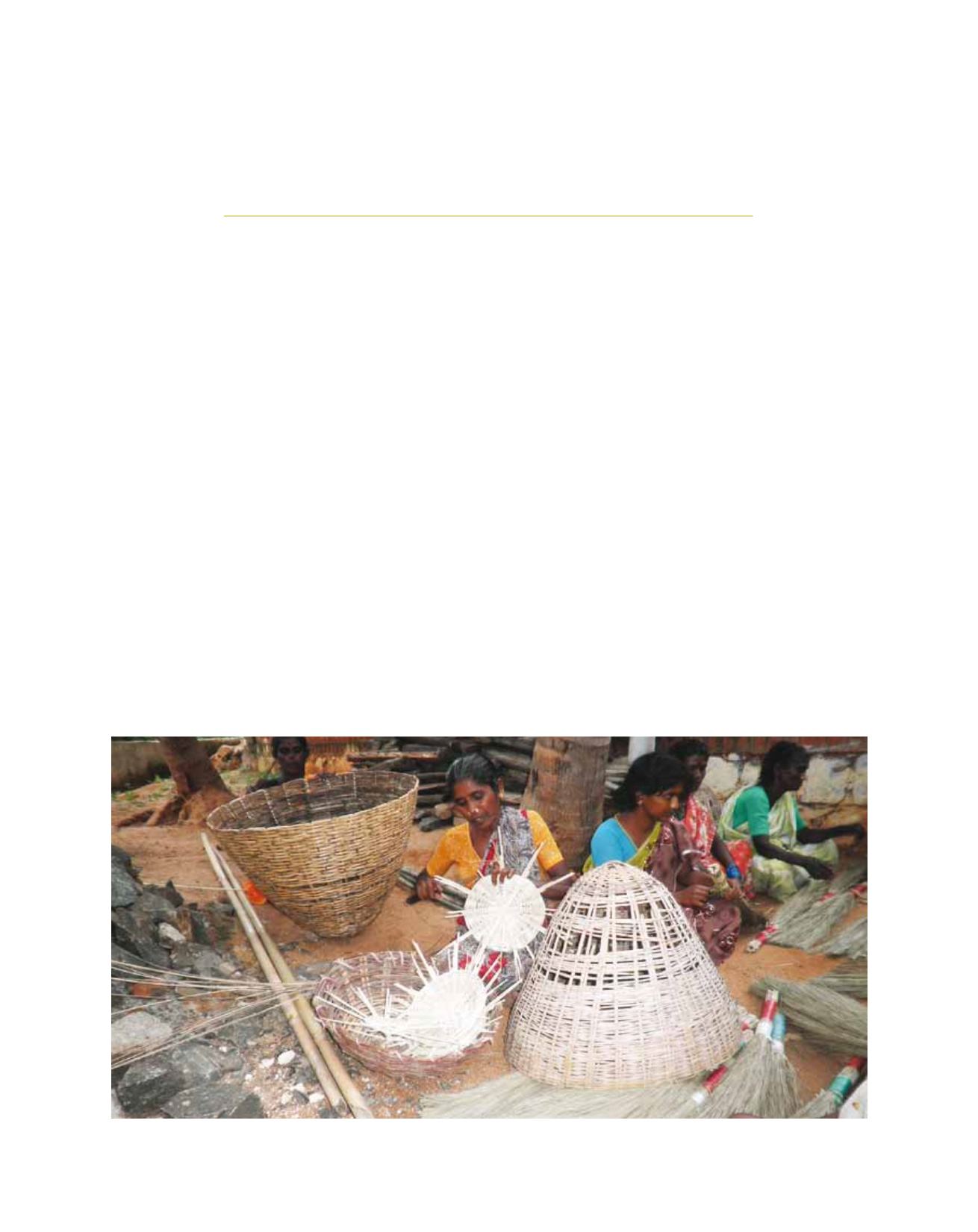
Livelihood option for women – making baskets and brooms
Image: Centre for Environmental Educatiion, India