



 55 / 208

[
] 55
How organizations can manage
social responsibility for sustainability
Christian Brodhag, Professor, National School of Mines, Saint-Etienne
A
concept with multifaceted origins, social responsibility
should be seen as an essential element of implementing
sustainable development as well as being part of governance.
Based on theoretical considerations, four different approaches to social
responsibility can be considered, including instrumental, political,
integrative and ethical.
1
Instrumental theories, which focus on the
economic objectives of social activities seek competitive advantages
through cause-related marketing. Political theories promote responsi-
ble business power relations within the political arena based on a social
contract between business and society. Integrative theory concentrates
on global performance, integrating social demand through stakeholder
management. Finally, the ethical approach aims for a contribution
to sustainable development through private enterprise investment in
universal human rights and common production.
Referring to implementation and political considera-
tions, we can consider two main visions of Corporate
Social Responsibility (CSR). The first, historically
known as ‘contractualist,’ relies on taking account
of shareholder interests. The second, described as
‘institutionalist’, favours performance and advocates
enterprises reaching goals beyond meeting legal compli-
ance, seeking universal rights. These are two opposing
visions of collective action.
The contractualist vision is upward-oriented, focusing
on the nature of the social contract between the actors in
society. Beyond their basic duty to shareholders, compa-
nies assume responsibility to a broader constituency
that includes various stakeholders. This approach places
great importance on the managerial process and on how
P
eople
:
social
inclusion
,
green
jobs
,
education
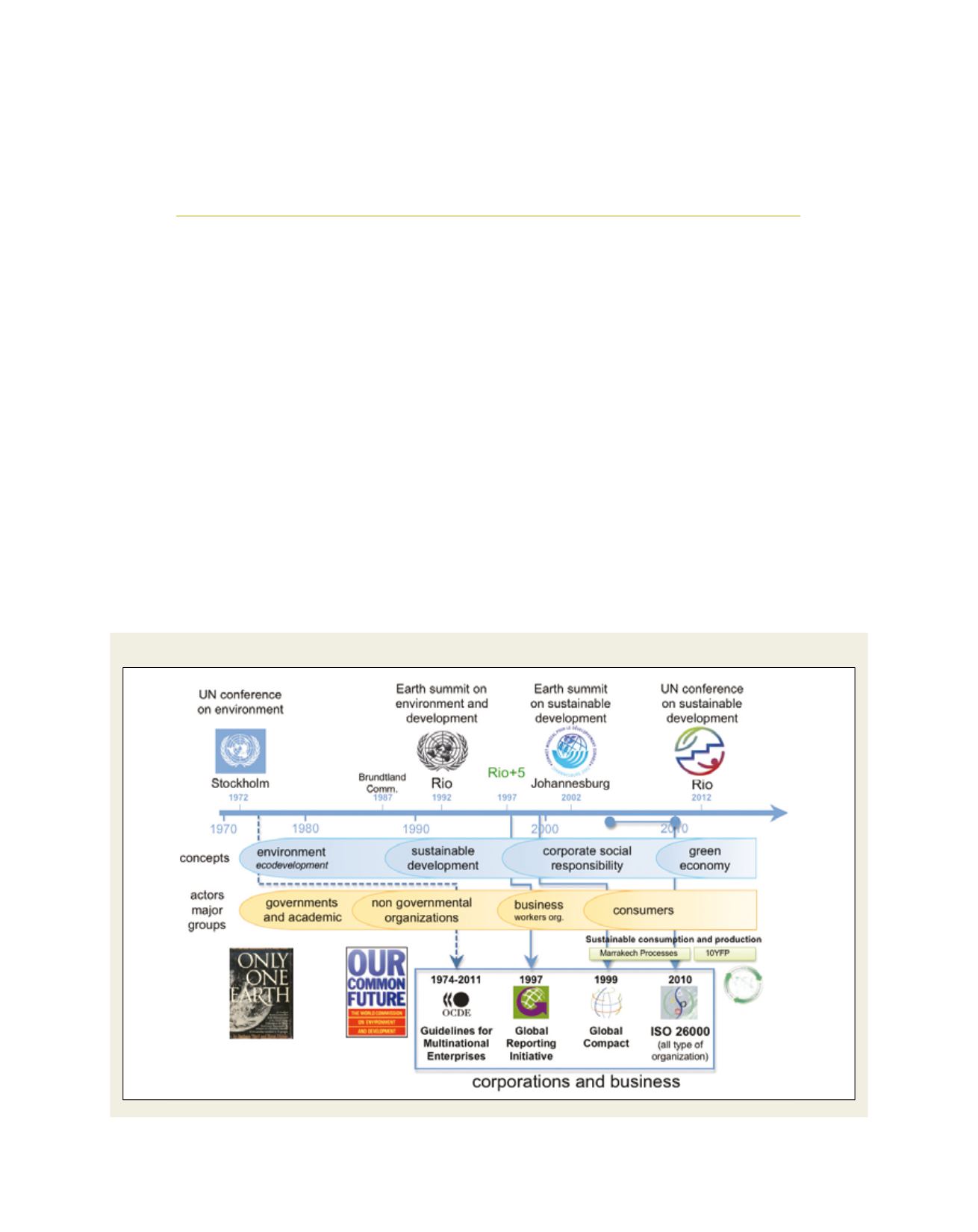
Key milestones in sustainable development
Source:
©brodhag.org