



 52 / 208

[
] 52
P
eople
:
social
inclusion
,
green
jobs
,
education
Centre for Environment Education (CEE) as a Centre of
Excellence in environmental education. CEE was formed
primarily to improve public awareness about the envi-
ronment, with a view to promoting conservation and the
sustainable use of nature and its resources, for a better
environment and quality of life. Today, through 40 offices
across India and several hundred partners, programmes
are offered in all major languages of the country. CEE
develops innovative training material, building capacity
in sustainable development and education across various
development sectors. Having the lead role in the United
Nations Decade of Education for Sustainable Development
(DESD) the CEE is the central agency for implementing
DESD programmes on behalf of the Ministry of Human
Resource Development, India. CEE is also responsible
for ESD at different levels, including educating key deci-
sion makers, running programmes within formal teaching
systems, working with rural communities in assisting after
natural disasters, capacity-building groups for taking up
new livelihoods in the green economy, programmes in the
informal sector in urban areas, and projects within small
and medium enterprises, along with large corporations
wanting to become more sustainable.
ESD for an aware generation
The Constitution of India requires every citizen to care
for the environment and in a public interest litigation, the
Supreme Court of India ruled that every formal course of
studymust have environmental education built into it. Over
the years, the National Council of Educational Research
and Training and CEE have worked closely with education
boards across the country to ‘green’ their textbooks. The
National Green Corps programme, offered by the Ministry
of Environment – in partnership with NGOs, including
and more tested, innovative systems, and there is greater understanding
of the policies and financial mechanisms that lead to more sustainable
behavior. But the existence of options without the ability to evaluate
these, along with the will and courage to do things more sustainably,
will not be enough. If a new development strategy is to be realized,
it requires people to think and act differently. Whether policymakers
or the people on the street, young children or youth, everyone needs
to make this transition. Education, communication and knowledge
management are key to this change; we need critical thinking, outside
the conventional box that has defined post-industrialization develop-
ment. This is the role of education for sustainable development (ESD);
a driver to the sustainable world, acknowledged at the United Nations
Environment Programme (UNEP), which recognized the importance
of environmental education and recommended its further development
to the world so that actions needed for protecting and improving the
environment would be better understood. This led to the first UNESCO
Intergovernmental Conference on Environmental Education, which
was held in Tbilisi, Georgia in 1977. The resulting report emphasized
that: “Environmental education is a lifelong process and should not be
confined to the formal system. Integrating environmental education in
other forms of teaching – particularly within the working environment
– the school pupil, factory or field worker, and economically-educated
consumer, represents an urgent need.”
5
Agenda 21 was one of the important outcomes of UNCED in 1992.
While education was dealt with in most sections, chapter 36 focused
specifically on education, training and capacity-building, stressing that:
“to improve sustainable development education, nations should make
environment and education development available to people of all ages.”
6
In the early 1980s, India sought ways to develop institutions to bring
environmental considerations into its development plans. Initially a
Department – later a Ministry of Environment – was created within
central Government. Education was recognized as crucial in a sustain-
able development strategy. In 1984, the Indian Government joined
forces with the Nehru Foundation for Development to establish the
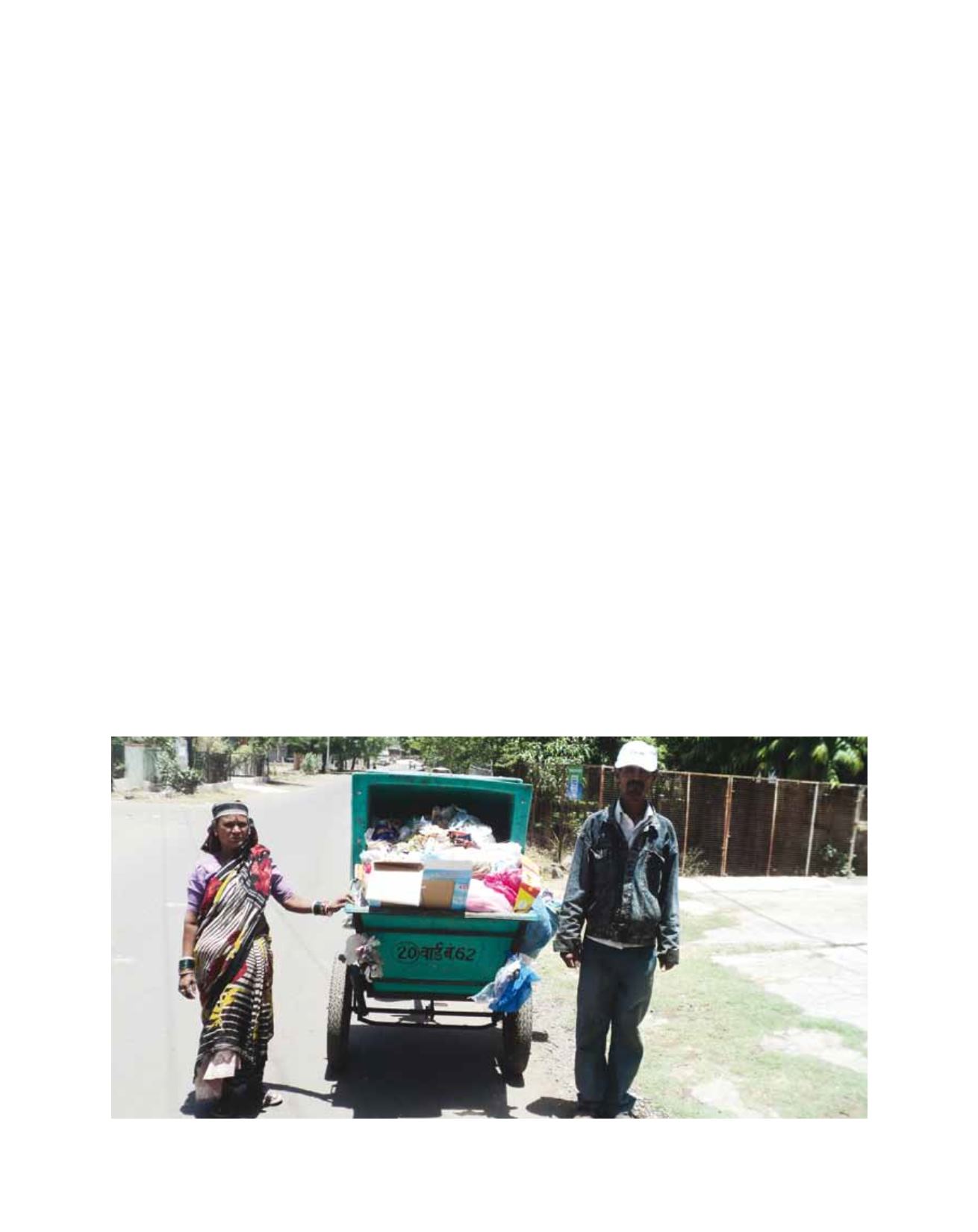
Rag pickers collecting plastic for recycling
Image: Centre for Environmental Educatiion, India