



 50 / 208

[
] 50
P
eople
:
social
inclusion
,
green
jobs
,
education
are the ones relating to the constant increase of inequality between
the richest and poorest. The 50 richest individuals globally have
a combined income greater than the poorest 416 million. The 2.5
billion people living on less than US$2 a day – 40 per cent of the
world’s population – receive only 5 per cent of global income,
while 54 per cent goes to the richest 10 per cent of the world’s
population.
To reverse this dangerous trend, we must strengthen existing
social protection systems and urgently establish social protection
floors, as contributing to social cohesion is one of the main ways
to distribute wealth. Only 20 per cent of the world’s population has
access to adequate social protection, with horrid consequences: 150
million people each year suffer from financial catastrophe and 100
million are pushed to the poverty line when compelled to pay for
healthcare.
The social protection floor is a first step; a set of basic social secu-
rity rights and transfers, to promote human rights and support decent
living standards worldwide, extending basic support and protec-
tion for all those in need. Within this framework, the International
Labour Organization promotes four essential guarantees: access to
healthcare, child benefits, basic retirement pensions, and income
support for the working poor, the unemployed and pregnant
women. Statistics on inequality show us that policies for income
redistribution are needed without delay and the social protection
floor should be resolutely followed by initiatives to increase vertical
coverage of social security.
In regard to the ecological crisis, social protection is needed more
than ever. Increasingly, climate change, depletion of commons
and collapse of biodiversity push more people to migrate. Again,
social protection is a key element: the International Organization
for Migration states that in communities where social protection
was articulated, there has been less displacement and
more effective reconstruction. Finally, by providing the
poorest communities with protected income and the
capacity to have more sustainable livelihoods, social
protection systems could reduce the environmental
pressure poor families place on natural resources.
Unions have the necessary will
The required changes are complex but possible if they
are accompanied by sufficient determination to engage
in social dialogue and democratic participation in deci-
sion-making. Although at times conflicts exist between
labour and the environment, so do solutions. With the
environmental crisis as a backdrop, to avoid the conflict
today simply means aggravating it tomorrow.
Sustainable development is not achievable without
democracy. To put policies into practice that seek to
achieve the common good, greater participation in the
decision-making process is needed. Governments must
work to reverse the overwhelming influence of vested
interests. This means more democratic institutions and a
rights-based framework for information and participation
across all levels from the national level to the workplace.
At Rio+20, unions expect these democratic princi-
ples to be a reality. They want their demands heard
and governments to commit to concrete outcomes in
decent and green job creation and social protection.
But they also want to lead by example and renew their
commitment to sustainability; they will be gathering
prior to Rio+20 in a global trade unions assembly, to
do just that.
Unions leading by example
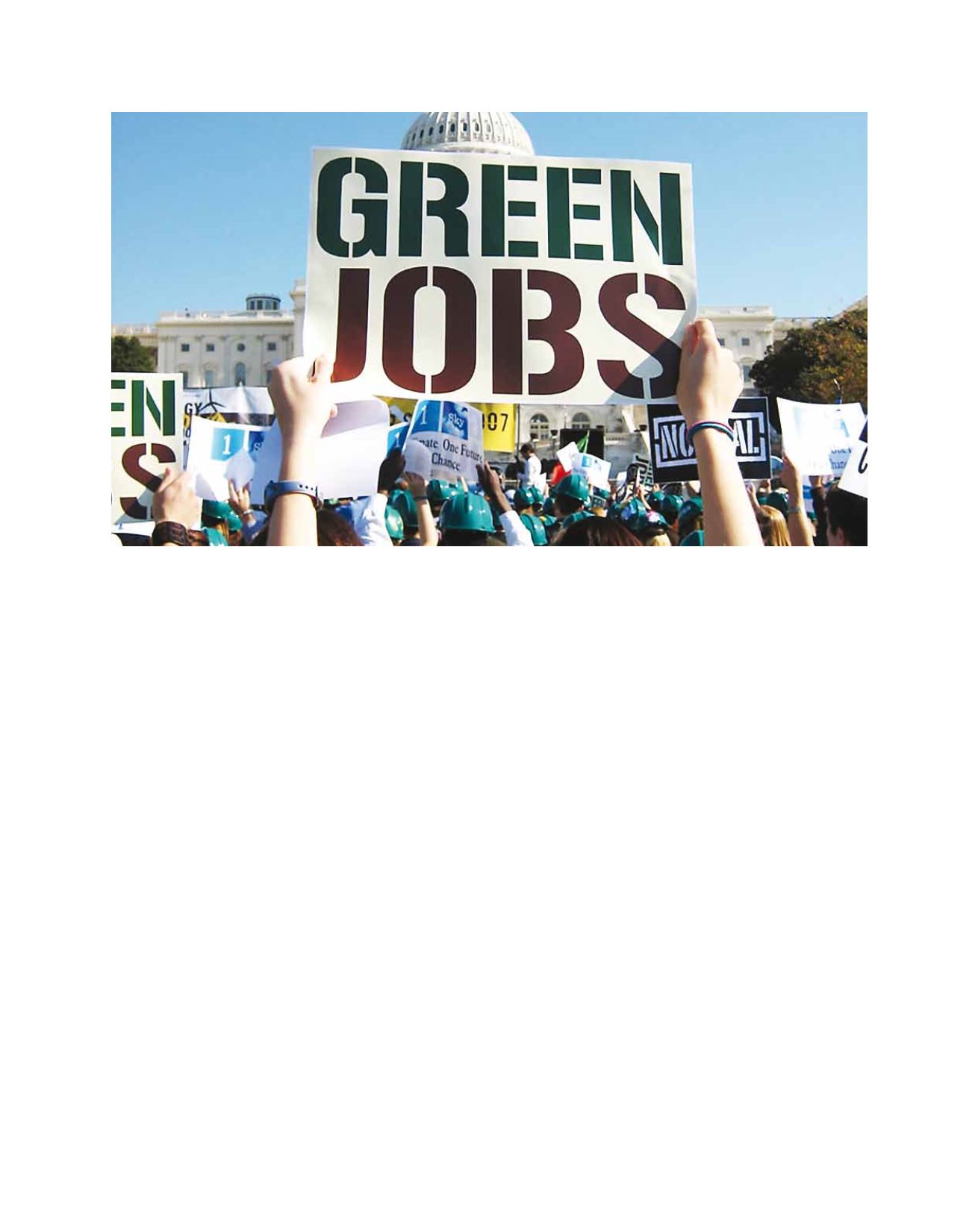
Image: Sustainlabour