



 45 / 208

[
] 45
P
eople
:
social
inclusion
,
green
jobs
,
education
There can be no doubt that leaders of the world must
first and foremost address poverty and inequity.
Addressing risks to the planet and humanity
We urgently need to change the trends of global envi-
ronmental destruction to ensure a safe space for human
development. We are already trespassing on the plan-
etary boundaries through the impacts of climate change
and the rate of biodiversity loss. Governance of our
‘global commons’ is vital to achieve sustainable develop-
ment for this and future generations. The risk to human
survival arising from increasing levels of greenhouse gas
emissions has been scientifically demonstrated, with the
only possibility for risk mitigation being a reduction of
emissions necessary to slow global warming to around
1.5
o
c by the end of the century. Inaction is simply due to
a lack of political will in the face of the same dominant
interests largely responsible for the causes of inequity.
There are also serious questions about the survival of
humanity if the risks of food, energy and water security
are not addressed. With 50 per cent more food, 45 per
cent more energy and 30 per cent more water needed
by 2050, world leaders must act now.
Ensuring food security for nine billion people, while
cutting 33 per cent of humanity’s ecological footprint
by 2050, requires an overhaul of the global food system.
This means scaled-up investment in hundreds of
millions of small-scale food producers including secure
access to critical land and water resources, and action to
prevent and reduce vulnerability to food price shocks.
We need to get the world on the right path by putting in
place a fair and sustainable food system as a key element
for economic growth.
higher in Israel, Turkey and the United States at fourteen to one. Chile
and Mexico have the highest levels of income inequality in the OECD
with the income of the richest being 25 times that of the poorest.
For working people and their unions, anger is growing at the
current political and economic attacks on their job security, wages,
pensions and services. These attacks are occurring despite OECD
analysis finding that the ‘regulatory reform’ which has weakened
labour market institutions has had a significant impact on wage
inequality among fulltime workers, and that this in particular is due
to the weakening of employment protection legislation governing
the employment of temporary workers, as well as product market
deregulation and lower unemployment benefit replacement rates.
These policy trends continue.
The consequence of growing impoverishment and inequity
for working people, the bitter crisis of unemployment and the
dramatic marginalization of young people from productive employ-
ment are causing, and will continue to generate, social unrest.
The International Labour Organization’s annual ‘World of Work’
report in 2011 featured a new ‘social unrest’ index showing levels
of discontent over the lack of jobs, and anger over perceptions that
the burden of the crisis is not being shared fairly.
Indeed, as the economic recovery slowed or stopped over the last
year, social exclusion and discontent became more widespread.
In 40 per cent of the 119 countries for which estimates could be
made, the risk of social unrest had increased significantly since
2010. Similarly, 58 per cent of countries showed an increase in the
percentage of people who report worsening standards of living.
Confidence in the ability of national governments to address the
situation weakened in half the countries.
The ILO report showed that to date, social discontent had
increased most in advanced economies, the Middle East, North
Africa and to a lesser extent, in Asia. However, income disparities
in Asia are now beginning to rise quickly.
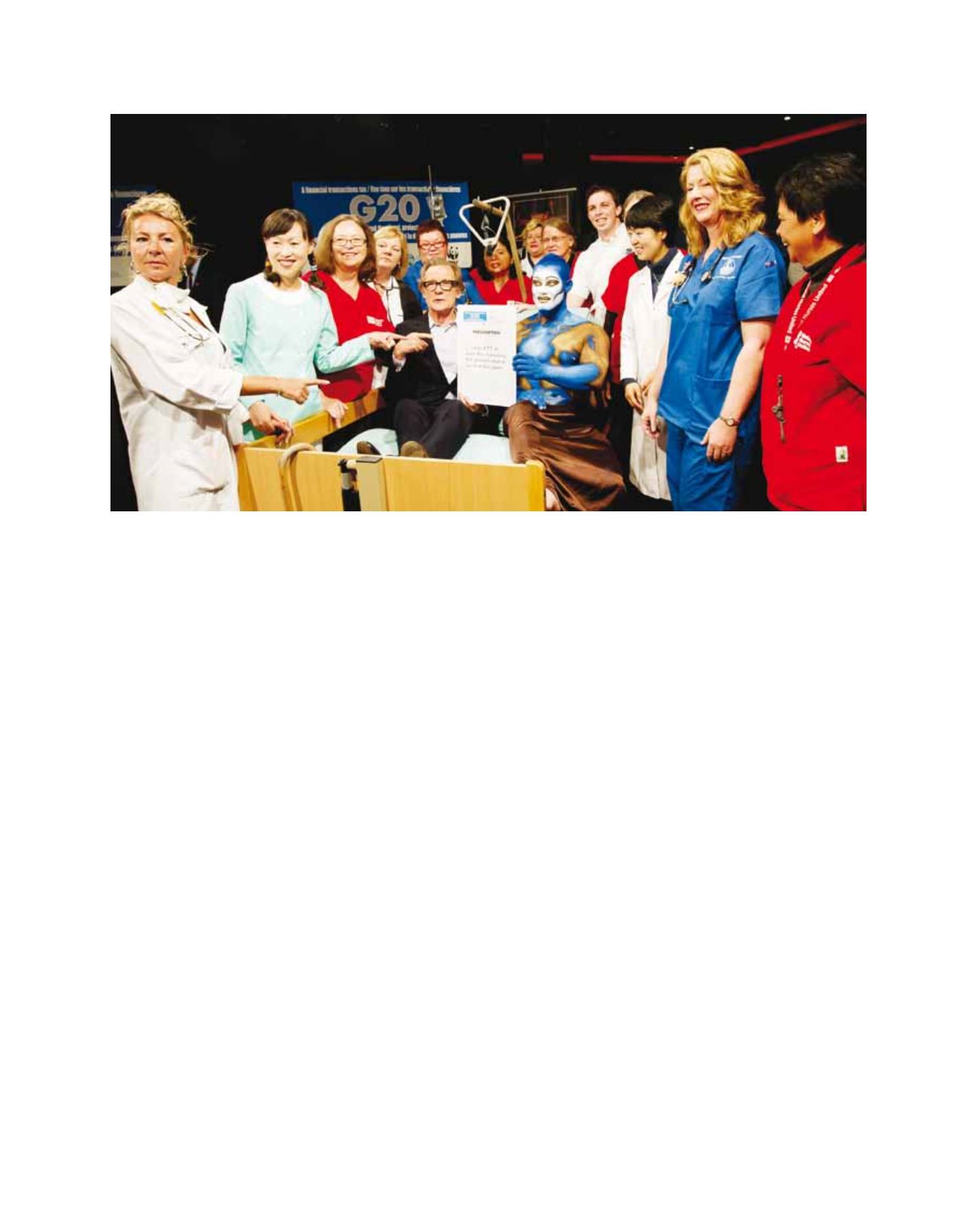
Nurses from many countries, supported by actor Bill Nighy, highlighted the need for a Financial Transactions Tax at the G20 meeting in Cannes, November 2011
Image: ©Gaetan Nerin