



 47 / 208

[
] 47
P
eople
:
social
inclusion
,
green
jobs
,
education
developed, emerging and developing in all regions of the world
– demonstrates that an investment equivalent to two per cent of
GDP at national level could potentially create 9.8 million jobs
each year in the 12 countries and economic sectors analysed.
1
Countries studied include: Europe (Germany, Spain, Bulgaria);
The Americas (Brazil, Dominican Republic, USA); Africa (South
Africa, Ghana, Tunisia); and Asia and the Pacific (Indonesia,
Nepal, Australia), in the energy, construction, transport, manu-
facturing, agriculture, forestry and water sectors.
The trade union movement has been clear that a green job should
reduce environmental impacts of enterprises and economic sectors
to sustainable levels, while providing decent working and living
conditions to all those involved in production and ensuring workers’
rights are respected.
A green job must provide adequate social security and decent
wages and be covered by sufficient health and safety provisions.
From this definition, several dimensions of green jobs must be
taken into account: their ability to reduce the environmental
impact in all sectors, their capacity to deliver decent work, their
compliance with trade union rights and their ability to outper-
form traditional jobs when it comes to the inclusion of women and
youth in the labour market.
The Social Protection Floor
The United Nations describes social protection as ‘the missing
piece in a fair and inclusive globalisation’. The Social Protection
Floor is a set of basic social security rights, services and transfers
to help promote human rights and support decent living stand-
ards worldwide. Basic income security and access to essential
services through the various phases of life requires healthcare,
child benefits, basic retirement pensions and income support
for the working poor, the unemployed and pregnant women.
In Rio, trade unions demand that heads of state implement the
Universal Social Protection Floor initiative by 2020
and that funding is provided for its establishment in
the poorest countries.
Financial Transactions Tax
Innovative approaches are needed to address both
environmental concerns and social inequities exac-
erbated by speculative financial sector practices. A
global Financial Transactions Tax (FTT) could fund
programmes to alleviate global poverty and support
sustainable development and climate action by taxing
specific financial transactions from the very sector that
created the global financial crisis.
Imagine a future where there is the dignity of decent
work and secure incomes from the growth and develop-
ment of a green economy. This future will be optimistic
for all the world’s people, as the Social Protection Floor
will have ensured that the Millennium Development
Goals are realized and the interdependence of people
and nations will have generated a greater cooperation
in the governance of the world’s resources. All it takes
is the political will of leaders in Rio de Janeiro in June
2012, to set the world on a sustainable path.
The world’s unions know there are no jobs on a dead
planet, no equity without rights to decent work and
social protection, no social justice without a shift in
governance and ambition and ultimately, no peace
for the peoples of the world without the guarantees of
sustainability.
The solutions are available to us. Rio and beyond
provides the opportunity to address these complex and
interrelated issues. The challenge is to secure commit-
ted and cooperative leadership.
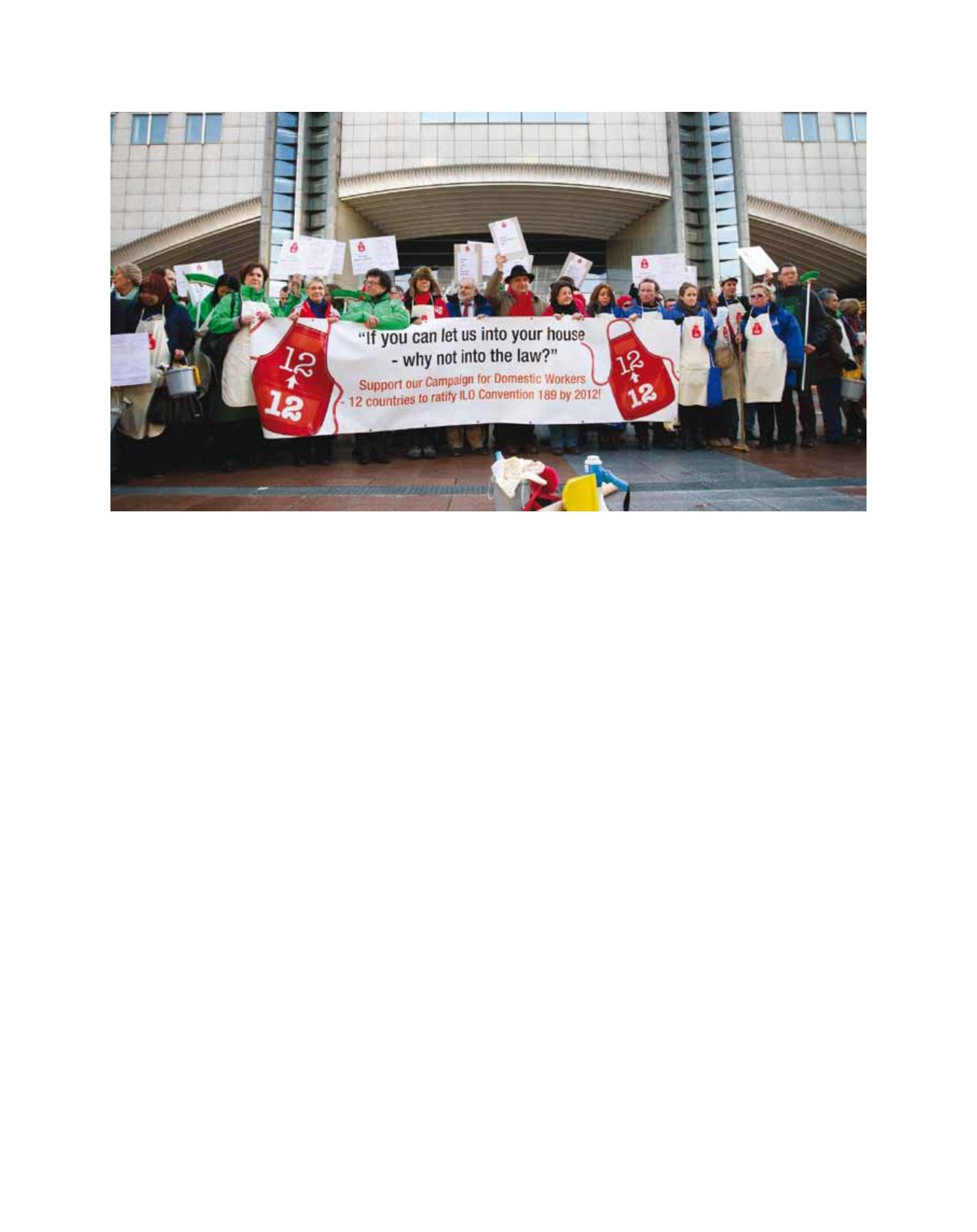
Fundamental rights for all workers were promoted at the launch of the ITUC campaign for Domestic Workers, outside the European Parliament in December 2011
Image: ©Gaetan Nerin