



 53 / 208

[
] 53
P
eople
:
social
inclusion
,
green
jobs
,
education
CEE– targets eco-clubs in schools. CEE has also launched a programme
called ParyavaranMitra–or Friends of the Environment –which is being
implemented in over 100,000 schools across the nation to instil environ-
mental leadership qualities into students through curriculum-linked and
co-curricular projects, for positive change at individual, family, school
and community levels. The slogan ‘increase your handprint and decrease
your footprint,’ where ‘footprint’ represents the negative impact of our
lifestyle on global resources and the CEE-introduced handprint concept
represents positive environmental action, has become the symbol of posi-
tive action for a generation who will be tomorrow’s decision makers.
Sustainable solutions and the decision makers
Ahmedabad, a city of about 7 million people in the western part of
India, houses the main office of CEE. Over the past 40 years, while
the city’s population has grown by nearly 150 per cent, the number of
vehicles has increased by over 4,000 per cent, amounting to about 2
million –mostly two-wheeled – vehicles. The proportion of the popu-
lation using private vehicles went up from nearly 50 per cent to more
than 75 per cent and the city’s transport systems were under pressure,
until in 1994, a student in the School of Planning and Architecture in
Ahmedabad completed a dissertation project on bus travel in the city.
By 2005, the concept of a Bus Rapid Transport System (BRTS) had
been proposed. Developed in Bogota, Colombia, this systemwould not
normally have been an option open to an Indian planner, but with the
assistance of a knowledge partner and by raising awareness among poli-
cymakers – including a trip to Columbia – this was possible. The BRTS
is 129 km long withmore than 100 hundred buses now using the route.
Rebuilding after disasters
CEE was directly involved with helping 41 villages in 2001, after a
major earthquake in Kachchh, Gujarat, saw more than 25,000 people
lose their lives and about 7,900 villages destroyed. Having faced such
calamity, people were questioning their own assumptions and thinking
about their futures in new ways. As well as the construction of more
than 1,000 homes – alongside many schools and other facilities – an
intensive education and awareness programme was under-
taken. New developments, apart from being earthquake
proof, had better management of water and other natural
resources through the direct involvement of local commu-
nities. Three years later in 2004, when a major tsunami hit
southern India, CEE once again found that people were
ready for rebuilding in a more sustainable way. Activities
included planting in coastal areas, the creation of new
green jobs and sustainable livelihood options. One of the
most difficult, yet important, issues for ESD was helping
people while maintaining their initiative. It is very easy
to arrive intending to do good work but end up making
an otherwise entrepreneurial and full-of-life community
dependent on assistance. CEE’s approach was to engage
people in rebuilding their lives and livelihoods in ways
they viewed as more appropriate, rather than having an
external model of sustainability forced upon them.
Sustainable solutions through facilitating learning
Naroda, an industrial estate covering about 350 hectares
on the outskirts of Ahmedabad, is the oldest estate in
India. Of its 900 industries, about 600 were discharg-
ing toxic chemicals. An effluent treatment plant was
established and with CEE facilitating, key ESD strategies
were identified, including raising awareness among, and
capacity-building of, management and workers within
chemical factories. There was a large variation between
best and worst practices on the estate, but if perform-
ance levels could be raised to emulate the best, it would
lead to significant improvement. So CEE identified best
practice engineers and encouraged them to communicate
to others. Using ESD, horizontal communication proved
an effective way of bringing about change. Working with
industry groups, CEE is now helping set up a knowledge
centre for hazardous waste at a landfill site. The idea is
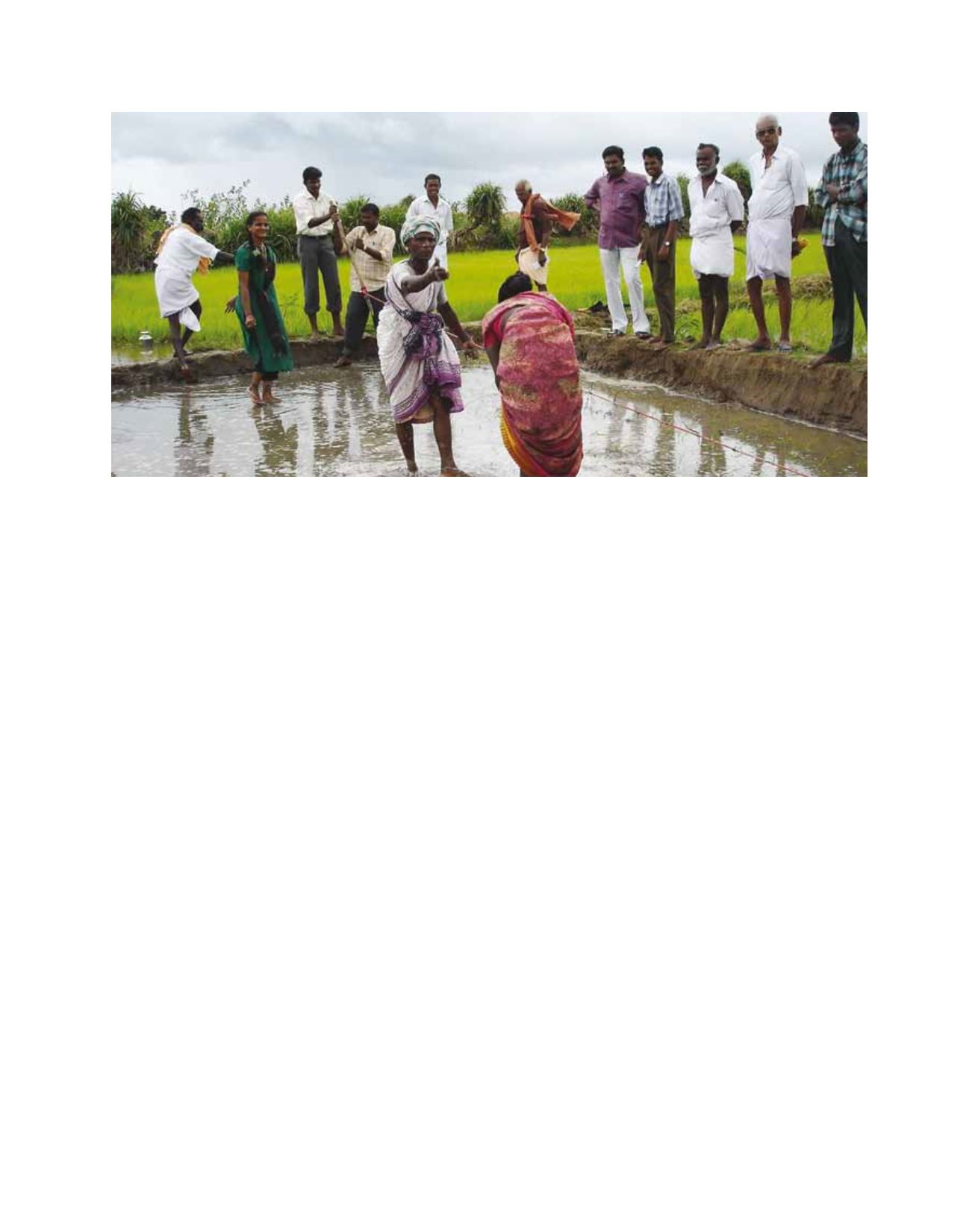
System of Rice Intensification (SRI) planting
Image: Centre for Environmental Educatiion, India