



 54 / 208

[
] 54
P
eople
:
social
inclusion
,
green
jobs
,
education
not simply to reduce waste, but to explore how waste generated from
one industry could be used as a resource for another.
In partnership with the waste management facility, a knowledge
management centre with a museum for schools and the public –
including a conference centre – is being established at the site.
Partnerships in managing urban waste
Bhopal, a city in central India, generates 14 per cent plastics in its
solid waste so local NGO Sarthak, along with the municipal council
and local rag pickers, is developing a sustainable model to reduce
plastics disposal and improve conditions for rag pickers. CEE is the
national host institution for the Small Grants Programme within the
United Nations Development Programme. Through grant funding and
co-financing by the local group, the project has expanded so that close
to 900 rag pickers are now involved. Plastics smaller than 20-40 micro-
grams are recycled at 5,000 kg a day. Bundled plastics are then sent to
four different cement plants, where they are burned at 1200° C and used
as replacement fuel for coal, with no fluoride or dioxins produced. The
waste reprocessing units have enhanced the rag pickers’ skills, knowl-
edge and practice, while ESD has connected them with social security
initiatives, allowing them dignity and respect.
Remodelling projects
In the south Indian state of Tamil Nadu, a major poverty reduc-
tion project is underway across 25 districts, with support from the
World Bank. Its key objective is generating employment to improve
livelihoods for the poorest sections of the population – women,
the vulnerable, the disabled and tribal people – using a participa-
tory, community-driven process. To ensure the environment is not
compromised, an Environment Management Framework (EMF) has
been integrated into the project, with CEE appointed as the State
Environmental Resource Agency (SERA).
ESD is involved with capacity-building, material development and
environmental supervision and monitoring. This means managing
natural resources in efficient ways so livelihoods are sustainable
by suggesting cost-effective, environmentally-friendly
practices. This in turn provides a platform for creat-
ing community awareness, building skills, addressing
issues linked with commons – water bodies and pasture
lands – by using eco-friendly technologies, and enhanc-
ing local environment and ecosystem services.
Agricultural practices in Thiruvallar, Tamil Nadu,
where both jasmine and vegetable cultivation are the
main livelihoods, involved using restricted chemi-
cal pesticides. Coordinating with the District Project
Management Unit and environmental appraisers, SERA
taught members about organic farming techniques and
provided training in using organic extract.
Embedding work in rural communities
The Hingolgadh Sanctuary in Rajkot district of Western
India is a fragile, semi-arid rural area that is environmen-
tally vulnerable, drought-prone and with limited natural
resources. Nearby village communities are dependent on
the natural resources of this region. The shift in livelihoods
from agricultural biodiversity to the monoculture of cash
crops such as cotton led to soil degradation and over-extrac-
tion of ground water. ESD tackled these issues by forming
a local natural resource management group comprising
local women and youth, to develop village-level institu-
tions and provide community funding for eco-enterprises.
Criteria are in place to ensure the proposed enterprises are
environmentally sound, economically viable and socially
beneficial. CEE is also supporting activities related to agri-
culture and animal husbandry, with objectives set up for an
institutional framework that influences practices and helps
strengthen the local economy through more sustainable
approaches, which support the community and therefore
reduce stress on the fragile ecosystem.
Education is the key to change
These examples illustrate not only the diverse sectors
and environmental issues needing ESD, but the various
approaches required to suit local situations, alongside
reflecting CEE’s philosophy and highlighting the essen-
tial role education plays in moving towards sustainability.
Raising awareness among policymakers about sustainable
alternatives, as in the case of the BRTS – sharing best prac-
tice, using disaster situations as opportunities to rebuild
not just infrastructure, but also livelihoods, trust and
hope, while building capacity in communities to exploit
the power of education to influence policymakers – are all
educational components for creating a development path
that is sustainable. The focus has been not only on natural
resource management itself, but the way to sustainable
livelihoods, including identifying suitable options – along-
side building skills and capacity – for effective adoption.
ESD is also concerned with offering dignity and respect
to communities by expanding knowledge and providing
better social security. CEE, through its long and varied
experience, has sought to demonstrate that education can
be a key driver for change; one that is environmentally
sound, economically viable and socially beneficial. This
is the essence of education for sustainable development.
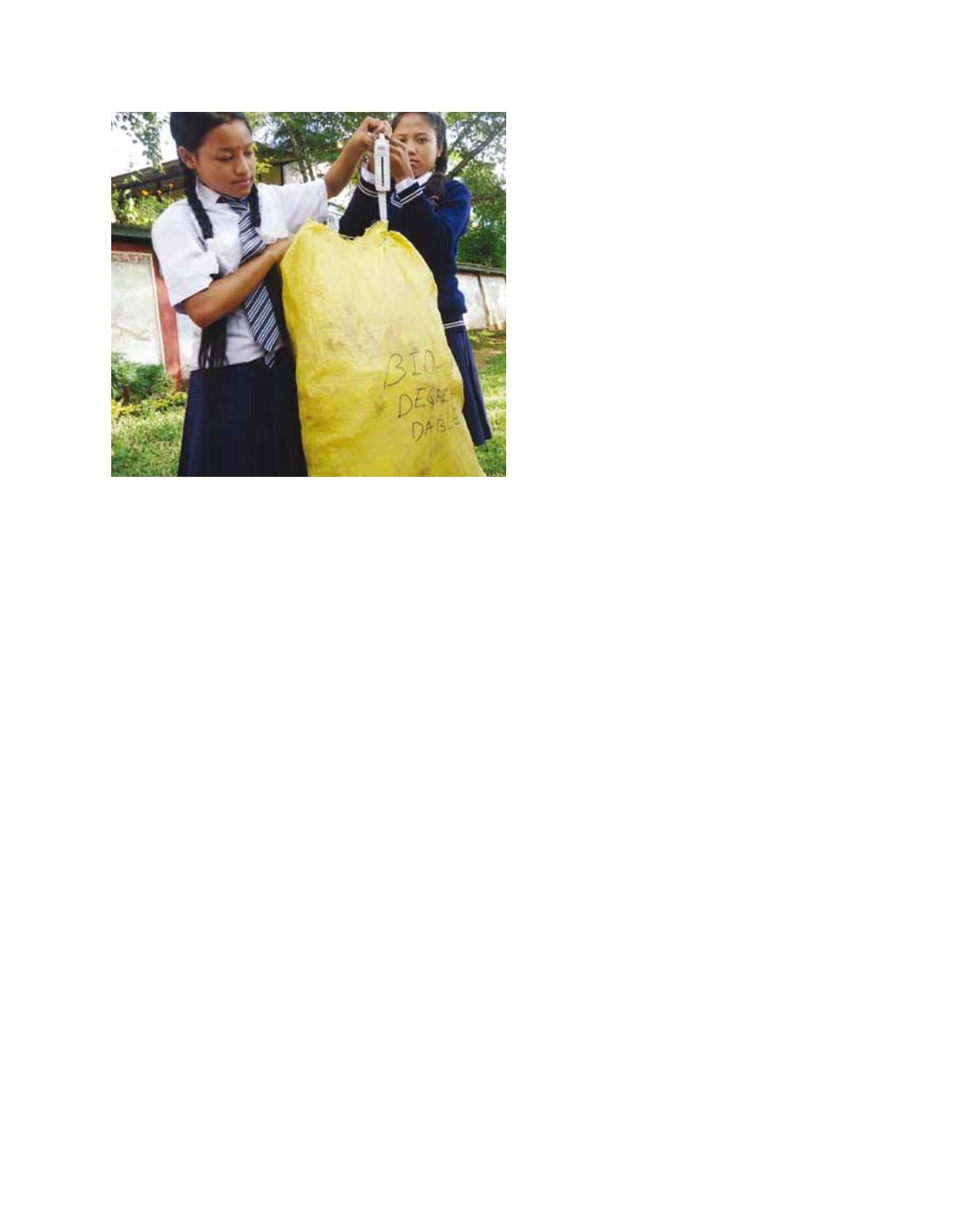
Students quantifying their school’s waste
Image: Centre for Environmental Educatiion, India